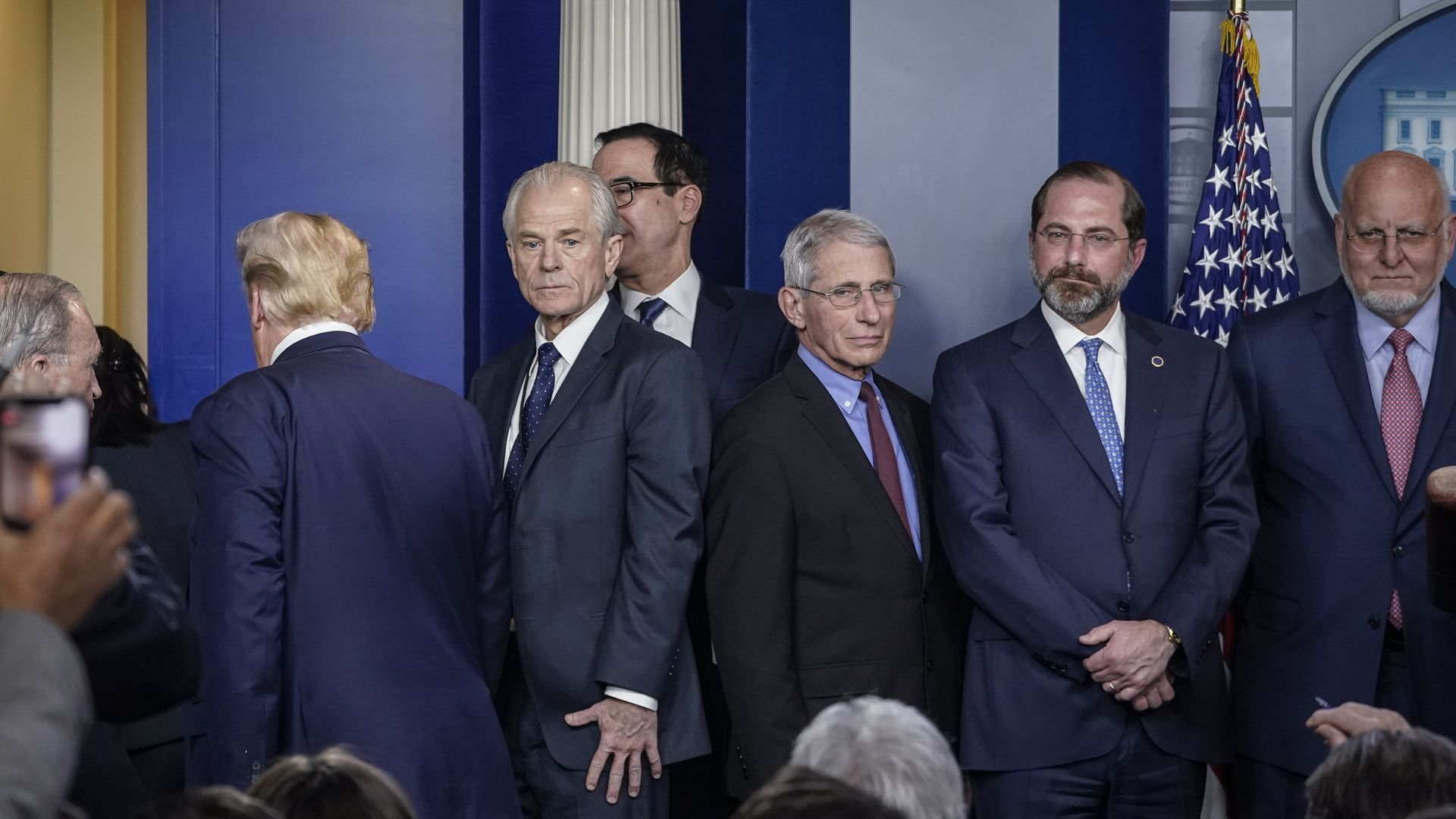
The White House coronavirus task force had its biggest fight yeton Saturday, pitting economic adviser Peter Navarro against infectious disease expert Anthony Fauci. At issue: How enthusiastically should the White House tout the prospects of an antimalarial drug to fight COVID-19?
Behind the scenes: This drama erupted into an epic Situation Room showdown. Trump's coronavirus task force gathered in the White House Situation Room on Saturday at about 1:30pm, according to four sources familiar with the conversation. Vice President Mike Pence sat at the head of the table.
Why it matters: It's the first known animal to test positive for the virus in the United States. The tiger is believed to have contracted the virus from an asymptomatic zookeeper.
Navy Capt. Brett E. Crozier has tested positive for the coronavirus just days after losing command of the U.S.S. Theodore Roosevelt, the New York Times reports, citing two of his Naval Academy classmates.
Why it matters: The ship has seen more than 100 cases of coronavirus on board, and all sailors remaining on the ship must test negative for the disease before being evacuated.
House Majority Whip Jim Clyburn (D-S.C.) said on CNN's "State of the Union" Sunday that the coronavirus committee created by Nancy Pelosi (D-Calif.) will oversee how the $2 trillion stimulus bill is distributed during the pandemic, not the federal government's initial response to the virus.
What he's saying: "This is not about the president of the United States or even the independent counsel or the inspector general. This is about focusing on how the money is spent, whether or not the people who are getting the money are actually working on behalf of the American people, or whether or not they are profiteering."
New York Gov. Andrew Cuomo said in a press conference on Sunday that New York is struggling to maintain medical supplies while combatting the novel coronavirus — operating "literally" on a "day-to-day" basis.
Why it matters: New York City has become an epicenter of the coronavirus outbreak, facing mass quarantines and stay-at-home orders. Cuomo said Saturday that New York reported 630 new deaths in 24 hours — an "all-time increase" that beat the previous day's record of 562 deaths.
U.S. Surgeon General Jerome Adams said on "Fox News Sunday" that the next week will be "the hardest and the saddest week of most Americans' lives" — calling it our "our Pearl Harbor moment, our 9/11 moment" — as the projected death toll from the coronavirus pandemic surges.
Why it matters: Unlike those tragedies, Adams emphasized that the direct effects of the coronavirus will not be "localized" and that it will be happening "all over the country." But he also stressed that the public has the "power to change the trajectory of this epidemic" by following social distancing and other public health guidelines.
Joe Biden said on ABC's "This Week" Sunday that he will follow the Centers for Disease Control and Prevention's new recommendation that people wear face coverings when they leave home to prevent the spread of the coronavirus.
Why it matters: After the White House announced the guideline last week, President Trump said he will likely not wear a mask and emphasized that the guidance was "voluntary."
Louisiana Gov. John Bel Edwards said on CNN's "State of the Union" Sunday that coronavirus modeling projects his state will run out of ventilators on April 9 and hospital beds on April 11.
Why it matters: Louisiana has around 12,500 infected people and 409 deaths. New York is the only state in the country with a worse per capita death rate.
Americans are doubling down on their worst habits to cope with the mental and emotional stress of the coronavirus pandemic.
Why it matters: The pandemic will have a long-lasting impact on the health of the American people, in part due to the habits they'll pick up during the weeks and months they're forced to stay home.