Details: The CDC investigation is ongoing, but 109 people have contracted E. coli in 6 different states. All of those affected said they ate ground beef either at home or at a restaurant. The organization stated a common distributor or brand of ground beef hasn't been identified, adding that people shouldn't stop eating ground beef, but should handle carefully.
Sens. Dick Durbin and Bill Cassidy — a Democrat and a Republican — introduced a new bill yesterday that would tackle evergreening, the process by which branded drug companies extend their monopolies by tacking on additional patents.
Where it stands: While the bill may reduce legal barriers to generic market entry, "someone still has to go through all the trouble and expense to overturn the patent," said Robin Feldman, a professor at UC Hastings.
People with lower incomes spend more of their money on health care, although wealthy people spend more in dollar amounts, according to Bureau of Labor Statistics data.
Why it matters: The cost of health care is growing more prominent as a social and political issue, and it hits low-income people hardest. Democrats differ on how far left they want to go, but Medicare for All is partially about redistributing these costs.
Several GOP senators introduced a new bill to protect people with pre-existing conditions yesterday, including several senators who are up for re-election next year.
What's new: The bill is an enhanced version of one introduced by Sen. Thom Tillis (R-N.C.) last year; unlike last year's, it requires insurance companies to cover treatment of an enrollee's pre-existing conditions.
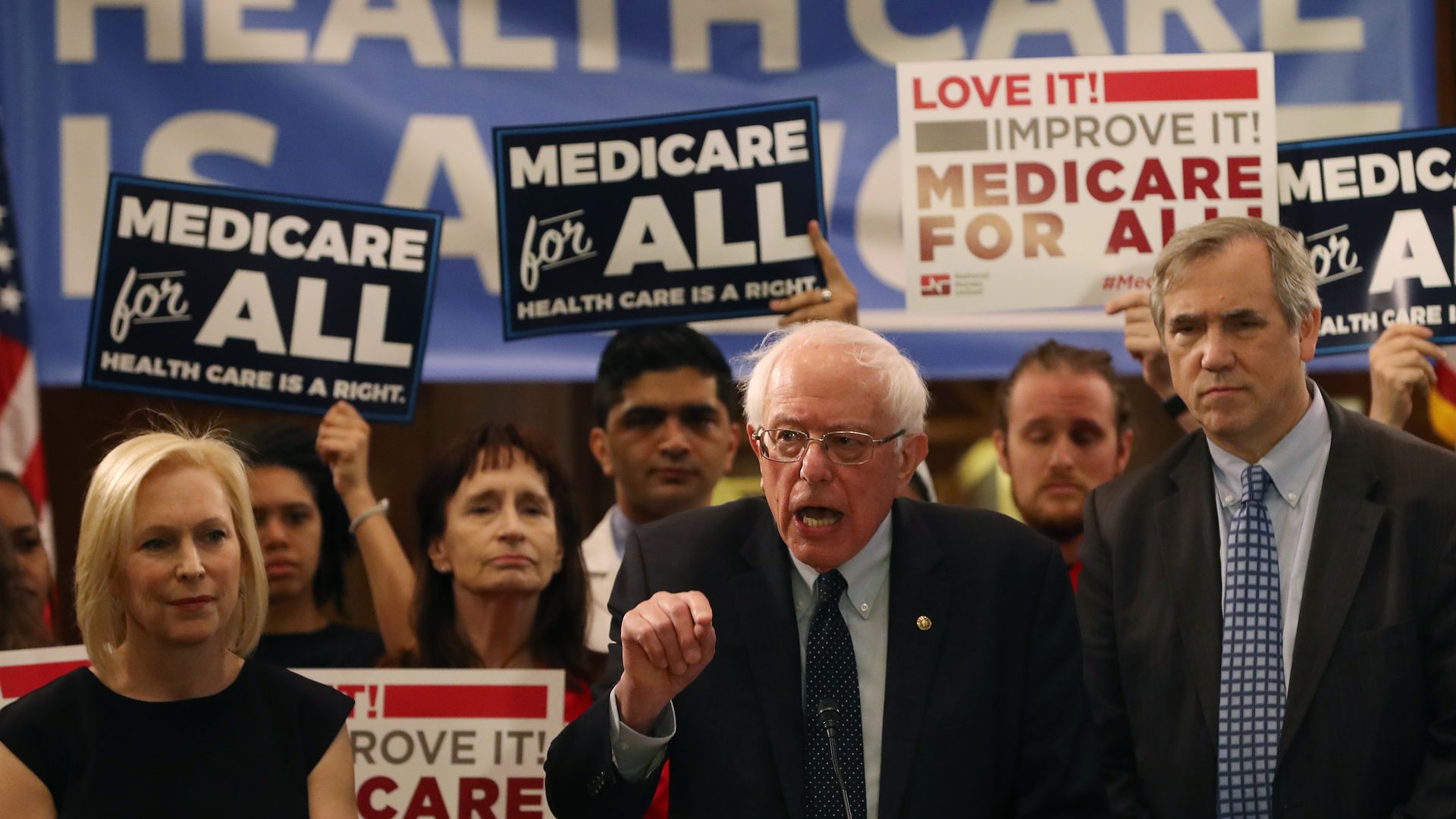
Sen. Bernie Sanders' Medicare for All plan would drastically change not only how health care is paid for, but who ultimately pays for it.
Between the lines: While the wealthy and the poor usually pay the same premium for today's employer-based insurance, Sanders' plan would beef up insurance coverage for everyone and pay for it by increasing taxes disproportionately on the wealthy.
Centene's pending acquisition of WellCare Health Plans, a deal valued at $17.3 billion including debt, would create a health insurance behemoth with almost $100 billion of revenue — nearly all of which comes from taxpayer-subsidized health care programs.
The big picture: The industry has never been more consolidated. And this deal, being reviewed by states and the Department of Justice, raises specific antitrust concerns in Medicaid, the main line of business for both companies.