Norway's finance ministry proposed Friday that the country's huge sovereign wealth fund should drop holdings in oil exploration and production companies in order to "reduce the aggregate oil price risk in the Norwegian economy."
Why it matters: It's the biggest sovereign wealth fund in the world, and, as the Financial Times points out, "the move is likely to be seized upon by environmentalists as a template for other big global investors and marks the biggest proposed divestment of fossil fuel assets."
A first-ever address by a sitting secretary of state and the economic crisis in oil-rich Venezuela are set to drive the agenda at a conference next week in Houston of the world’s biggest energy companies.
The big picture: This is the first time the conference, held for almost 40 years, is occurring with America as the world’s biggest crude oil producer, a milestone reached last year.
Daniel Yergin, host of the conference dubbed CERAWeek, calls the U.S. boom, driven by surging production from shale formations, an “earthquake” in the world oil market.
For the second straight year, the Bering Sea — a turbulent and bountiful stretch of the northern Pacific Ocean — is virtually ice free at a time of year when it should be gaining ice.
Reproduced from Rick Thoman using NSIDC data; Chart: Axios Visuals
The Department of Energy has been declining to update and strengthen many energy efficiency standards for home appliances and equipment. A newly proposed process rule from the department could slow or freeze further updates to the standards and provide for additional product exemptions.
Why it matters: These energy efficiency rules have been instrumental in cutting Americans' energy use, even as home appliances have expanded their features and improved their performance. They have also saved Americans money on their utility bills — about $63 billion in 2015 alone. Failing to update them could cost households billions of dollars over the next several years.
ExxonMobil yesterday announced plans to boost capital spending in coming years as the multinational giant seeks to develop massive resources in the shale patch and offshore in South America.
Why it matters: Exxon said its capital expenditure (capex) would be $30 billion this year and up to $35 billion annually through 2025. The updated capex stands in contrast to more thrifty (by massive-industry standards) plans by some other companies, including rival Chevron.
"Our investments reflect quality opportunities secured when much of the industry pulled back with the last downturn in the commodity price cycle," Exxon CEO Darren Woods told investors in remarks Wednesday.
But, but, but: The company's stock dipped slightly yesterday.
"With investors increasingly pressuring energy companies to return cash to shareholders, it is no surprise that the higher capital budget was not positively received by the market," Raymond James analyst Muhammed Ghulam told Reuters.
The big picture: "Exxon is doing nothing less than an overhaul of the portfolio, as might be expected after a few years of setbacks. When you're this big — the size of an OPEC producer — that costs money," notes Bloomberg columnist Liam Denning.
Scooter company Bird is finally rolling out its franchise program, first announced last fall, through which it will provide select entrepreneurs with scooters and software for them to operate local scooter rental services.
The big picture: This could be a clever way for the company to outsource some of its growth into new markets. But it will also be interesting to see whether it'll be a healthy business.
Republicans and Democrats staged a rhetorical war over climate change on the Senate floor yesterday, but it was just a theatrical preview of more consequential battles to come.
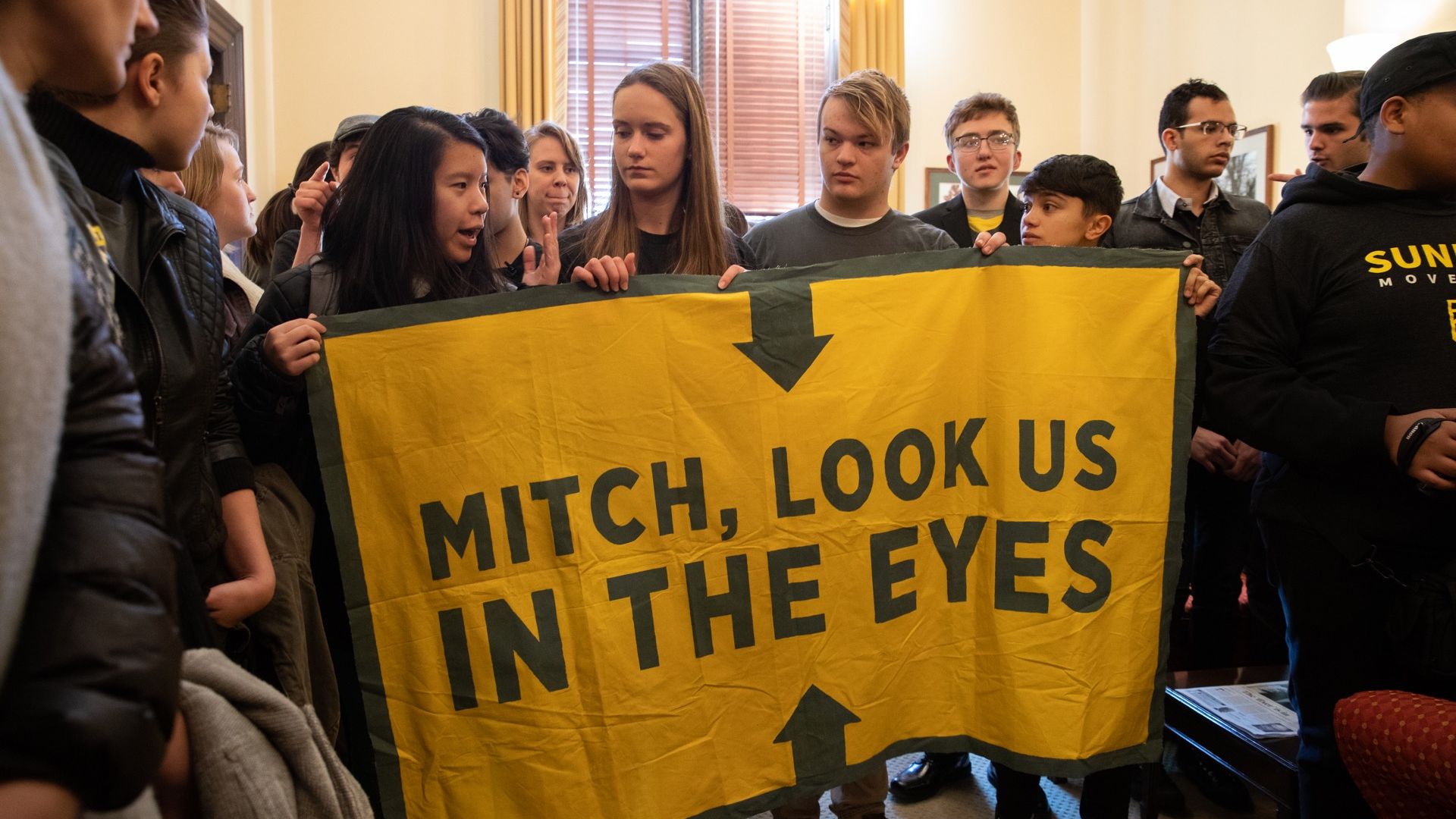
Where it stands: Majority Leader Mitch McConnell wants to put his opponents in a political bind over the Green New Deal resolution, which has uncertain Democratic support. Democrats are countering with attacks on GOP rejection of mainstream climate science and what they call the party's absence of effective ideas.
Even without seeing Robert Mueller's report, or knowing what prosecutors with the Southern District of New York have unearthed, or what congressional investigators will find, we already have witnessed the biggest political scandal in American history.
Historians tell Axios that the only two scandals that come close to Trump-Russia are Watergate, which led to President Richard Nixon's resignation in 1974, and the Teapot Dome scandal of the early 1920s, in which oil barons bribed a corrupt aide to President Warren Harding for petroleum leases.