Tuesday's energy & climate stories

EPA chief: Americans "deserve" a TV debate on climate change
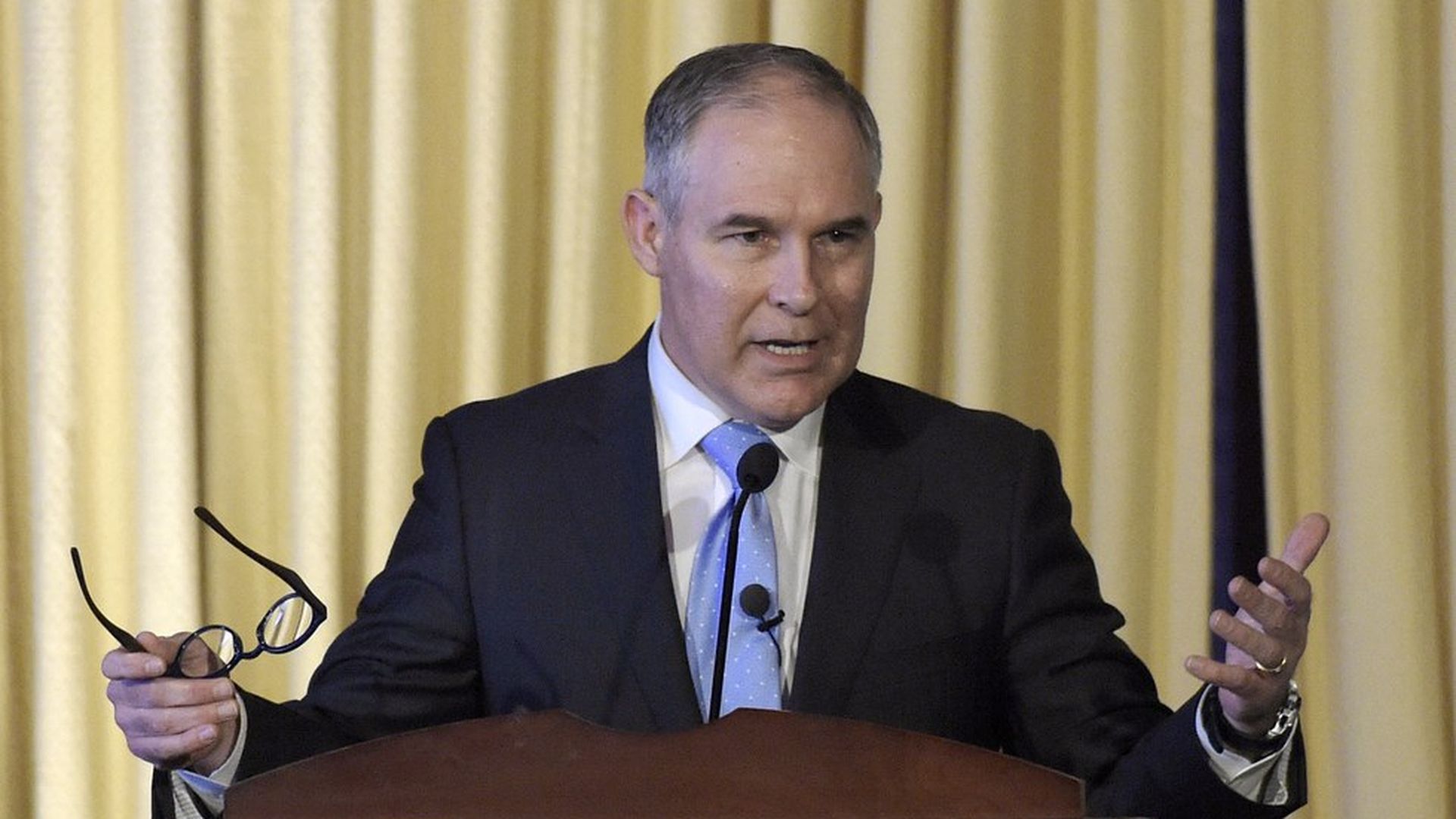
EPA Administrator Scott Pruitt, who has been dismantling Obama's efforts to combat climate change and has worked to undo more than two dozen regulations, is challenging scientists to debate whether climate change is a threat on TV, he told Reuters.
The reasoning: "I think the American people would be very interested in consuming that. I think they deserve it."
Pruitt's message to scientists who think they are right about climate change: "if you're so certain about it, come and do your deal." He added, "There are lots of questions that have not been asked and answered."

Climate article goes big time — and draws pushback
A deeply reported, deeply pessimistic New York Magazine cover piece on global warming titled "The Uninhabitable Earth" has set the climate policy world buzzing since it went up Sunday night. David Wallace-Well's piece makes the case that human-induced climate change is on such a dangerous pathway that, absent far more aggressive action, "parts of the Earth will likely become close to uninhabitable, and other parts horrifically inhospitable, as soon as the end of this century."
Yes, but: The piece is getting some pushback in climate science and journalism circles.
- Penn State's Michael Mann, one of the world's most prominent climate scientists, posted a rebuttal that criticizes the "doomist framing" and says the piece "paints an overly bleak picture by overstating some of the science."
- Over at Mashable, veteran climate journalist Andrew Freedman writes that in some places, the piece exaggerates evidence or makes mistakes. His verdict? "It's still worth reading, but with a sharp critical eye."
The next frontier for renewables powers up

Siemens and AES Corp. announced Tuesday they are combining forces to create a major new energy storage industry powerhouse with a joint venture called Fluence.
Why it matters: Growth in battery storage is an important way to enable integration of more renewable energy sources, while it also can aid reliability and curb the need for additional fossil fuel generation and other infrastructure to serve peak demand.

Farmers feel the effect of warming Arctic

Warmer weather in the Arctic due to climate change is making winters in the U.S. longer and affecting farms, according to a new study.
The Arctic is warming twice as fast as the rest of the planet, changing the circulation of cooler air to the planet's middle latitudes. The effect is harsher winters and cooler spring seasons that, in the years studied, were associated with a 1 to 4% decline in agricultural yield on average in the growing seasons following warm Arctic years. Certain areas, such as Texas, saw a much steeper decline of 20% due to the colder temperatures and drier weather.
Why it matters: The Arctic is only getting warmer, and American farmers may have to adjust harvesting schedules to handle the weather changes. Fewer plants also mean that less carbon dioxide is absorbed from the atmosphere, which can accelerate the effects of climate change even more.

71% of greenhouse emissions could be linked to 100 companies
The Carbon Majors Report took a look at industrial carbon dioxide and methane emissions by fossil fuel producers since 1988, and found that just 100 companies have been the source of more than 70% of the world's greenhouse gas emissions, per the Guardian. About half of those emissions have been produced by just 25 corporations, including ExxonMobil, Shell, BP and Chevron.
The study's goal: To pinpoint "how a relatively small set of fossil fuel producers may hold the key to systemic change on carbon emissions," according to Pedro Faria, the technical director at environmental non-profit CDP.
Why it matters: The companies have played a big role in causing greenhouse emissions, and now they could have a big role in cutting them as alternative energy plays a bigger role.