Saturday's economy stories



Local pushback mounts, but AI buildout surges on




America's electric-car boom leaves renters behind


Axios Live: How employers are rethinking AI's role in entry-level work
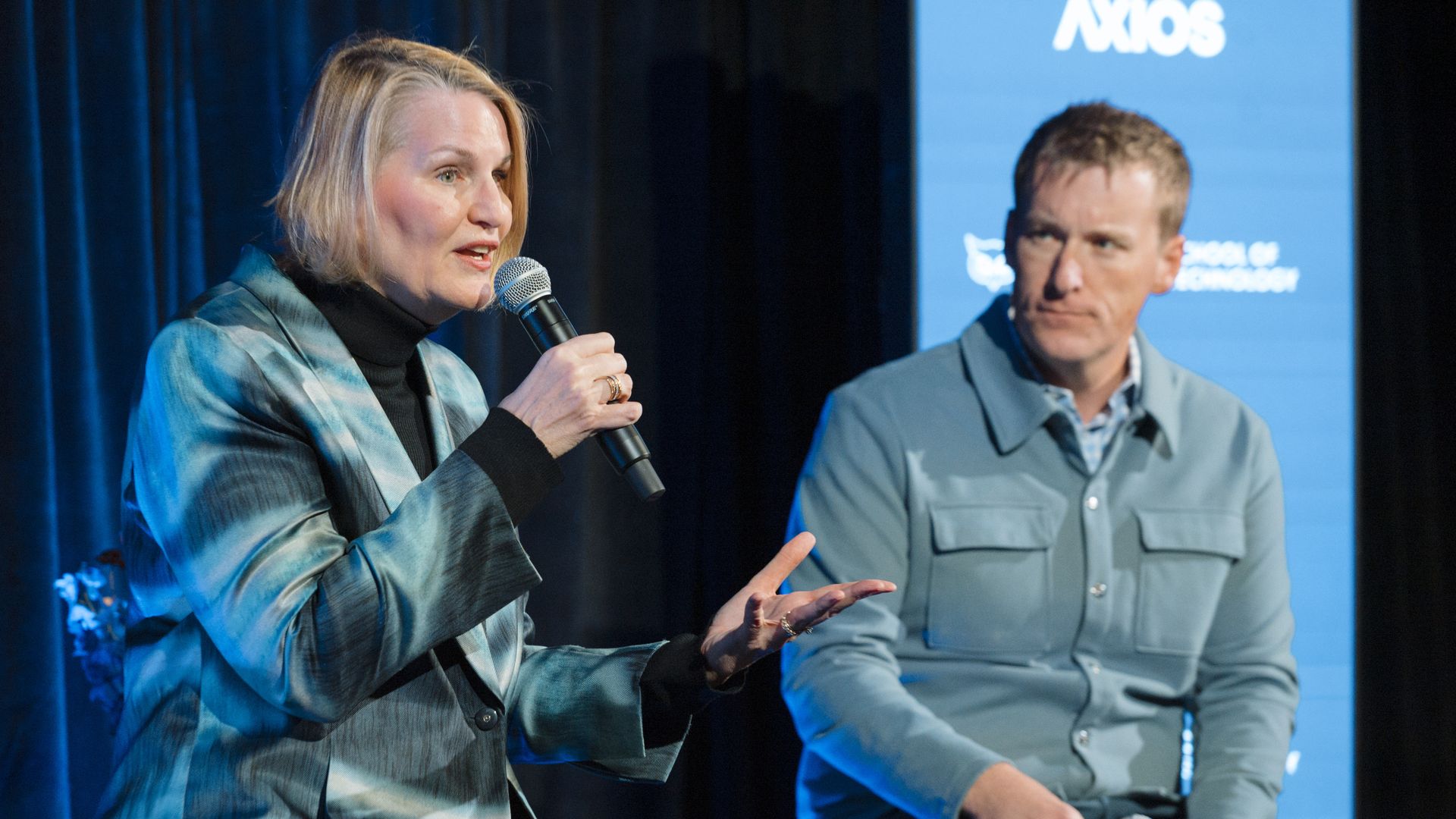
SEATTLE — Business and education leaders said AI is reducing routine early-career tasks, challenging employers to reimagine how workers gain substantive experience and advance in their fields.
Why it matters: Business leaders are betting that the technology could create new workforce opportunities, even as concerns about AI reducing jobs persist.
Axios' Nathan Bomey and Melissa Santos spoke with Microsoft corporate vice president of AI and Work Transformation Katy George and Technology Alliance CEO Laura Ruderman. The Oct. 28 event was sponsored by Western Governors University.
What they're saying: "I think all workforces need to be transformed, and, more importantly, the way we work, the way our business processes run, the way we make decisions, the way that we protect our infrastructure," George said. "All of that is changing with AI."
- George discussed how AI integration at Microsoft automates traditional "grunt work."
- "What we can do instead is to redesign the early career to, frankly, make them more interesting jobs," George said. "But it requires [entry-level workers] to actually level up in terms of judgment and perspective much faster."
Yes, but: Microsoft is reportedly offering voluntary employee buyouts to about 60,000 employees, or a quarter of its global workforce.
- George contended the company is also hiring and argued that AI implementation at Microsoft is "doing far more strategically in terms of driving growth and innovation and risk reduction, and actually creating new opportunities for people."
State of play: Ruderman said schools and training programs are emphasizing different skill sets due to AI's proliferation.
- "I hear a lot from educators now that critical thinking and all of those soft skills are coming back into vogue."
Content from the sponsor's segment:
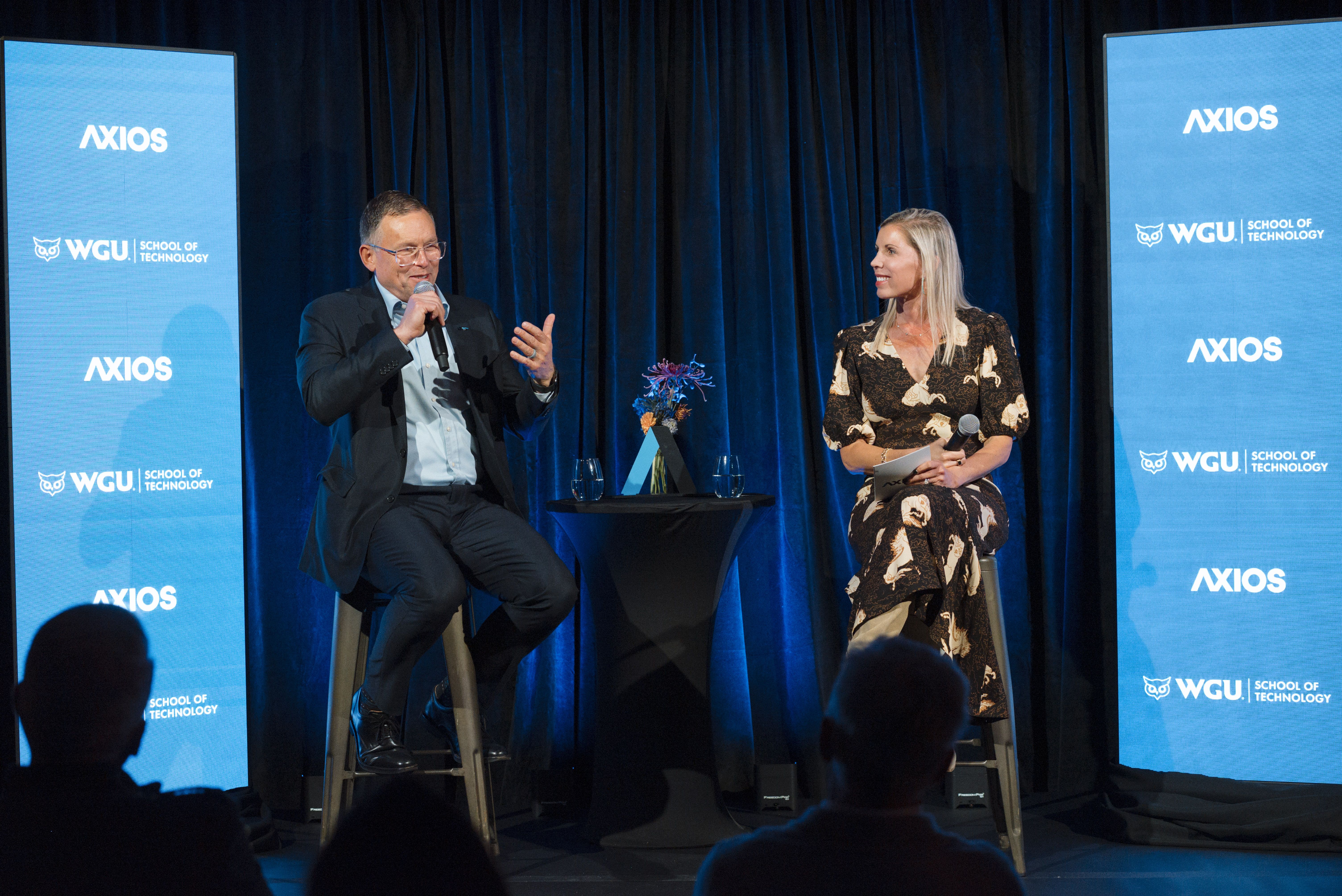
In a View From the Top conversation, Western Governors University senior vice president and executive dean for the School of Technology Paul Bingham described how the school is preparing students for the workforce while being mindful of AI's impact:
- "The way that we're preparing is to infuse the AI skill sets into all of our legacy programs of computer science and cybersecurity, data analytics, cloud and network engineering," Bingham said.


French economy unexpectedly contracts in Q3


Health care is eating Americans' paychecks




The haunted housing market

Here's a scary truth: The housing market is haunted. Home sales are anemic, yet prices are still high, and homebuilders say it's hard getting people out to even look at places.
Why it matters: For a long time, the residential real estate market was a crucial economic engine in the U.S., and homeownership the backbone of the American dream and wealth building.
- Now, not so much.
Where it stands: The average rate on the 30-year mortgage is 7.24%, up from just under 6% at the start of the Iran war — that put the kibosh on what had been a tentative thaw in the frozen sector.
- With rates that high, a lot of folks — particularly younger first-time buyers — can't afford the monthly payments. In September, 14.5% of pending home sales fell out of contract, per Redfin, the highest share outside the early pandemic.
- Traffic of prospective buyers to new homes fell to its lowest level since 2012 this month, according to a survey of homebuilders from the National Association of Home Builders.
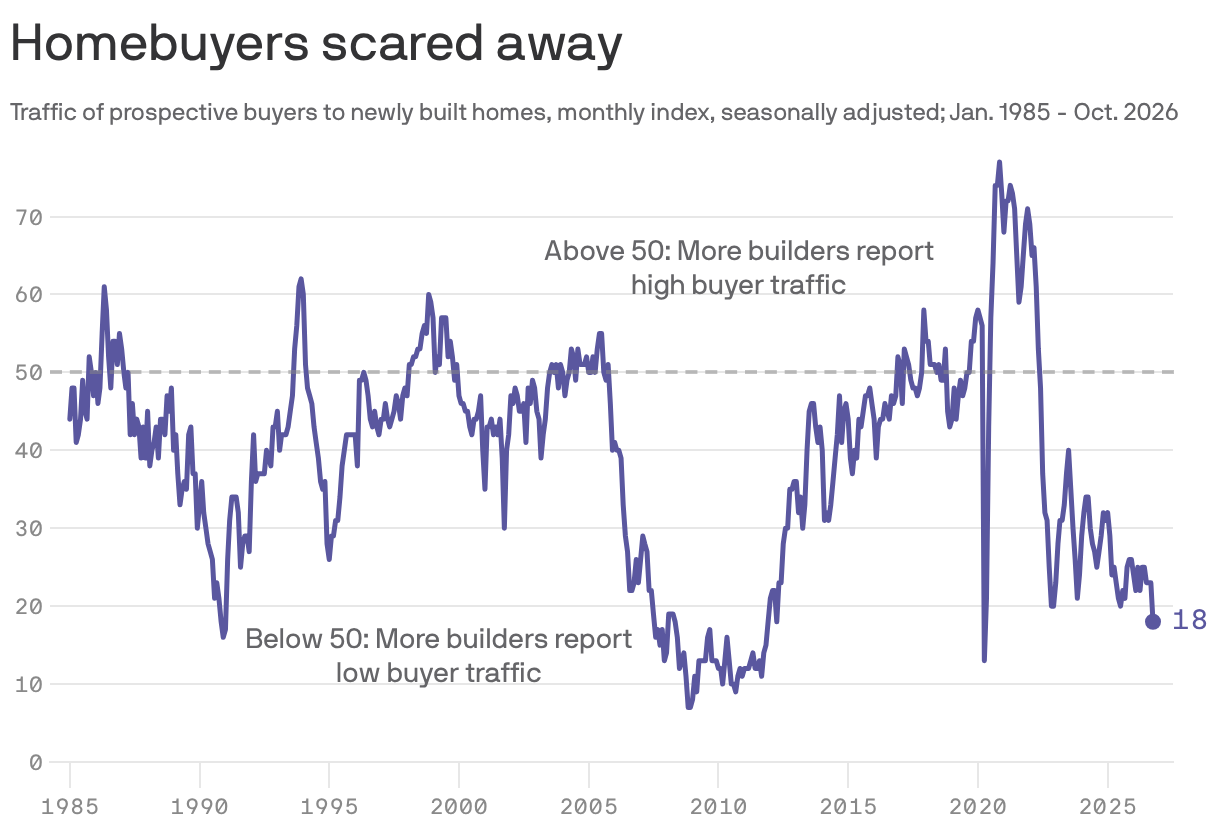
The big picture: This is a situation years in the making. After the financial crisis in 2008, the Federal Reserve kept interest rates ultra-low, which meant low mortgage rates for buyers.
- Perhaps, perversely, that helped drive up home prices — you can afford to pay more when your mortgage rate is low.
- Home prices exploded, culminating in around a 40% increase during the 2021 and 2022 buying frenzy.
State of play: But now, home prices are still high — they haven't adjusted down as mortgage rates have gone back up.
Catch up quick: The previous era's low mortgage rates — an average of 4.15% from 2008-2021 — were an anomaly.
- "Consequently, there is little reason to believe that mortgage rates will fall much below 7.0% in the months or even years ahead, in the absence of a recession," David Kelly, chief global strategist at JPMorgan Asset Management, wrote in a note titled, yes, "Haunted Housing."
Zoom in: The market is "haunted by the legacy of too-easy monetary policy for well over a decade, which allowed prices to vault higher in the post-pandemic boom," he wrote.
- Tariffs and immigration policies are also taking a toll, Kelly said. The former is driving up prices for materials used to build homes, and the latter is driving up labor costs to build.
Zoom out: The situation is increasingly putting homeownership out of reach for young adults — the homeownership rate for that group, which had bounced back from its post-pandemic low, has fallen back some in recent years.
- Kelly says this is the scariest chart of all:


The bottom line: The housing market is more trick than treat lately.

Some of the spookiest charts about the markets
It's natural to be jumpy this time of year, with armies of undead pedestrians hitting the streets Saturday in search of moist human brain — and Skittles.
- To add to the mood, here are some of the charts we've seen recently that have made the hair on our arms stand up.
Why it matters: After weeks of wobbling sideways, the markets seem to be at a crossroads amid real questions about the durability of the AI trade and the economic boom that backs it.
- Were the AI boom to suddenly turn to bust, it could have scary implications for the economy — investment in data centers is supercharging GDP — the markets and the finances of investors.
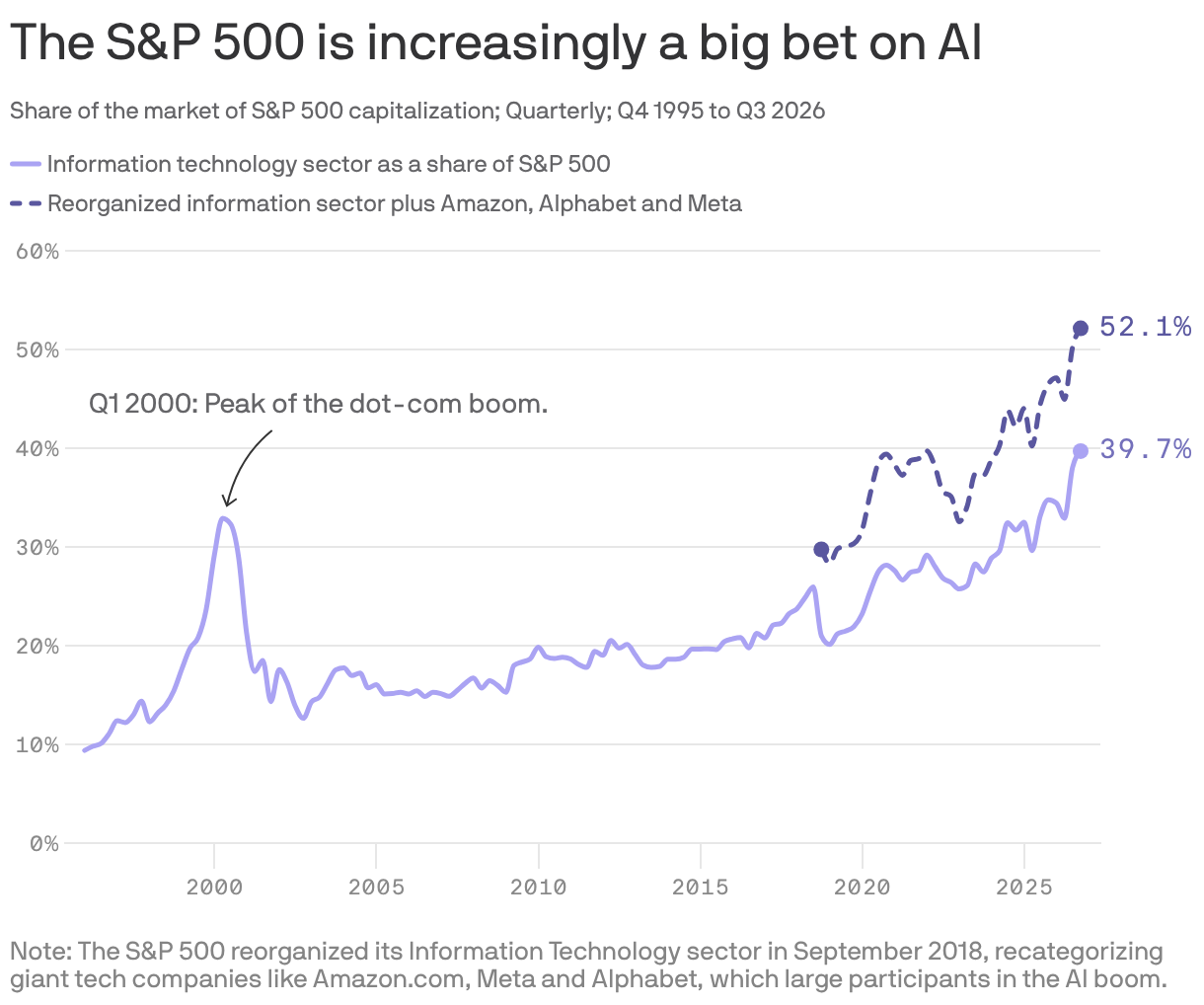
The big picture: The stock market has become increasingly AI-pilled, with tech stocks and hyperscalers now accounting for more than half the capitalization of the S&P 500. This is higher even than during the dot-com-driven market boom that peaked in early 2000 before the market crashed.
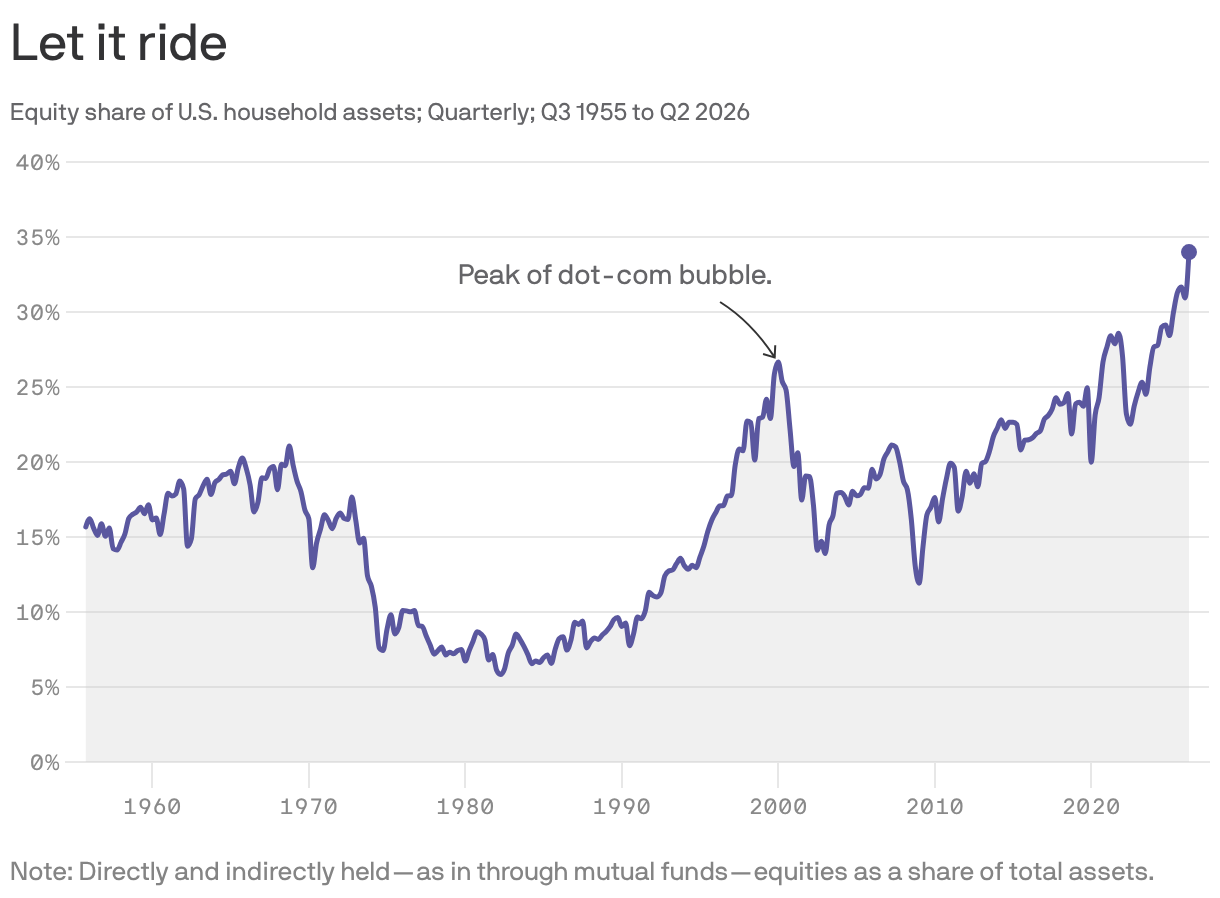
Context: American households are long in the market, as they've never been before.
Zoom in: At the same time, there are real questions emerging about the durability of the AI boom.
- For instance, prices for tokens — the main measure of AI computing power usage — are tumbling. That's not something you typically see in a market where demand is off the charts, which AI insiders claim.
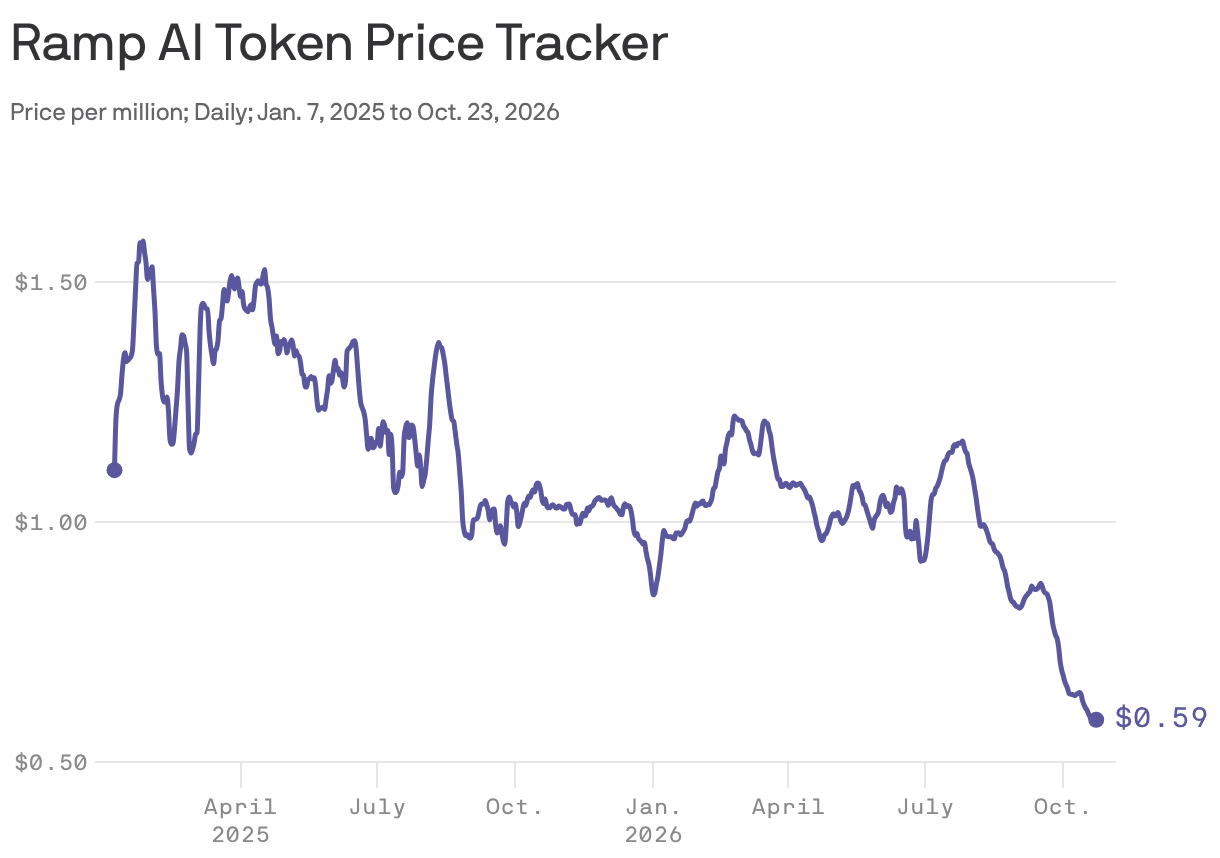
Between the lines: Falling prices don't mean sales won't go up. (If you boost volumes because of lower prices, you can still make more revenue.)
- But it will sure make it harder to generate the revenue to pay off the massive amounts of debt that tech companies have sunk into AI.
- The market is increasingly scrutinizing companies considered the weakest financial links in the AI ecosystem.
Case in point: The corporate bond market sharply repriced the interest rates it thinks CoreWeave should pay in recent weeks, pushing them to nearly 16% at times.
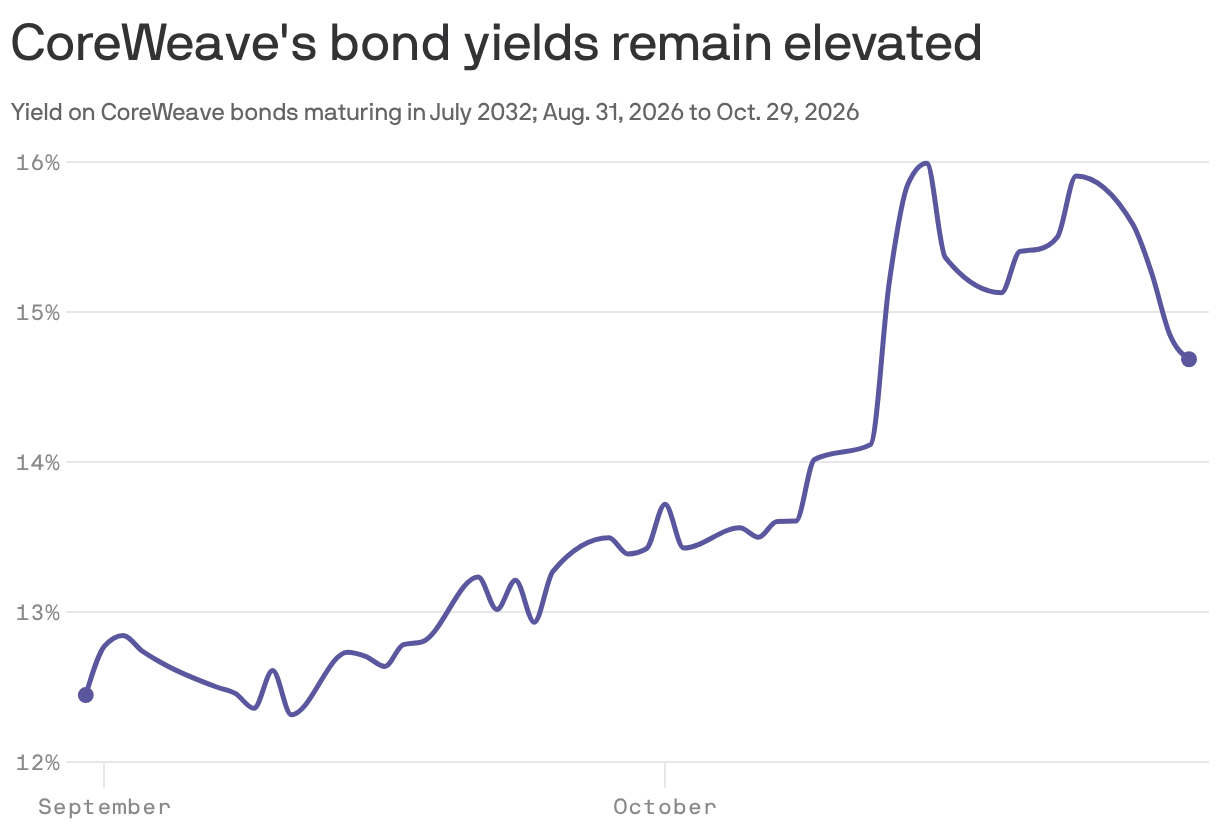
Yes, but: CoreWeave, some might say, is a heavily indebted player unrepresentative of the giant hyperscalers who are really driving the boom.
- That's true. But even the tech behemoths are seeing their borrowing and spending binge start to impinge on their once mighty cash flows.
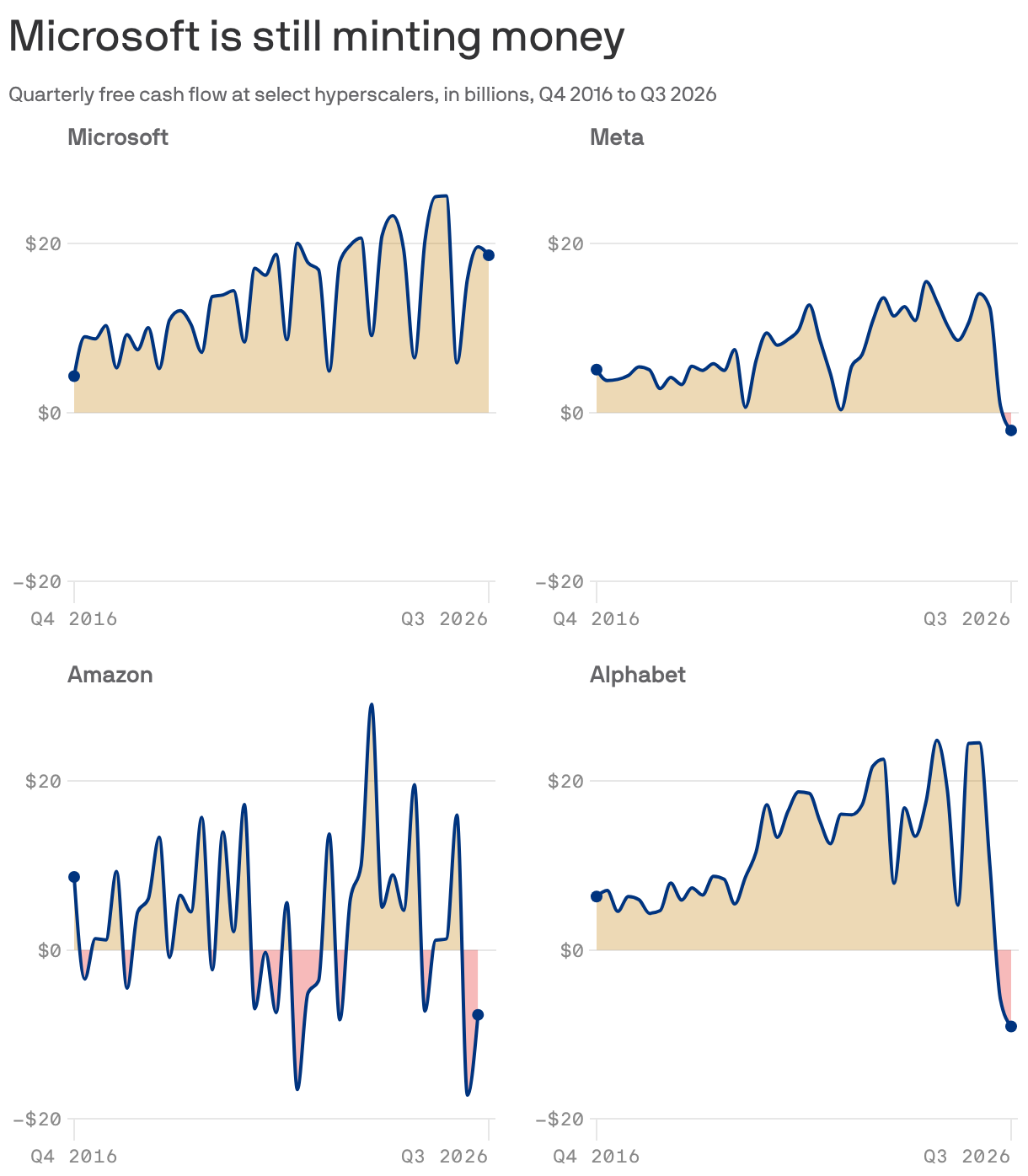
What to watch: The continuing rush to the capital markets, with Meta and Microsoft announcing multibillion-dollar offerings just this week.
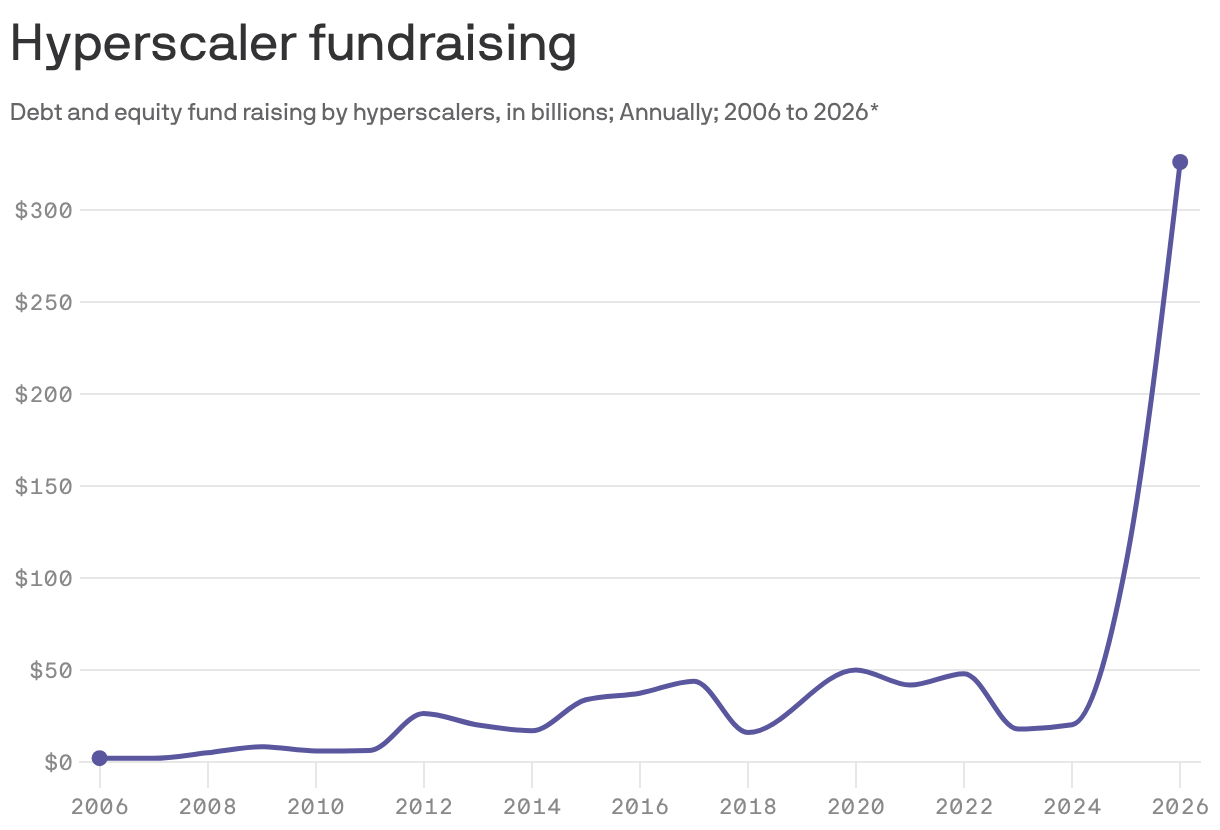
Fun fact: Massive borrowing binges — especially in the bond market — alongside surging asset prices are one of the few phenomena that academics have found to have a bit of predictive power when it comes to market crashes.
The bottom line: We hope these charts don't keep you up at night.
- Nobody knows when — or if — a crash will hit.
- 🎃 Happy Halloween! 👻
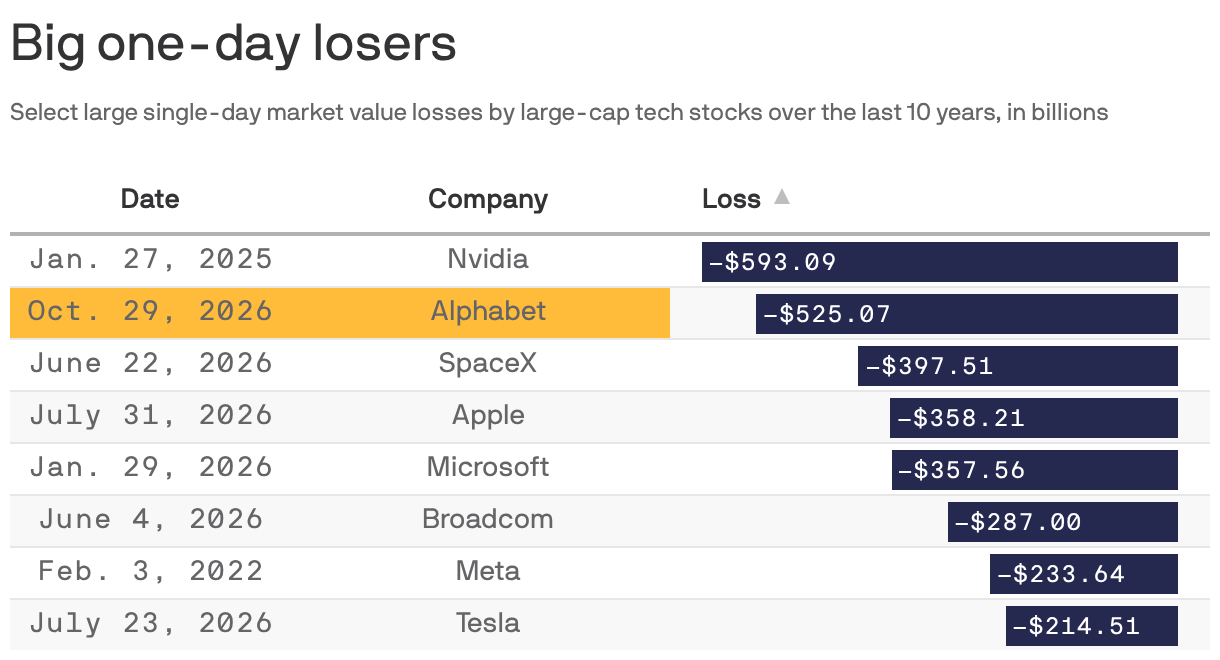
Alphabet suffers a rough day for the ages

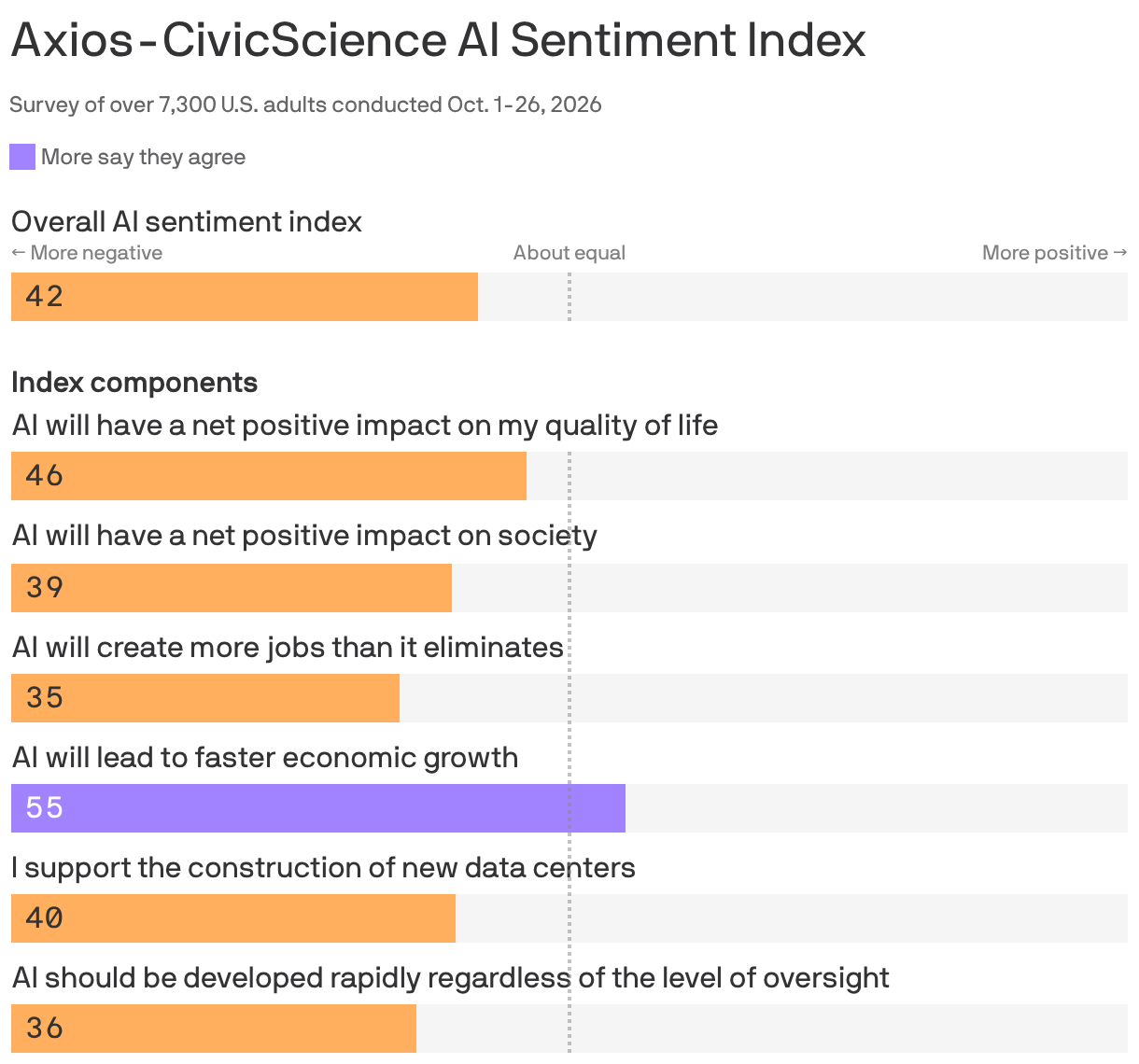
Exclusive: Americans expect a jobless AI boom