One of the final snapshots of how Americans feel about the economy before voters head to the polls in the midterm elections shows a nation still deeply frustrated by the cost of living.
By the numbers: The University of Michigan's consumer sentiment index registered 48 in October, virtually unchanged from September's 48.1 and revised higher from a preliminary reading of 46.3.
That initial estimate was the second-lowest in the survey's history, behind the all-time low hit in May.
Even after the upward revision, sentiment remains 10% below its level this time last year.
Zoom in: Beneath the flat headline reading, consumers grew more pessimistic about current economic conditions, with that index falling more than 4 points to 46.7.
Buying conditions for durable goods plunged 18% amid high prices and rising borrowing costs — accounting for the entire decline in consumers' assessment of current economic conditions.
"Purchasing power continues to dominate consumer views of the economy," Joanne Hsu, director of the survey, said in the release.
But consumers' outlook for the future improved, with the expectations sub-index rising 2.5 points to 48.8.
The intrigue: Separate data released alongside the index showed that the share of Republicans citing high prices as a drag on their finances has surged roughly 50 percentage points since January, a much larger increase than among Democrats or independents.
The increase was also especially pronounced among consumers with little or no stock wealth.
The bottom line: Americans don't feel much worse about the economy than they did last month. But their already bleak outlook isn't improving, either.
The Conference Board releases its October consumer confidence survey Tuesday — one week before Election Day.
AI tools have become shockingly good at carrying out much of the work produced by the economic profession — from the most elite halls of academia to think tanks, government agencies, consultancies, research shops and humble newsroom economics teams.
The big picture: This fact raises important — and, we confess, unnerving — questions about the role of humans in making sense of the economy.
On a recent evening near a secure U.S. facility, three federal agents saw a flying object they couldn't identify: a large "matte black triangle" that moved as fast as a fighter jet, made no sound and then disappeared, according to FBI and Defense Department reports.
Why it matters: The 15-foot flying triangle is classified as a UFO-like "Unidentified Anomalous Phenomena" because the U.S. doesn't have the technology to make such a craft — and neither do its adversaries.
Here's a surprising combination of words: Municipal bonds are sexy right now — offering historically attractive returns at a time when states and localities need more and more cash.
Why it matters: That may be good news for investors, but it costs taxpayers who foot the bill when states and localities borrow money by issuing these bonds.
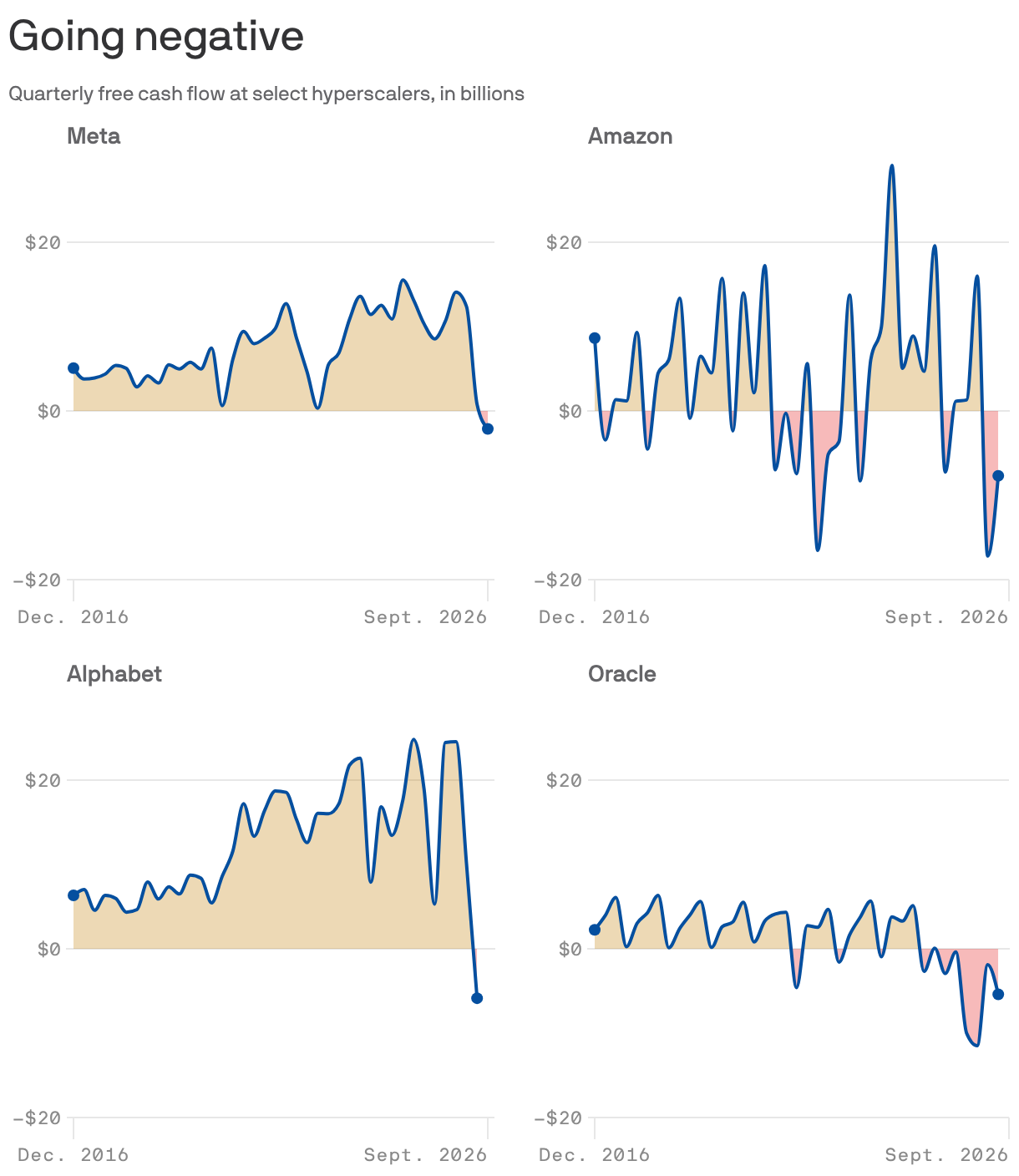
Data: FactSet, company filings; Chart Axios/Matt Phillips
Mark Zuckerberg's Meta got smacked around Thursday after reporting earnings that looked pretty strong at first glance.
Why it matters: Its drubbing in the stock market — Meta ended down 7% —suggests that investors are growing concerned that Big Tech's insistence on pouring more and more capital into data centers could end up costing them in the long run.
America's largest banks are working to prevent AI worst-case scenarios. But they're also preparing for the "day after" a catastrophe, Axios has learned.
Why it matters: America's financial institutions have joined the largest AI companies in scenario-planning for disaster, a prudent but worrisome signal about the extent of the risk that major corporations see on the horizon.
Your neighborhood's next hot bakery — or coffee shop, pizza joint or BBQ spot — might be inside someone's house.
Why it matters: More people are turning their home baking into a business, as online platforms and loosening state regulations make it easier for home cooks to reach customers.