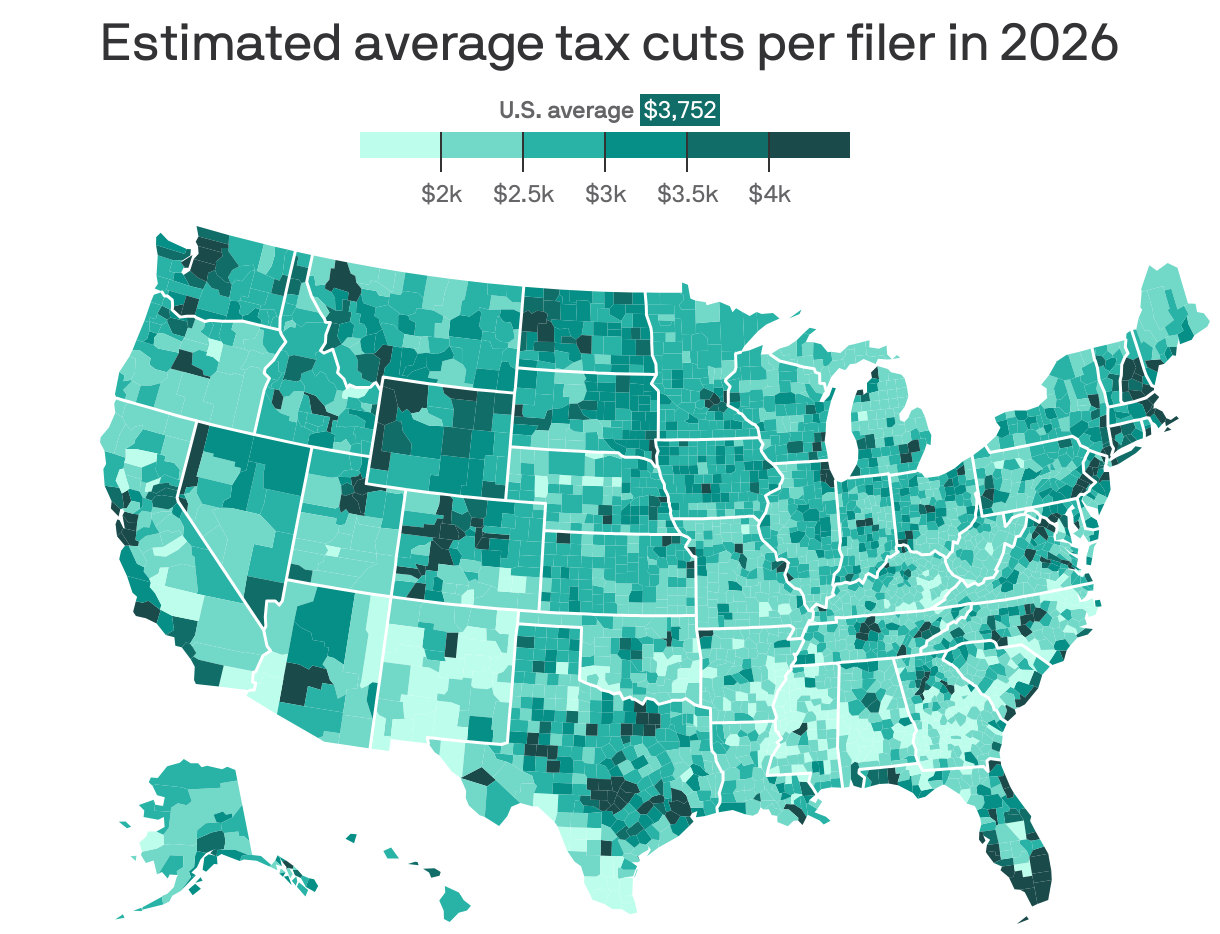
Americans dodged a big tax hike when Congress passed the "big, beautiful bill," making permanent the tax cuts of President Trump's first term — and adding on a bunch more.
Why it matters: Tax cuts free up money for folks to spend on other things — which could be dearly needed next year as wages still haven't caught up with inflation and tariffs threaten to push costs up further.
Economists are considering a new inflation risk: geopolitical tensions that keep upward pressure on prices, especially on the energy front.
The big picture: Despite messaging to the contrary over the weekend, a top White House official confirmed Monday that the administration will still impose heavy tariffs on India, a major buyer of Russian oil, second only to China.
That comes as the administration considers whether to impose even more economic penalties on Russia as its war against Ukraine drags on — a move that could reverberate across the global economy.
When President Trump issued his executive order on alt assets in 401(k) plans, one of the people cheering most loudly was Abdul Al-Asaad, CEO of a fintech startup called Basic Capital.
Driving the news: Basic Capital, which lets workers use private credit to leverage their 401(k) accounts, today is announcing $25 million in Series A funding led by Forerunner and Lux Capital.
Inflation is running above the Federal Reserve's 2% target, consumers are still spending, the labor market is slowing — all dividing economists over whether to cut interest rates. But it's not stopping investors from pricing cuts in.
Why it matters: The Fed, the White House and the financial markets all hope to control interest rates. Investors may have the upper hand.
Artificial intelligence is not taking your job just yet, according to MIT's State of AI in Business 2025 report. Instead, AI is predominantly replacing outsourced, offshore workers.
Why it matters: As U.S. workers feel the pain of a tight labor market coupled with fears of a white-collar bloodbath, any disruption from AI is so far hitting farther afield, the MIT findings suggest, even though its longer-term risk is much greater.
The Trump administration is undermining — or has stopped collecting — key, once-nonpartisan data that kept the public informed about the state of the nation.
Why it matters: From Congress to city halls to boardrooms, critical decisions rely on accurate government data and public trust in that data. Without it, leaders risk making costly mistakes that could affect millions.
Consumers and businesses are feeling the pinch from President Trump's trade war, with costs soaring for grocery staples and critical materials.
Why it matters: It's no longer anecdotal. The effects are difficult to ignore across key inflation indicators that might only get hotter in the months ahead.