Privacy scandals, data breaches and safety issues are impacting America's idealistic view of the internet as a force for good, according to a new Pew Research Center survey.
While 96% of U.S. homes have a television, other video devices are slowly reaching ubiquity as well, according to Nielsen.
Reproduced from a Nielsen report; Chart: Axios Visuals
A big trend: Roughly two-thirds of U.S. homes have an internet-enabled connected device that's capable of streaming content to a television set, which includes enabled smart TVs, multimedia devices and video game consoles.

A group of media, journalism and tech companies has joined veteran media executive Merrill Brown to create a full-service publishing platform specifically built for digital news publishers called The News Project (TNP).
Why it matters: Brown says his company is different from other digital publishing platforms, like Maven, Squarespace and Medium, because his focuses solely on news.
Digital publishers are doubling down on new TV-like video programming, specifically with streaming services, like Netflix, as well as with linear TV networks.
Why it matters: Universal device ownership is forcing brands to think about reaching users with compelling stories wherever they are spending time within their media diet, whether that's on a smartphone or a smart TV.
Substack, a San Francisco-based startup that provides users with tools to publish paid (or free) subscription newsletters, has raised $2 million in seed funding.
Why it matters: The media industry has been scrambling to figure out how to pay for journalism and content, and a growing number of organizations believe subscriptions can be a solution.
Special counsel Robert Mueller provided President Trump’s lawyers with a list of dozens of questions on various issues he wants to ask Trump if given the opportunity to interview him as part of his Russia investigation, and The New York Times reportedly obtained that list.
Why it matters: The questions, which reveal that Mueller is interested in learning more about Trump's ties with Russia, his relationship with his advisers and family, and the motivation behind some of his controversial tweets, offer one of the closest looks yet into Mueller's thinking. They also show that the investigation has expanded beyond Russian meddling and potential obstruction of justice to include the president’s conduct in office.
Ahead of a midnight deadline, President Trump has decided to extend tariff exemptions for European allies — but only for one month, the WSJ first reported and the White House confirmed.
The big picture: Trump isn’t just worried about China. The U.S. trade deficit with the EU has grown steadily — something Trump made sure to raise with German Chancellor Angela Merkel last Friday, and which had him considering opening a European front in his trade war.
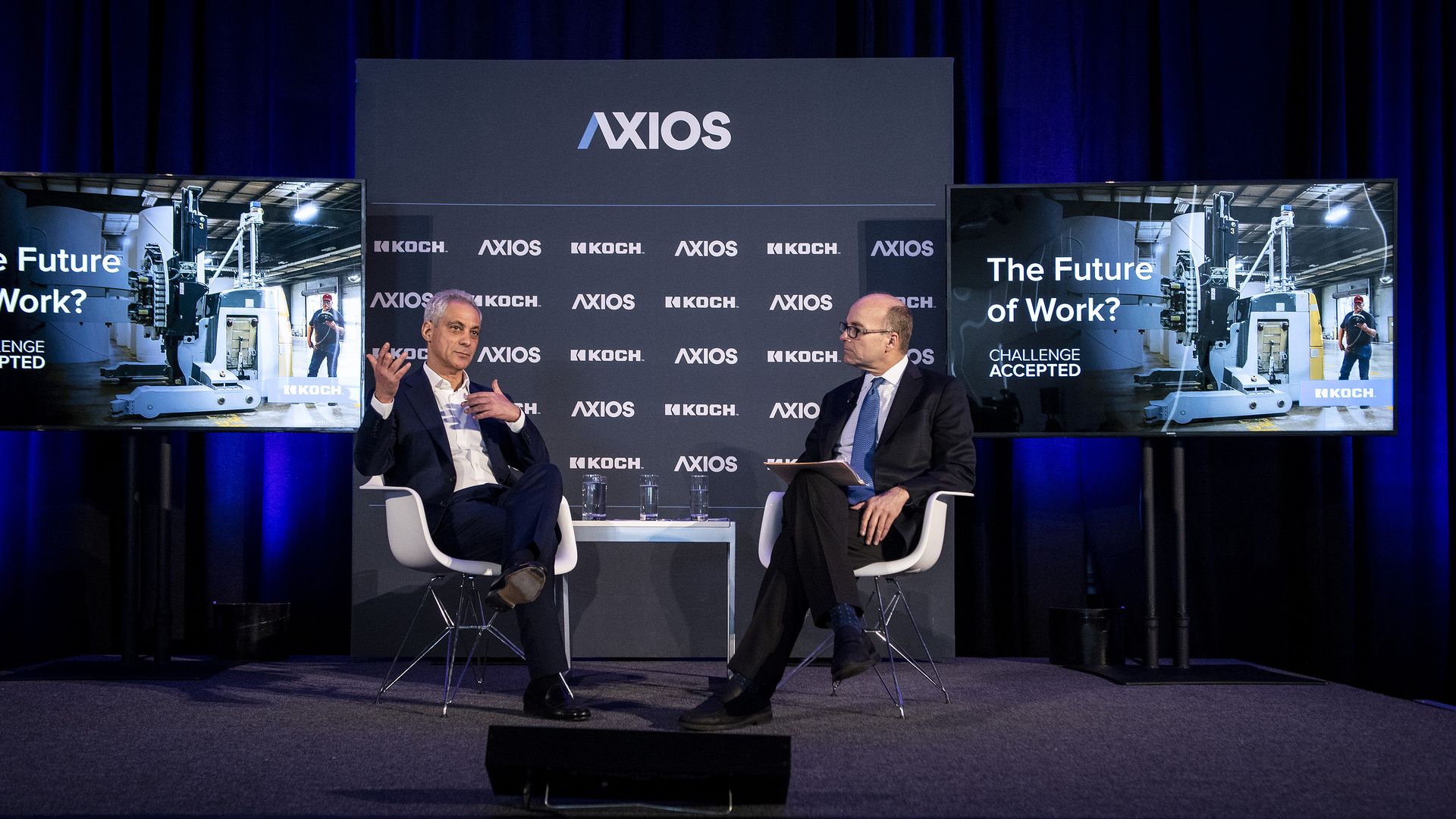
Axios' Mike Allen was in Chicago last week to discuss the Future of Work 💼 and smart cities 🏙 with:
T.H. Rahm Emanuel, Mayor, Chicago; T.H. G.T. Bynum, Mayor, Tulsa; Mr. Imir Arifi, Head of Artificial Intelligence & Machine Learning, Health Care Service Corporation.
"[W]ith only days left before the exemptions expire and punitive tariffs take effect, it’s dawning on foreign leaders that decades of warm relations with the United States carry little weight with a president dismissive of diplomatic norms," the N.Y. Times reports.
Why it matters, from Axios future editor Steve LeVine: Our eye is on the Chinese-U.S. trade talks. But the EU is our biggest trading partner, and we appear to be headed toward a precipice with them no one stopping it.