Rite Aid's stock plummeted 28% on Thursday after a ghastly earnings report called into question the company's strategy for keeping up with its bigger drugstore competitors.
Driving the news: Despite inflation fueling revenue gains for companies throughout the economy, Rite Aid reported a 3.5% second-quarter decline in sales, which it said was due in part to a reduction in revenue from COVID vaccines and testing as well as store closures.
Hurricane Ian is expected to undermine the already precarious market for property insurance in Florida, supercharging premiums and exposing gaps in coverage.
Why it matters: Ian's trail of wreckage will inevitably trigger a host of insurance claims by homeowners, saddle those without flood coverage with devastating losses and bludgeon the strained finances of the state's insurers.
The Securities and Exchange Commission imposed a $20 million penalty on the Chinese affiliate of Deloitte Touche Tomahotsu, accusing the accounting giant's arm of failing to comply with "fundamental U.S. auditing requirements."
Driving the news: On Thursday, the financial watchdog charged that, over the course of several years, Deloitte's China employees allowed clients to choose their own samples for audits and prepare documents, creating the appearance that the firm had conducted the due diligence.
The Biden administration launched its new Chief Diversity Officers Executive Council (CDOEC) on Thursday to help implement strategy for diversity, equity, inclusion and accessibility (DEIA) across the federal government.
Why it matters: Biden campaigned on the promise to bolster diversity and equity across the American economy, but two years into his presidency the federal government continues to face challenges with hiring, retaining and elevating people of color.
A big economic mystery has been the unprecedented divergence between two growth yardsticks that, historically, have been more aligned.
Driving the news: Revised figures published Thursday bring the measures more in step, and partly solve the mystery. But the result isn't especially reassuring: Depending on your preferred metric, economic growth was weaker than previously thought.
Friday morning, the government will release new numbers on incomes, spending and inflation for August. Analysts expect core personal consumption expenditure (PCE) inflation, the Fed's preferred measure, to come in at 4.7% over the last year.
But a surprising calculation quirk is pulling those numbers lower. It underscores the importance — and pitfalls — of focusing on the innards of inflation figures.
Why it matters: Over the last year, much has been said aboutwhy various forces pushing inflation up are one-offs and should be ignored. But that cuts both ways.
The details: For PCE inflation, one of the biggest downward forces is linked to purportedly falling prices in the "portfolio management and investment advice" category. They are down 18.5% just since January.
But it isn't that investment managers are slashing their prices. Rather, they often charge a percentage of assets under management — and asset prices have plunged.
For example, if someone paid their money manager 1% of assets in annual fees, but the value of their portfolio fell 25%, it would show up in the inflation data as the price of money management services falling 25%.
Whatever you think of that approach, to the degree plunging asset prices are, in a mechanical sense, flowing through to lower core prices, it means the reported inflation numbers are lower than what most people are experiencing.
After all, most portfolio management fees are paid by people with lots of financial assets. Rich people may be saving some money, but for a person with a modest or non-existent portfolio, it doesn't matter.
According to calculations by Jason Furman and Willie Powell III at Harvard Kennedy School, prices rose at a 5.3% annual rate in the April through July period if you exclude these services, not the 4.3% rate at which core prices were reported to have risen.
What's next: "Given how it is constructed, portfolio management inflation tends to track asset market performance, and is highly correlated with the equity market with a one-month lag," Deutsche Bank chief U.S. economist Matthew Luzzetti tells Axios.
Therefore, he doesn't expect much impact on tomorrow's August inflation numbers, since stock prices were relatively flat in July.
But it implies that September inflation may be misleadingly high (because stocks rose in August) and October inflation misleadingly low (because stocks plunged this month).
The big picture: To get a clear reading of inflation trends, it's important to sweat the details of how indexes are calculated. But you can't look at just the components pointing in your preferred direction.
As Furman notes, there has been much coverage of how quirks in the used car market have made inflation look artificially high, yet virtually none (until now!) of how portfolio management quirks may be making inflation artificially low.
The bottom line: It's important to look carefully at even the aspects of economic data that don't tell you what you want to hear.
Dani Dudeck has a knack for building communications teams — she did it for MySpace, Zynga and most recently, Instacart, where she serves as chief communications and public affairs officer.
Circle Internet Financial, the issuer behind the dollar-pegged USD Coin, is reinforcing its position as the stablecoin race heats up.
Driving the news: The second-largest stablecoin is getting a boost, per announcements made during Circle’s inaugural Converge22 conference, to make usdc available on Cosmos, a multi-chain ecosystem that has been looking to fill the hole that another, more dysfunctional stablecoin left behind.
Bitcoin had an immaculate conception, in that the conditions of its launch can never be replicated. That's mainly because no one cared about it then, which — looking back — has been a real boost to its credibility.
Why it matters: The distribution of any new form of money is important. The more people who have it and use it, the more people each person who has it can transact with. Money needs a big footprint. When a new cryptocurrency launches, creators put a lot of thought into how to get it into as many hands as possible (and outsiders put a lot of thought into how to game its distribution).
Black and Hispanic-owned venture capital and private equity firms have a particularly onerous time raising follow-on funds, according to new research from Harvard, Vanderbilt and the University of Michigan.
Why it matters: This trend exacerbates existing wealth disparities between racial groups.
Porscheraised €8.2 billion in its IPO, pricing at the high end of its €76.50 to €82.50 per share range. Shares climbed in early trading on the Frankfurt Stock Exchange.
Why it matters: This is the year's largest European IPO, and the second-largest ever in Germany (behind Deutsche Telekom in 1996).
It also means that Porsche's market cap is approaching that of parent company Volkswagen, whose shares fell as some investors appear to have switched allegiances.
Details: Volkswagen offered 911 million shares and the stock symbol is "P911," both homages to Porsche's iconic 911 model. Expectations are that VW will use proceeds for electrification efforts.
The bottom line: There are hopes that Porsche's debut could jumpstart both the moribund European IPO market and public investor interest in luxury carmakers (see chart below). But this is more likely to be an exception than the start of a new rule.
Substack has acquired Yem, a small startup that helps newsletter writers grow their email lists through email marketing campaigns, Substack co-founder Hamish McKenzie told Axios.
Why it matters: The deal is part of a wider effort by Substack to help provide the writers on its platform with tools to grow their audiences organically by tapping into Substack's broader network of writers.
Here's your Thursday pick-me-up: It's National Coffee Day and savings are brewing on cups of joe.
The big picture: Coffee is considered the most popular beverage with 66% of Americans drinking it each day, more than any other beverage including tap water, according to data from the National Coffee Association.
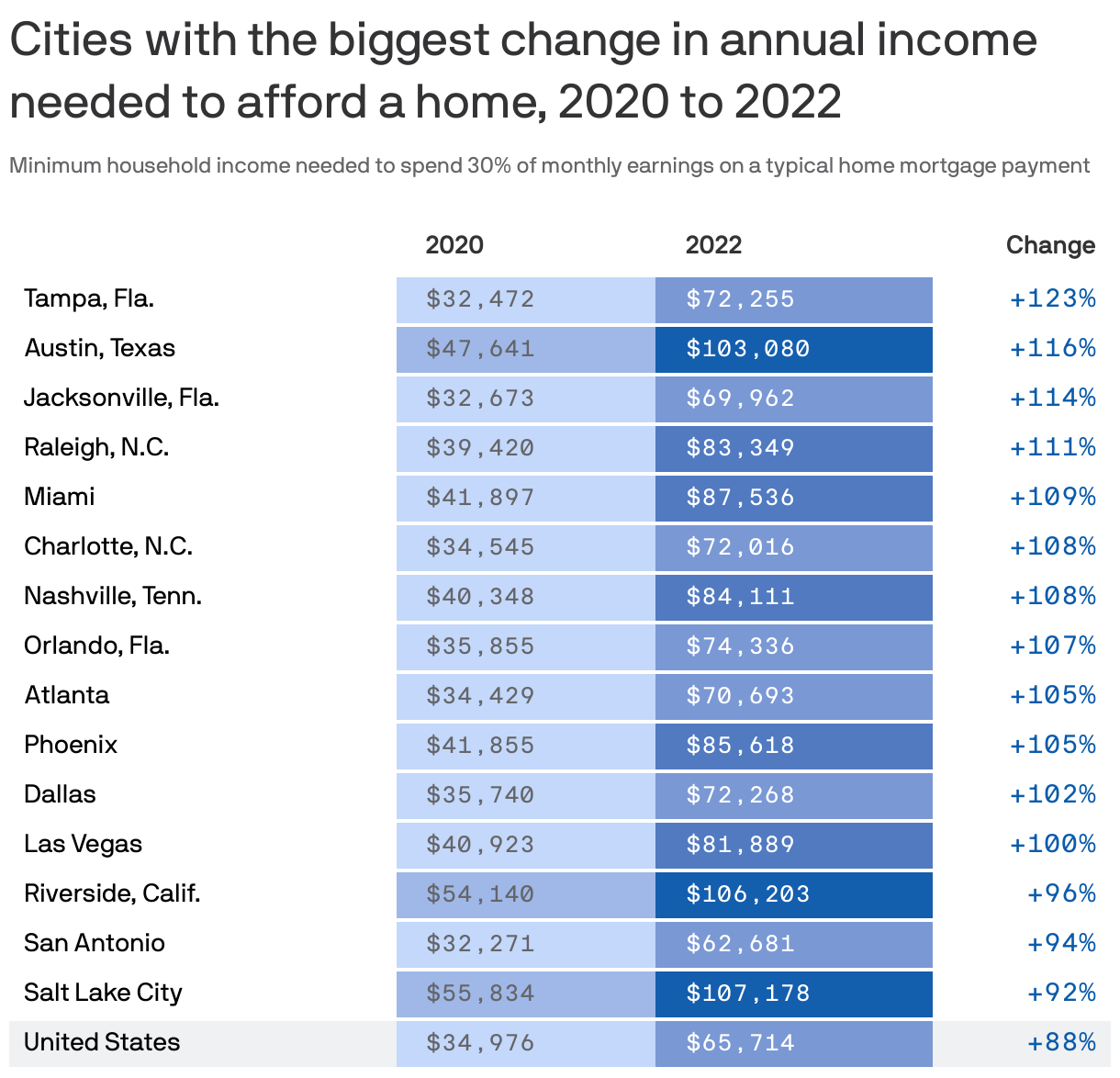
Pending home sales, or contract signings to buy existing homes, fell again in August, according to data from the National Association of Realtors out Wednesday. It's the seventh month this year they've dropped, as rising mortgage rates put already high home prices out of reach for a lot of people.
Why it matters: A quick glance at that chart up there explains a lot. The minimum income needed to afford a typical house doubled since 2020 in several major metro areas, according to data from Zillow.
The turmoilin the British bond market is the backdrop for a battle between the nation's politicians and its central bank over who really runs the U.K. economy.
Driving the news: With British government bond prices plunging and bond markets showing signs of growing dysfunction, the U.K. central bank announced an emergency plan Wednesday to start buying as much as £65 billion in government bonds, known as gilts.
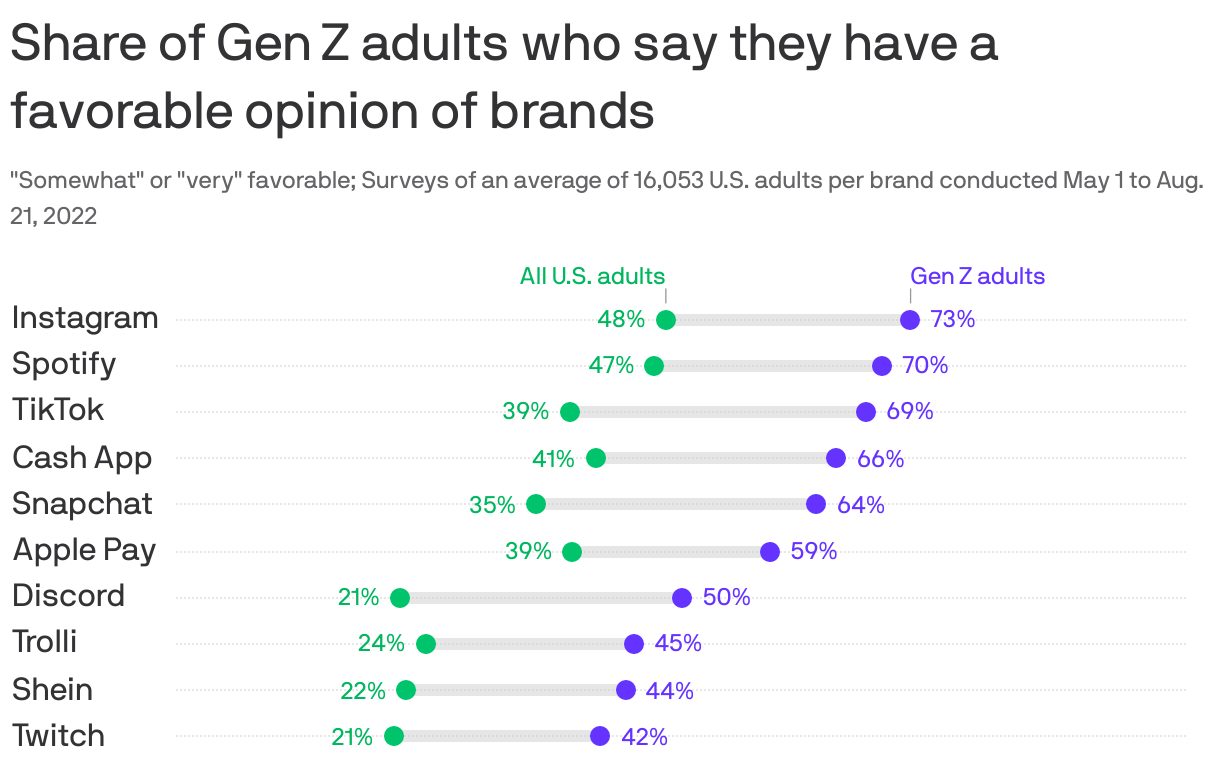
Data: Morning Consult; Note: Gen Z adults defined as ages 18-25; MOE ±1 percentage point for all adults, ±2 for Gen Z; Chart: Madison Dong/Axios Visuals
The youngest generation of adults is so crazy for tech companies that YouTube, Google, Netflix and Amazon are their four favorite corporate brands, a new Morning Consult survey finds.
Gen Z also loves junk food and mass retail: The other brands in their top 10 are M&Ms, Doritos, KitKat and Oreo, plus Amazon, Walmart and Target.
A number of surveys, studies and interviews are pointing to one big trend: Middle managers are getting short shrift in the new working world.
Why it matters: The middle of any organization is key to its culture, productivity and success — but as work changes, it's that same middle that's bearing the brunt of the turmoil.