More than 2 million infant swings and rockers were recalled Monday due to possible strangulation and entanglement hazards.
Driving the news: The Consumer Product Safety Commission issued the recall of 2 million MamaRoo swings and 220,000 RockaRoo rockers after an infant death was reported.
The Federal Reserve Board on Monday announced final guidelines that could open up a path for institutions peddling new types of financial products, or those with novel charters, to tap into the banking system.
Why it matters: The guidelines seek to clarify a longstanding question critical to the crypto industry — who is allowed to have a master account. Such accounts would allow crypto banks and fintech platforms to access the central bank's rails (payments and services) without partnering with a traditional bank.
Adam Neumann's next act is coming a bit more into focus — or at least capital. Flow, the residential housing company he's been quietly working on after departing WeWork under a cloud of failed ambitions, just raised a reported $350 million (at a valuation over $1 billion) from Andreessen Horowitz, per the NY Times.
Why it matters: It's got all the intrigue: A controversial founder, big money, and a hot sector. Not to mention it's already a unicorn.
Oil giants have made huge profits this year as prices and demand have soared.
Driving the news: Saudi Aramco, the world's largest oil company, yesterday reported a 90% increase in second quarter profits from last year, to $48.4 billion.
Disney is facing renewed pressure to focus its future more narrowly around its streaming business.
Driving the news: Activist investor Dan Loeb said Monday that his fund, Third Point, "repurchased a significant stake" in Disney. In a letter to CEO Bob Chapek, Loeb recommended the company take full control of Hulu sooner than targeted, spin off ESPN, cut costs, suspend dividends and change up its board.
Walmart has signed a deal with Paramount to offer subscribers of Walmart+, its subscription membership program, access to the ad-supported tier of Paramount's subscription streaming service, Paramount+, for free.
Why it matters: As streaming becomes more competitive, entertainment giants are looking for ways to bundle their services to attract more users — a tactic long championed by cable companies.
Starbucks is alleging that National Labor Relations Board employees have engaged in “highly improper, systemic misconduct involving Starbucks and Workers United” in unionizing attempts.
Why it matters: In a letter sent to the labor board Monday, the Seattle-based coffee giant is asking the board to “immediately suspend all Starbucks mail-ballot elections nationwide” until there have been a thorough investigation.
Kraft Heinz said it is recalling 5,760 cases of Capri Sun Wild Cherry because a diluted cleaning solution was "inadvertently introduced into a production line" at one of the company's factories.
Why it matters: The company said Friday it voluntarily recalled the cases after it received "several" consumer complaints about the taste of the affected product.
Crypto audits are coming back in style, but it's still a voluntary practice akin to paint-by-numbers — and without all the numbers. Call it a trust exercise.
Why it matters: This voluntary math goes through cycles of popularity (usually after things go wrong) and have become important again in the wake of a pair of large crypto lenders — Celsius Network and Voyager Digital — filing for bankruptcy reorganization. But they aren't perfect.
Dunkin’ is revamping its loyalty program and free doughnuts, coffee and breakfast sandwiches will be up for grabs.
Driving the news: The new program, Dunkin’ Rewards, debuts Tuesday in California before launching nationwide later this year, the chain shared exclusively with Axios on Monday.
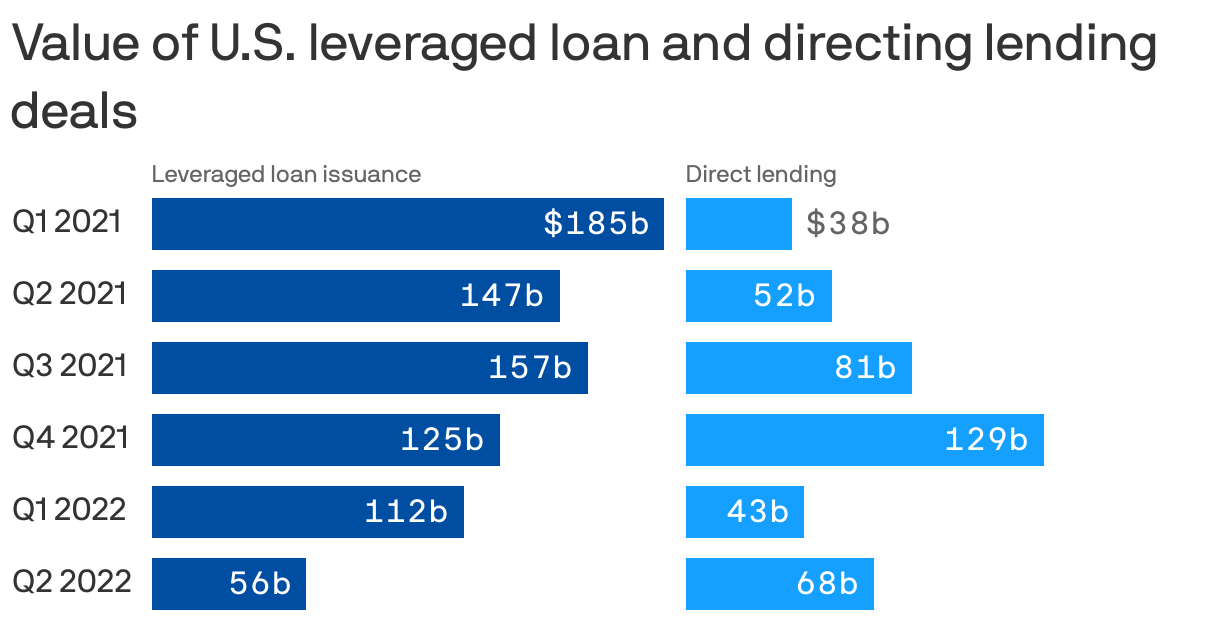
Direct lenders are increasingly muscling in on the loan-making that fuels M&A and private equity buyouts — an area long dominated by banks. In fact, PE buyouts, which have plunged this year compared to 2021, likely would have declined even more if not for the private debt market.
The big picture: When interest rates rose rapidly at the beginning of the year, some investment banks were caught holding commitments for buyout loans that were suddenly not priced at prevailing rates.
One year after the U.S. withdrew from Afghanistan, the country's economy has — as predicted — imploded, exacerbating an already-existing humanitarian crisis.
Why it matters: Afghanistan entered 2021 as a client state of the U.S., reliant on foreign aid for 75% of public spending. When Joe Biden made the decision to withdraw, that grant funding disappeared, and some $9 billion of Afghan central bank assets were frozen, rendering many normal central bank functions impossible.