Friday's economy & business stories

Companies finalize record $26 billion opioid settlement

Johnson & Johnson and three other drug companies on Friday announced settlements over their alleged involvement in stoking the nation’s opioid crisis, sending $26 billion in aid to state and local governments, Nathan writes.
Why it matters: Nearly 841,000 people have died from drug overdoses in the U.S. since 1999 — and in recent years, opioids have been involved in more than two-thirds of those deaths.
- Critics say that pharmaceutical companies like J&J used aggressive marketing to popularize pain-killing opioids, downplaying their addictive qualities.
Details: The latest settlements — the largest to date stemming from the opioid crisis, according to the AP — were made by Johnson & Johnson, AmerisourceBergen, Cardinal Health and McKesson. Most of the funding will be dedicated to combatting the crisis.
Of note: J&J, which will pay $5 billion over nine years, is taking a variety of steps to contain the liabilities it’s accumulated over alleged wrongdoing over the last few decades.
- The company on Friday also won approval to move forward with its plan to place a newly created subsidiary into bankruptcy court to resolve accusations that its talc-containing baby powder caused cancer.
- Consumer watchdogs had accused the company of abusing the legal system by placing its talc liabilities in bankruptcy court despite being financially healthy as a corporation.
Yes, but: J&J maintains that it’s done nothing wrong with opioids or talc.

Burnout risk threatens cyber defense readiness

Adam Meyers is still recovering from COVID and hasn’t slept much this week as he and his team at cybersecurity firm CrowdStrike work around the clock to monitor and defend private sector and government clients against potential new threats from Russia.
Why it matters: U.S. ability to detect, monitor and defend systems against direct attacks or fallout from cyberattacks may be compromised by potential burnout of cybersecurity workers.
The big picture: Cybersecurity experts have already had to deal with years of increased large-scale attacks while facing the same physical, mental and emotional challenges as the rest of the global workforce during the health crisis.
- Being in a prolonged period of high state alert where people are constantly trying to react and respond to incidents may lead to people being worn down and making mistakes, Meyers, SVP of intelligence, tells Axios.
- "If you're a bad guy and you target an organization and cause those defenders to constantly get worn down ... that's a long game strategy that may result in degrading their ability to respond."
What they're saying: "You're literally the only person that's ever expressed any concern about the people that are working on this," Meyers told Axios.
- "I have over 70 people that have been burning the candle on both ends for the better part of six weeks now because of this situation."
- For smaller organizations, the issue may become even more acute, says Luke McNamara, principal analyst with cybersecurity company Mandiant.
- "You may have [only] one individual ... so that's a tremendous load."
State of play: While it's hard for experts to say exactly how and what a direct cyberattack on a U.S. company or agency might look like, the consensus, largely, is that the threat level is low for the moment, but the situation is changing continuously.
- "What we're seeing so far is pretty tame," says Josephine Wolff, associate professor of cybersecurity policy at The Fletcher School at Tufts University.
- Spreading of disinformation and cyber espionage have been constant, and not just from Russia, McNamara says.
- "What we're always looking for is any sort of notable changes in the threat activity," he adds.
Threats to watch: The concern anytime you see espionage is how that activity might be further leveraged for something more destructive.
- Specifically, cybersecurity analysts are looking at where sanctions are going — think finance and energy — because that's where there may be signs of retaliatory targeting by Russian "threat actors," according to McNamara.
The bottom line: "There's no shortage of crises that are happening when it comes to cyberthreats," he says.
- Just this morning, Meyers reminded his team to "get some sleep, exercise, whatever — to be in fighting shape. And some of them refuse because there's a sense of mission."

Russia's Ukraine invasion and the fintech industry

Russia's invasion of Ukraine and the geopolitical shockwaves it's creating is hitting nearly all corners of the global economy, including the nascent but fast-growing field of fintech.
- "As almost all tech companies have some exposure to Ukraine / Russia…. every CEO is now a 'war-time' CEO," tweeted venture capitalist and fintech investor, Saar Gur.

The crypto industry's latest milestone: its own corporate VCs

Earlier this month, NFT marketplace OpenSea became the latest big crypto company to set up a venture arm.
Why it matters: Despite the recent boom in VC money now focused on backing cryptocurrency and web3 companies ($32 billion invested in 2021 alone), these corporate VCs still believe there’s something unique they can bring to the table.

Inflation stayed hot in January


Consumer prices continued rising rapidly as the year began, according to new government data that show no sign of U.S. inflation pressures abating.
Driving the news: The inflation measure preferred by the Federal Reserve, known as the personal consumption expenditures (PCE) price deflator, rose 0.6% in January, or 0.5% when volatile food and energy are excluded.

The Great Resignation generation: Gen Z wants to job hop

America's youngest generation entered the job market amid the Great Resignation — and that has changed the way they view working.
Why it matters: This cohort will make up a third of U.S. labor by 2030, shaping the future of work.
Jerome Powell's math problem
When the Federal Reserve chair speaks, the world listens, assuming his policy preferences will be enacted.
Yes, but: Through an unusual constellation of events, Jerome Powell faces extremely tight math in attaining a majority of the Fed's policy-setting committee for his preferred actions.
Ukraine could turn boomflation into stagflation

Russia's invasion of Ukraine creates a new wrench in the gears of the global economy that will simultaneously worsen inflation pressures and damage growth prospects. That makes it a stagflationary shock, essentially making things worse on all economic fronts at once.
Why it matters: So far in the pandemic recovery, major Western economies have had boomflation — strong growth with high inflation. What we may face now is the kind of inflation that could undermine the "boom" part and worsen the "flation" part.

Russia's government bond yields skyrocket after Ukraine invasion


Global investors fled Russian government bonds after Russia’s invasion of Ukraine Wednesday night — sending the yield on the dollar-denominated debt skyrocketing as high as 19%.
The big picture: Holders of the dollar bonds in the U.S. and Western Europe sold en masse in part because of the possibility that upcoming sanctions could restrict their ability to hold them. As bond prices go down, the yield goes up.
Amazon moves up in music streaming, but Spotify still rules
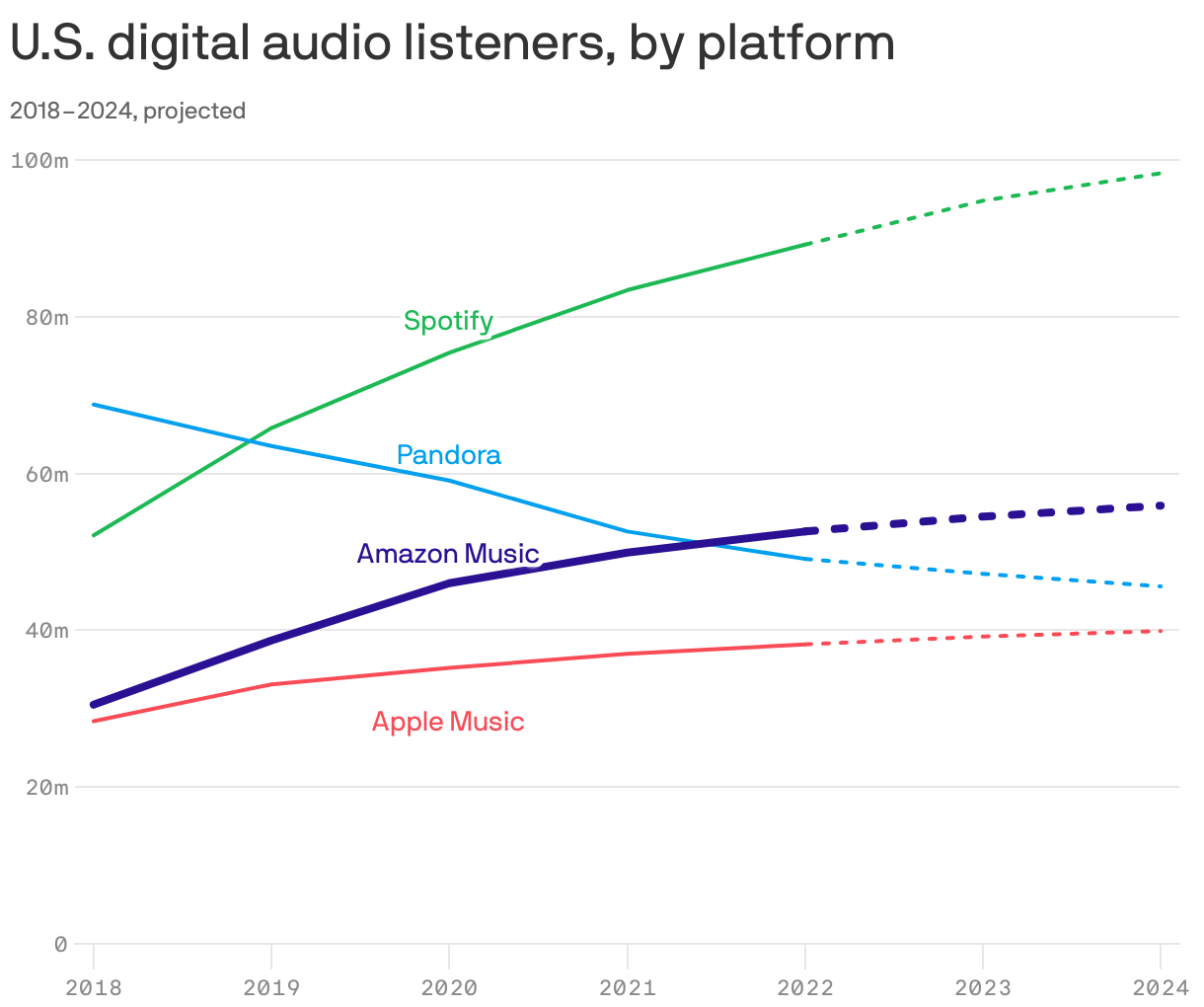
If you’re like us, you might need to take a break from doom-scrolling with a few good tunes — in which case you’re more likely to listen to Amazon than Pandora.
- Amazon Music is poised to surpass Pandora as the second most popular music app by total listeners, according to new data released by Insider Intelligence.
- Nearly 53 million people will listen to Amazon Music at least once a month in 2022, compared with 49 million to Pandora.
But, but, but: Spotify maintained its lead by a long shot.
Russian invasion sparks massive market volatility


Stocks swung from huge losses to gains on Thursday as Russia's invasion of Ukraine triggered enormous volatility.
- The S&P 500 was down more than 2.6% before reversing course and closing up 1.5%. The Dow was down 859 points in the morning but closed up 92. The Nasdaq was down nearly 3.5% before finishing up 3.3%.
The big picture: Traders seemingly snap-sold stocks in the early going, fearing economic turmoil from the war.
Yes, but: Stocks rallied on hopes that the financial effects will be contained to the region.

Unprecedented sanctions are cold comfort to Ukrainians

The sanctions against Russia announced today by President Biden are unprecedented. The move to cut off Russia's largest banks from Western financial systems, in particular, will inflict severe economic pain on Russia, possibly pushing it into a recession, experts tell Axios.
- "I was part of the team that designed sanctions in 2014, and this is far beyond what we contemplated," says Edward Fishman, former Russia and Europe sanctions lead in the Obama administration's State Department. "The Russian financial sector is by and large isolated now from the global financial system."
Market swing brings more questions than answers

There are more questions than answers today. And while what happened in the markets following Russia’s invasion of Ukraine is undoubtedly not the most important story, it reflects real concerns for many.
State of play: Call volumes are up at Charles Schwab, chief investment strategist Liz Ann Sonders says, but the questions haven’t been all that different from those posed during other times of uncertainty.
- Do I need to be doing something differently with my money? How long will this conflict impact markets? Will the Fed change its approach to raising interest rates this year? How much will gas prices go up?
The answer to all is an unsatisfying one: It depends.
- “There’s no blanket, singular answer that’s appropriate for every investor,” Sonders says, in terms of strategy.
- At the same time, panic should never be a strategy, whether it’s both buying or selling, she adds.
How long the conflict could impact markets is also not easily answered, and certainly not as simple as suggested by historical charts making the rounds today showing market performance after other major geopolitical events, Sonders says.
- While there’s nothing invalid about showing past performance, using that as a definitive conclusion ignores more dire warnings.
- “Those that are suggesting this is a nothing burger … what news are you watching?”
The big picture: Markets started to weaken a year ago, longer than a lot of people think.
- “We've been sort of in a stealth bear market,” she said. “It’s just that last year, most of the weakness was concentrated in [smaller stocks].”
- Geopolitical tensions have also been roiling markets already this year, exacerbating the churn from last year.
What to watch: The Fed will likely raise rates as expected in March but the likelihood that the bump will be 50 basis points may now be lower due to the Russia-Ukraine conflict.
- "The Fed's job is not to step in every time there's financial market volatility, unless it threatens financial system stability," she said.
- As for gas prices, expect more volatility with one silver lining — the weather is warming.
Hope’s thought bubble: The world is just barely emerging from the depths of the pandemic and is now faced with another potential existential crisis. Human resiliency will once again be tested.
The bottom line: “It's not what we know that matters in terms of being successful over the long term. And as an investor, it's what we do along the way,” says Sonders.
War further pressures food and energy prices

Russia’s invasion of Ukraine threatens to sustain or even exacerbate inflation in the U.S. as food and energy prices face further upward pressure.
The big picture: Experts were hoping that inflation had peaked at a 40-year high of 7.5% in January and was poised to fall as the pandemic eases and spending normalizes.
Threat level: Energy prices, which were up 27% year-over-year in January, rose Thursday on fears that the war will disrupt the flow of gas and oil from Russia.
- U.S. oil prices on Thursday topped $100 per barrel for the first time in about eight years.
- A spike in spot prices of gasoline suggested that a $3.75-per-gallon national average retail price may be around the corner, according to GasBuddy petroleum analyst Patrick De Haan.
Yes, but: OPEC could take action to bolster oil supplies, especially if Saudi Arabia sees an opportunity to act.
- “It could be a very good PR exercise,” said Capital Economics chief commodities economist Caroline Bain. “It would improve relations with the U.S., and it would also convey that image that it’s the reasonable OPEC producer that likes to see the market in a comfortable balance, not prices sky high.”
The U.S. is also working with other countries to pursue the release of oil from the strategic reserves of major energy consuming countries, President Biden said today.
- "We're taking active steps to bring down the cost, and American oil and gas companies should not exploit this moment to hike their prices to raise profits," he said.
Keep in mind: Energy prices also affect food prices, as the cost of fuel affects transportation.
- Food prices face additional inflation risk as the war threatens supplies of wheat in the region once known as the “breadbasket of Europe.”
- Grain prices are poised to rise 20% to 30%, according to Bain.
What we’re watching: Whether sanctions or Putin’s actions disrupt the flow of energy and food — and whether the war causes any physical damage to fuel infrastructure or crops.


Discovery readies WarnerMedia merger amid uncertainty over CNN
As Discovery prepares to close its merger with WarnerMedia in April, its ultimate plans for CNN remain unclear.
Why it matters: It's a big area of the business to be left hazy. Even as he was praising CNN's coverage of Russia's invasion of Ukraine, Discovery CEO David Zaslav said the strategy for a CNN under Warner Bros. Discovery has yet to be formed.
- "We will in the next, in the near term, sit down and have a real business plan discussion with the people at CNN and CNN+. We haven't had that yet, we haven't seen it," Zaslav said Thursday morning during the company's quarterly earnings call with analysts.
Details: CNN is preparing to launch its own streaming service, CNN+, in the spring. But there is skepticism as to whether or not people would pay for a standalone CNN service.
- When Warner Bros. Discovery is formed, it will already include Discovery+ and HBO Max.
- One source offers that it might make sense for CNN+ to be part of some broader offering that includes HBO Max and Discovery+.
- CNN+ will have 8-12 live daily and weekly original series along with "more than a thousand hours of on-demand content" according to CNN press release on Wednesday.
- Other new streamers like HBO Max launched with 10 times that amount.
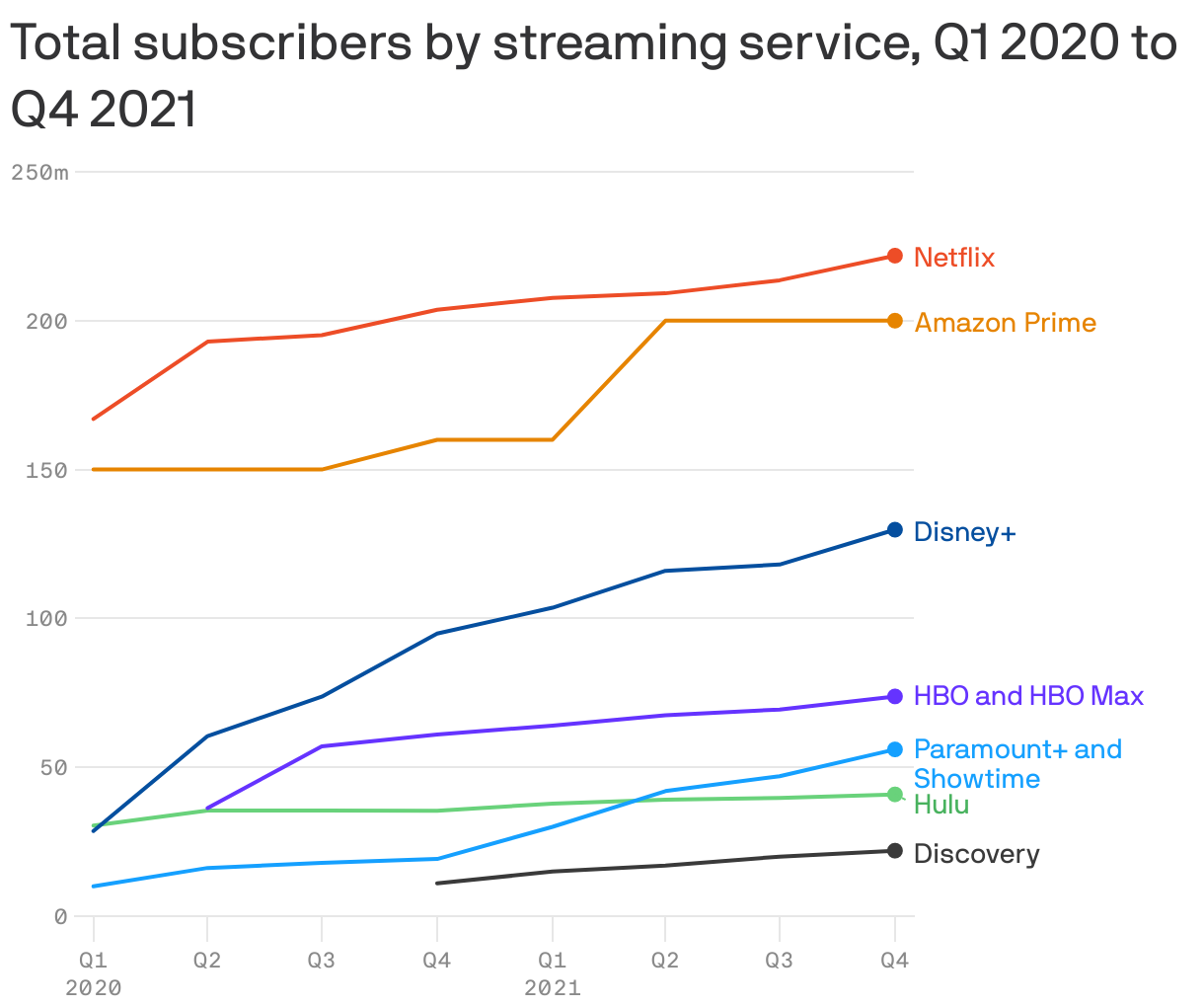
By the numbers: Discovery now has 22 million streaming subscribers, the bulk of that going towards Discovery+.
- That is still far behind other more established streaming services. HBO Max has more than 73 million subscribers.
- Netflix and Disney+ have more than 100 million each, with Netflix topping 200 million.
The big picture: Streaming is expensive and even those who show growth can get punished by a Wall Street crowd that is growing increasingly wary of streaming's long-term viability.
- Paramount Global's stock tanked the day after Paramount+ announced its best quarter of growth since its launch. Investors were doubly concerned with Paramount's plan to invest even more capital into streaming.
- Discovery execs cautioned they'll be more measured about their content spending.
- "It’s not about winning the spending war," said Discovery CFO Gunner Wiedenfels on the earnings call.
What's next: The merger is expected to close in mid-April, a source familiar with the deal tells Axios.
- There are still a few more boxes to check, starting with the Discovery shareholder vote on March 11. The deal has already received regulatory approval in the U.S. and European Union.
- The first step after the deal closes will be putting together a leadership team under Zaslav, which will likely include new heads of news, sports and entertainment. Current WarnerMedia CEO Jason Kilar is expected to depart after the merger closes.
- As Axios has previously reported, it’s likely Zaslav will keep his Discovery leadership team intact for many of the non-creative functions. Don't expect to see a larger leadership team announcement before April.
Markets react to Russia's invasion of Ukraine

Last night, Russian President Vladimir Putin announced a "special military operation" in Ukraine during a speech. Since then, attacks have killed dozens of Ukrainian soldiers and a few civilians.
Why it matters: Putin effectively declared war on Ukraine, despite specifying that he wants to "demilitarize" the country without occupying it.

Scoop: Sweater Ventures raises $12M to democratize VC

What if everyone could invest in venture capital? That's the question a new retail VC firm called Sweater Ventures seeks to answer, the firm tells Axios Pro.
Why it matters: If successful, Sweater could open up to everyday investors an asset class that has mostly been limited to endowments, pension funds, family offices, and high net worth individuals.

Putin's Ukraine invasion upends global markets


Stock, commodity and energy markets whipsawed on news of Russia's invasion of Ukraine.
Why it matters: The violent reaction of financial markets suggests investors think Russia's aggression could further unsettle a world economy struggling to recover from the pandemic.

Leonardo DiCaprio deepens ties to gravity storage startup
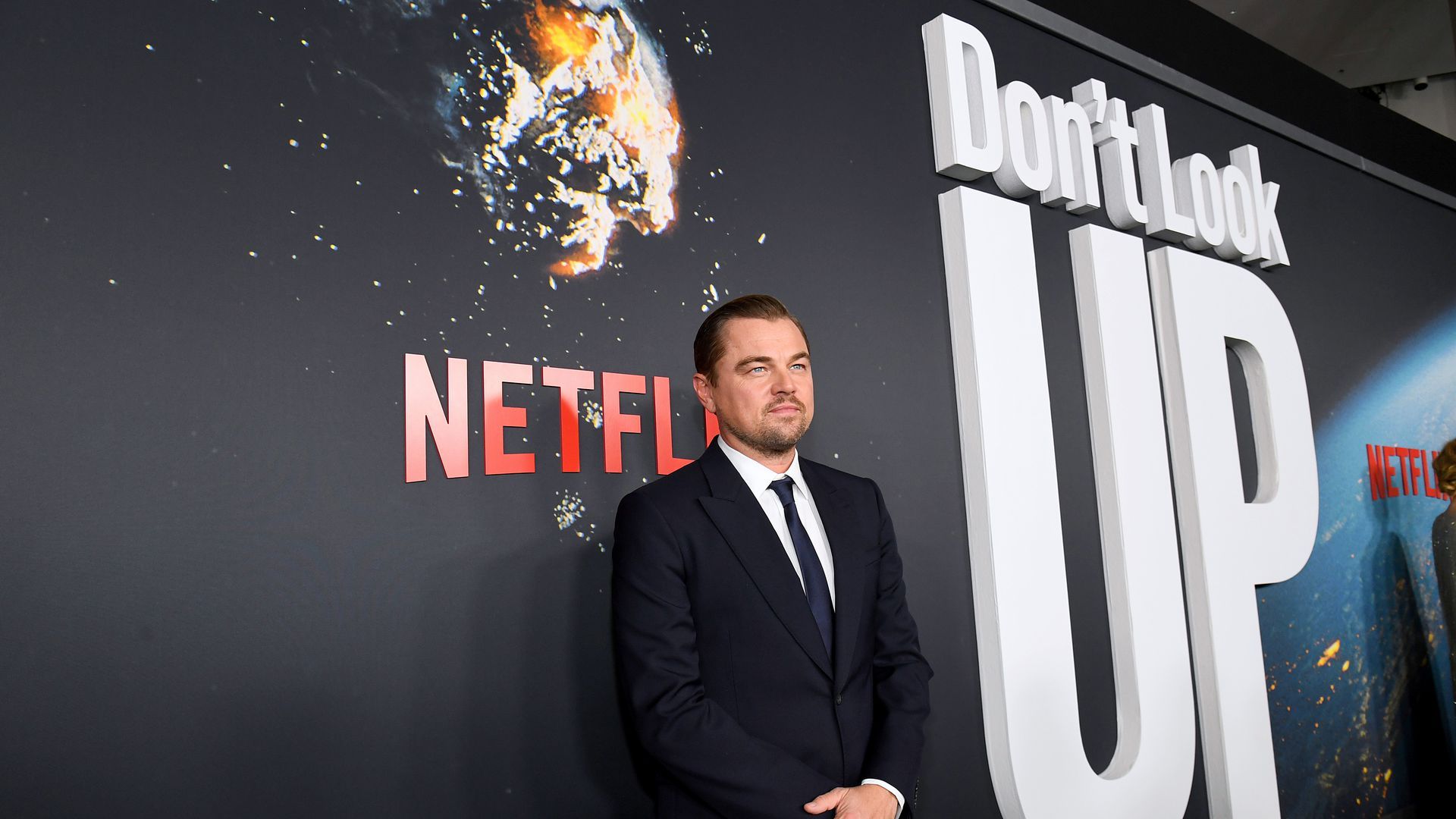
Actor and climate activist Leonardo DiCaprio has joined the newly formed strategic advisory board of Energy Vault, one of a few startups looking to commercialize gravity-based storage tech using solid materials.
Driving the news: The move by DiCaprio, who is also an investor in the company, is part of Energy Vault's wider announcement this morning of new advisers and board members.
Getting to the bottom of the remote-work pajama debate

Remote work means never having to wear hard pants, but does it also mean you show up to the home office every day wearing ... pajamas?
Driving the news: New York City Mayor Eric Adams is urging folks back to the office to help the city's economy. "You can't stay at home in your pajamas all day," he said on Wednesday.

Scoop: Virtual mental health company Paraclete gets $1.5 million in pre-seed funding

Paraclete, maker of an employer-facing virtual mental wellness offering, raised $1.5 million in pre-seed funding from Sovereign's Capital and several individual investors, the company's founder, Vineet Rajan, tells Axios exclusively.
Why it matters: Behavioral health is a sizzling sub-sector of the digital health market, and Paraclete targets people with mental health needs other than depression, ADHD or anxiety, the conditions most commonly addressed.

Big money for small(ish) solar

Aspen Power Partners is launching with $120 million in funding to support its focus on smaller scale solar developments, the company tells Axios.
Why it matters: The announcement is the latest sign of surging investor interest in distributed and community solar, especially community.
Insight Partners seals $20 billion fund
Insight Partners raised $20 billion for its largest flagship fund yet, the tech-focused venture capital and private equity investor announced on Thursday.
Why it matters: The new fund from Insight, one of the most active venture investors last year, adds to the flood of capital pouring into private companies but comes at a time when public market investors are souring on growth stocks.
Ruble plunges to record low after Russia invades Ukraine


Russia's invasion of Ukraine and the corresponding sanctions have triggered a sell-off in the ruble.
Driving the news: The currency has dropped to a record low against the dollar, falling roughly 6% over the last two days.
"Unretirements" are picking up, and that's good for the economy
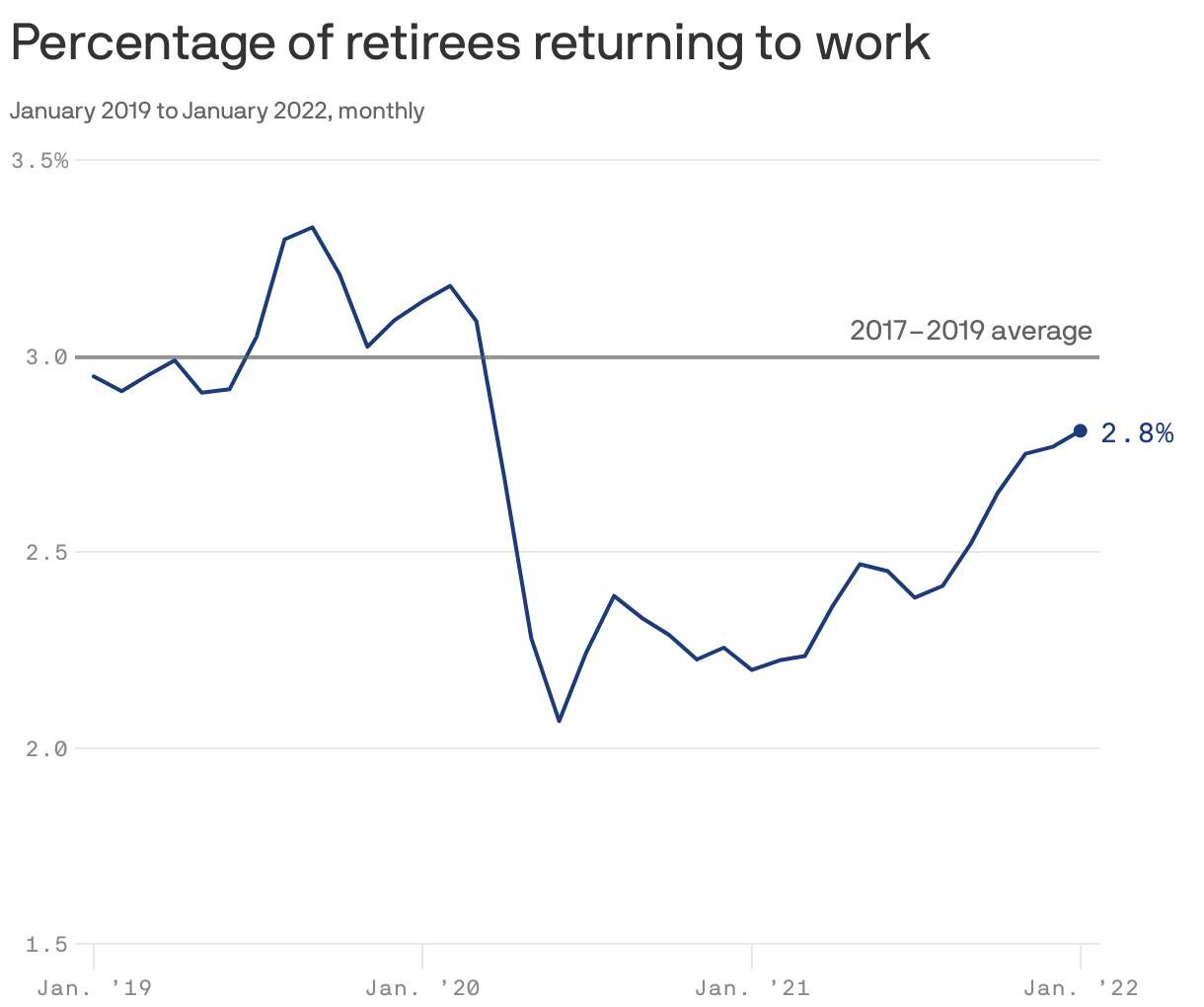
"Unretirements" are coming back: The share of retirees returning to work is approaching levels not seen since before the pandemic.
Why it matters: The pandemic drove millions of Americans into early retirement. Getting some of those folks back to work should increase the labor supply at a time when companies are still struggling to hire.
Scoop: Former Googler raises $22M for heart care
Tom Stanis is at it again. After spending nearly a decade building the virtual care offering at Alphabet life science spinout Verily, Stanis has raised $22.6 million in Series A funding for a new health venture called Story Health, he tells Axios exclusively.
Driving the news: Saratoga, Calif.-based Story Health is a virtual care startup focused on heart conditions. Northpond Ventures and B Capital Group co-led the round.
Wanted: Inflation scapegoat
Prices are going up and everyone wants someone to blame. For conservatives and Republicans that's easy: They can blame the president and his stimulus spending. On the other side, some progressive groups and Democratic lawmakers are arguing that corporate greed is making inflation worse — and pushing the White House to talk about this more.
Why it matters: It's natural to want a clear story to tell about inflation, with an obvious villain. But prices are rising for all kinds of reasons — yes, fiscal stimulus but also busted supply chains, increased demand, changing consumer preferences. It's not a simple story.

Biden's $5 billion master plan for EV charging
The Biden administration's $5 billion electric vehicle charging plan — while far short of what's needed — is a psychological play meant to ease Americans' anxiety about driving an EV, experts say.
Why it matters: EV owners drive less than 40 miles a day, on average, and most charge their vehicles at home or at work. But by strategically placing fast-chargers along desolate stretches of interstate highways, the government aims to reassure consumers they'll never be stranded.

The trickle-down of medical glove price hikes
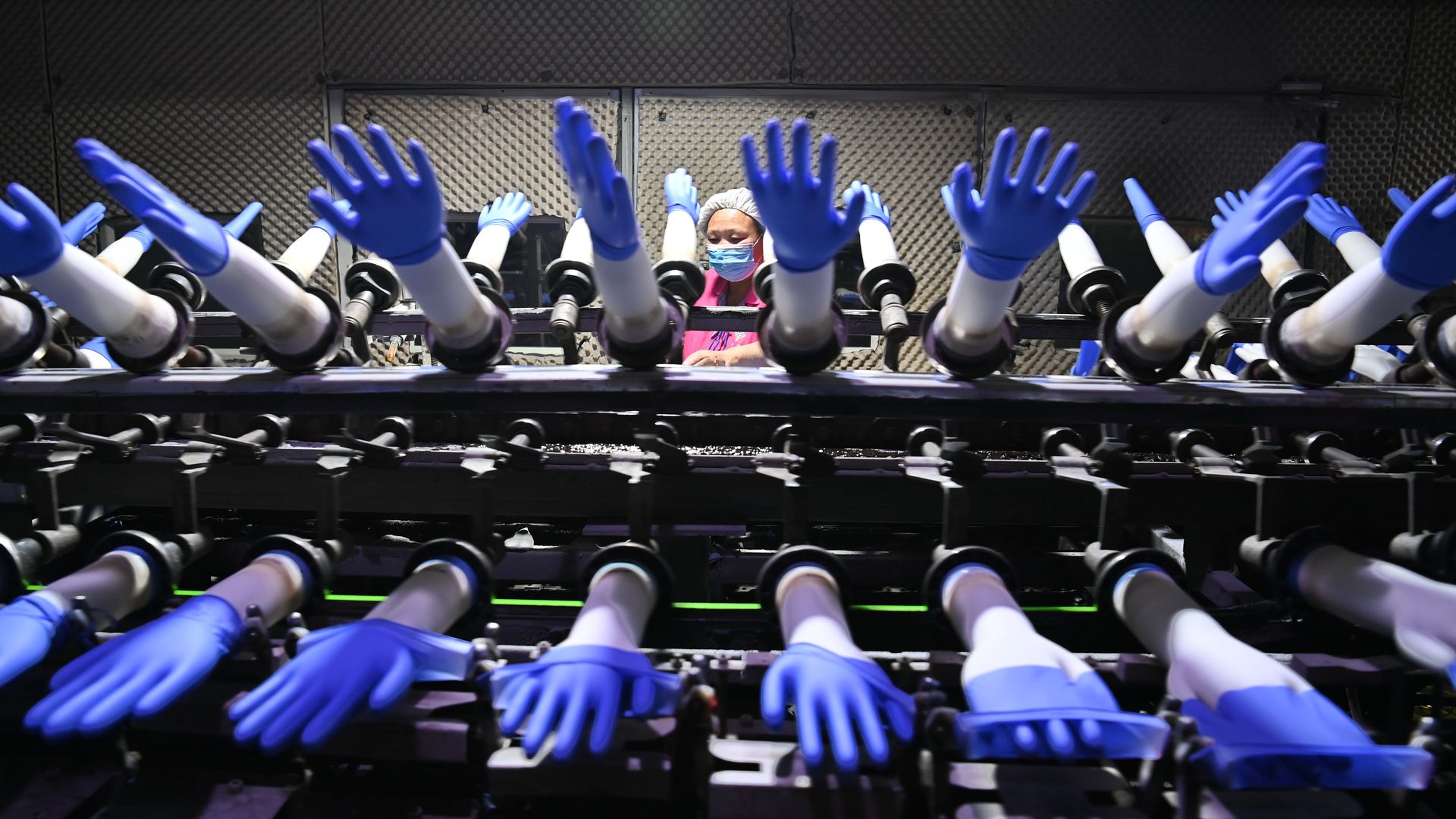
A critical shortage of medical gloves during the pandemic last year led to large price hikes from the makers of those gloves — costs that everyone ultimately will absorb.
Driving the news: Medical equipment supplier Owens & Minor reported $660 million of extra revenue in 2021, and expects an additional $235 million this year, based solely on passing along higher costs of purchasing gloves.
Amazon opens first Whole Foods with cashierless technology

The first Whole Foods equipped with cashierless technology from Amazon opened today, allowing customers to avoid the register altogether.
Why it matters: The 21,500-sq.-ft. store demonstrates how much autonomous shopping has improved.