In a new working paper, Stanford economist Charles Jones sets out to answer a simple question: Why over the past 150 years has GDP per person in the U.S. increased exponentially at a relatively stable rate of around 2% per year?
The big picture: Growth comes from ideas and ideas come from people — and new population projections suggest the U.S. will have fewer of those in the future.
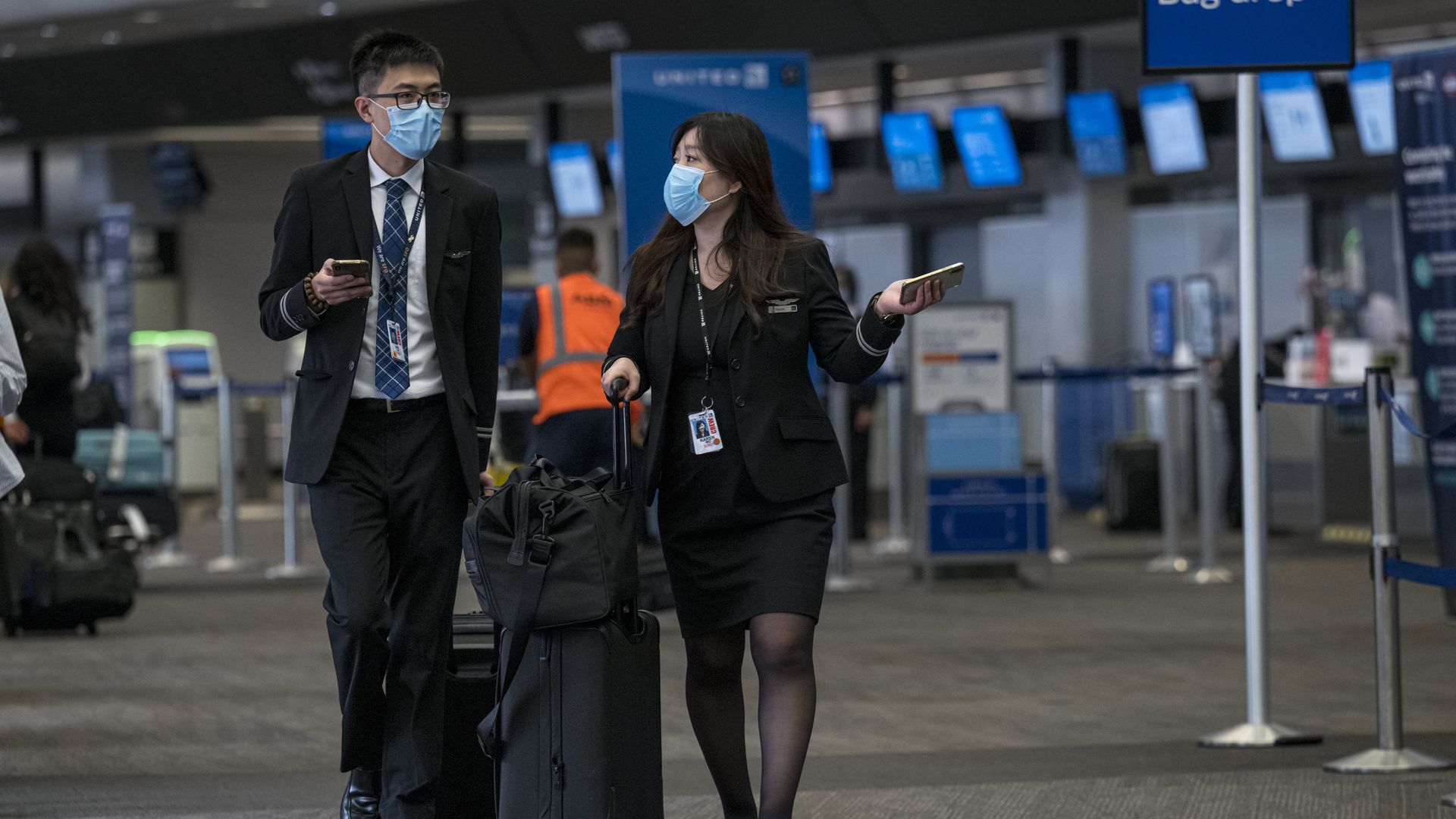
United Airlines is relaxing its rules on flight attendants' appearance in an attempt to be more inclusive.
State of play: Starting Sept. 15, United's customer-facing crew members will be allowed to have visible tattoos and workers of any gender can wear "natural-looking makeup" and nail polish. They will also be permitted to wear their hair down.
The Delta variant put a massive dent in one measure of consumer sentiment.
Driving the news: A key index saw the seventh-worst decline on record, going back over half a century. (It doesn’t top the drop at the onset of the pandemic, or the fall during the 2008 financial crisis.)
Boeing's Starliner spacecraft will be returned to a factory to fix four stuck propulsion system valves that forced the company to scrub an uncrewed test launch of the capsule last week, the company announced Friday.
Why it matters: The Starliner — designed to one day carry NASA astronauts to the International Space Station — has been repeatedly troubled by technical malfunctions, and its latest mission has been delayed multiple times.
Texas Gov. Greg Abbott (R) is pushing his conservative agenda in hopes of riling up the state's Republican base ahead of the 2022 gubernatorial election, but major corporations are not having it.
New video game sales rankings released in the U.S. and Japan show demand for Switch games is strong, even by Nintendo's standard measures of success.
Why it matters: With the next-gen Xbox and PlayStation still low in supply — and marquee new releases for Switch competitors delayed due to COVID — we're seeing the strength of Nintendo's steady, stubborn approach to the gaming business.
Carta, a San Francisco-based cap table management software company, raised $500 million in Series G funding at a $7.4 billion valuation led by Silver Lake.
Why it matters: Carta says it used its own private stock exchange a few months ago to figure out its new valuation, then picked investors it felt would be the best fit.
Private equity is pouring billions into renewable energy assets — it’s what LPs want, it’s what society demands and it’s what the world needs. But the classic private equity dilemma has surfaced: too much money chasing too few deals.
Why it matters: With heated competition for deals, prices for prime wind and solar power assets are getting bid up — and return expectations, in many cases, are coming down.
The amount of stuff shipped across the U.S. fell in July. But it wasn’t because of lack of demand.
Why it matters: Constraints along these domestic supply chains continue to hold back economic activity. And worse, they’re causing the prices of the limited goods to inflate.
Companies are experiencing different degrees of impact from the recent COVID spike.
Why it matters: While many businesses have adapted to new realities and many people have become fully vaccinated, Delta's spread is proving somewhat disruptive.
Producer prices jumped by more than expected. Some economists think it could be the peak rate of increase. But the spread of the Delta variant poses a big uncertainty.
Why it matters: Producer prices reflect what businesses pay for the materials that go into the stuff they eventually sell to their customers. Higher producer prices put more pressure on businesses to pass those costs on through consumer price hikes.
Corporate America's patchwork approach to vaccine requirements is deepening the pandemic's class divides.
Why it matters: New cases of coronavirus, driven by the Delta variant, are up 86% in the U.S. over the past two weeks. The rise in new infections has upended return to work plans for certain sectors of the economy, while others can't afford to change course.
The Delta variant has killed any hope that international travel will return to anything like its pre-pandemic trajectory.
Why it matters: In the decade to 2019, the number of international arrivals rose by 42%, to 2.3 billion, in a trend that seemed steady and unstoppable. Now, however, international borders seem set to be most countries' first line of defense against the coronavirus for the foreseeable future.
Bill Gates has pledged $1.5 billion to climate collaborations with the Department of Energy (DOE) through his climate investment fund Breakthrough Energy Catalyst, the Wall Street Journal reports.
The backdrop: Global warming is happening so fast that scientists now say we'll cross a crucial temperature threshold as early as 2030, up to a decade sooner than previously thought. The projects would depend on passage of President Biden's $1.2 trillion bipartisan infrastructure bill, which currently awaits a House vote.