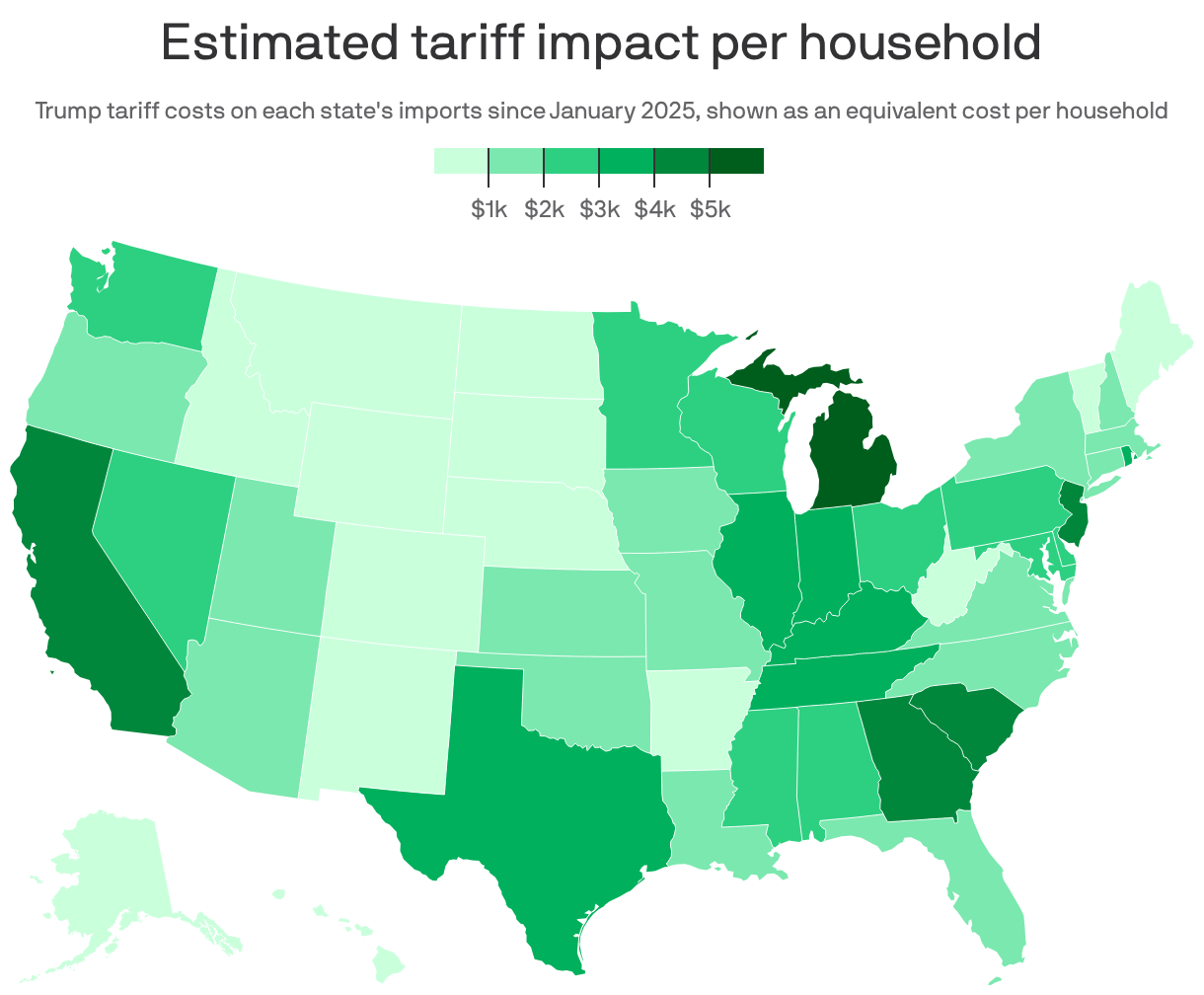
Data: Trade Partnership Worldwide, via National Taxpayers Union Foundation. Note: Includes tariffs mandated by executive order only. Totals through June 2026. Map: Brad Jennings/Axios
States bear wildly different estimated tariff burdens from President Trump's trade actions since the start of 2025, from California's $62.8 billion share to Wyoming's $107 million.
Why it matters: Local industries dictate how and how hard communities have been hit, from Michigan's auto industry to Virginia's aerospace sector.
The Trump administration is in talks with Venezuela's interim government about taking an ownership stake in the South American country's enormous oil resources, two U.S. officials tell Axios.
Why it matters: The historic deal would more than double U.S. oil reserves by drawing from a country that has the world's largest proven reserves.
Meta removed a network of Facebook and Instagram accounts tied to an Iran-based operation that used AI to target U.S. audiences with posts about American politics, the company first shared with Axios.
Why it matters: The operation attracted thousands of followers and included accounts posing as everyday Americans to appear more authentic.
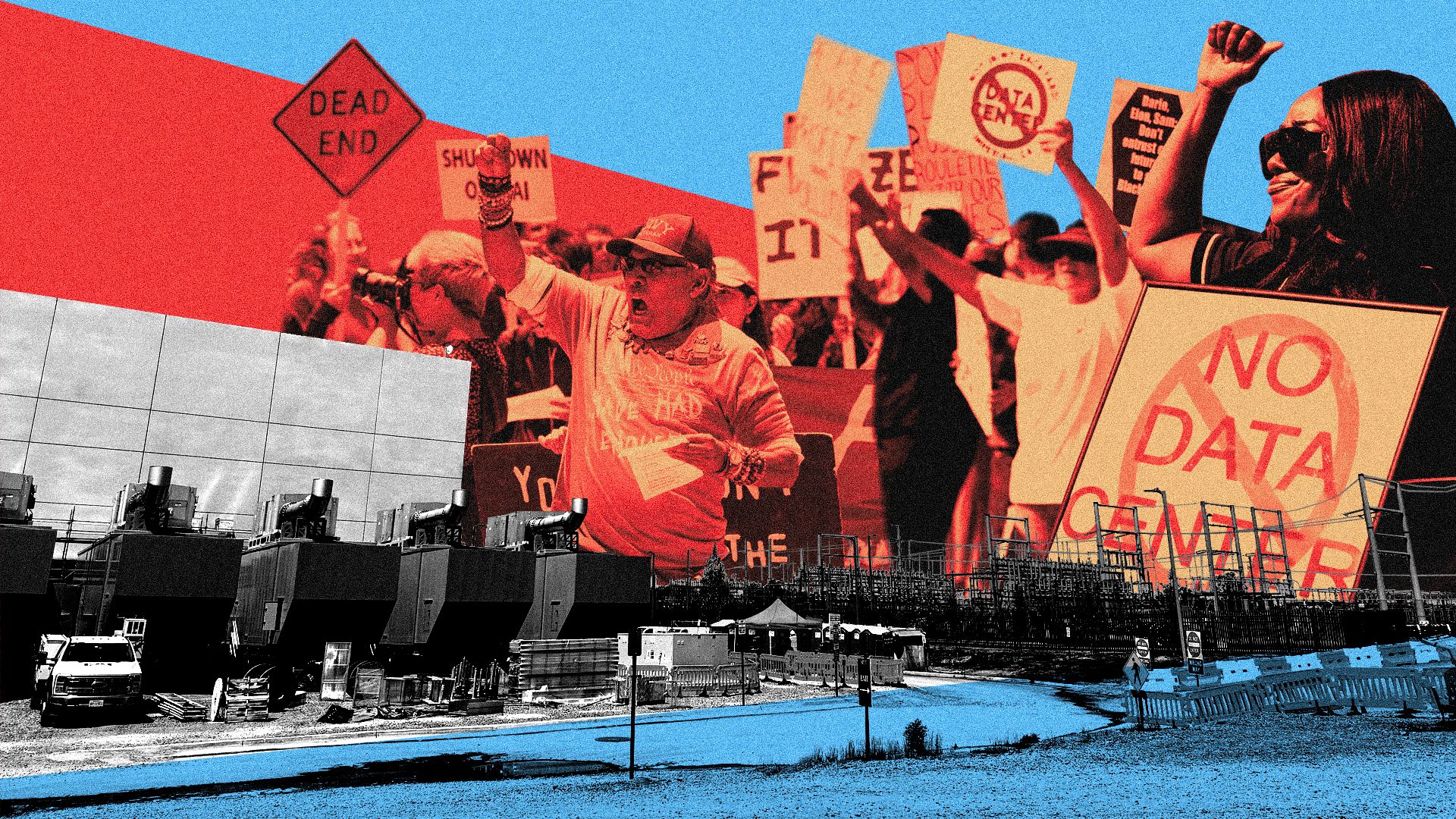
We're in the midst of a roiling online debate about whether the data center backlash is just a comms problem or something more fundamental.
"[H]ey guys we gotta figure out a new narrative on this data center thing...." Alexis Ohanian, Reddit co-founder and entrepreneur, posted on X last Friday.
Why it matters: Opposition to data centers crosses political, geographic and cultural lines as they become a stand-in for much larger anxieties over AI, jobs and economic inequality.
The data center debate is giving some communicators flashbacks to the fracking boom, which became a national political fight even as local battles frequently scrambled familiar left-right lines.
Why it matters: As it is with data centers, the comms challenge was never persuading communities to cheer for more industrial sites, but instead find ways to address local concerns while making the economic case for development.
By the numbers: Fracking never became broadly popular nationally, though opposition softened over time.
In 2025, 45% of Americans favored expanding fracking while 51% opposed it, according to a Pew Research Center survey of 5,085 adults conducted April 28-May 4.
In 2020, opposition stood at 60%, while just 37% were in favor, according to a Pew survey of 10,957 adults conducted April 29-May 5.
Case in point: Economic arguments can still help the industry win individual fights.
In Colorado in 2018, the oil and gas industry spent tens of millions of dollars fighting Proposition 112, which would have "dramatically increased" setbacks for new projects, reported the Denver Post.
The industry emphasized the economic fallout that would come from restricting development, and voters rejected the measure 57% to 43%.
Yes, but: Winning one ballot-box battle didn't put the issue to rest.
Months later, Colorado enacted a sweeping oil and gas regulation bill that prioritized health and safety and gave local governments greater authority over drilling, but also included industry-backed provisions to prevent "overly restrictive setbacks, delays or de facto bans."
The other side: Denton, Texas, demonstrated the limits of trying to outspend local resistance or dismiss it as foreign-influenced, reported the Texas Tribune.
In 2014, the industry-backed campaign opposing a fracking ban raised more than $700,000, more than 10 times what Frack Free Denton collected, spending on mailers, television ads and a PR and polling firm. All of this in a town with a population of 123,000 at the time.
Two state oil and gas regulators and an industry-funded group also suggested, without evidence, that local activists were working with Russia to protect its natural gas interests.
Nearly 59% of voters approved the ban anyway, including voters in precincts that also backed Republican Greg Abbott for governor.
What they're saying: "If you don't tell your story, someone else will tell it for you. And you won't like their story," said DUX Group CEO Amos Snead, who has worked energy and infrastructure fights for more than 20 years.
"The data center and energy growth stories can avoid that outcome by showing up early in these communities, in person, with a story they own and defend proactively."
The bottom line: When the fight reaches your backyard, the terms of the project, the credibility of the company and residents' feelings about being heard can matter more than the industry's best talking points.
Eun Chong "David" Kim knows precision matters, working at the intersection of military operations, the media and the U.S. alliance with South Korea.
As senior press officer for United Nations Command, Combined Forces Command and U.S. Forces Korea, Kim prepares leaders, coordinates across organizations and helps shape messages around events that can carry very different meanings across cultures.
Why it matters: Communicators don't just exist in boardrooms and agencies— careful judgment, nuance and close relationships are prized in diplomatic and military affairs.
The East Coast used to have its own version of Sand Hill Road, but it's about to be rezoned out of existence.
Catch up quick: The area was nicknamed Mount Money, a collection of office parks perched above a reservoir in Waltham, Massachusetts. Just off of Route 128.
Private equity giant KKR has agreed to a $250 million settlement with the U.S. Justice Department, over its alleged failure to file proper pre-merger notifications on over a dozen deals in 2021 and 2022.
Why it matters: This is the largest civil penalty ever for HSR Act violations.
After burning through its IT budget in the first quarter of the year, Uber has now stabilized its AI bills even as usage surges, the company tells Axios.
Why it matters: It's the latest example of enterprises finding creative ways to increase AI use without their bills ballooning.
To paraphrase Justin Timberlake in his iconic turn in the 2010 film "The Social Network," a trillion dollars isn't cool. You know what is? $3 trillion.
The big picture: That's roughly how much money seven Big Tech companies, including Google, Microsoft and Nvidia, have committed to spending on AI-related infrastructure in off-balance-sheet commitments, according to a new analysis from Morgan Stanley.
And that's on top of the estimated $770 billion in debt and lease obligations that are on the balance sheets.
AI behemoth Nvidia reported blowout earnings Wednesday — exceeding Wall Street's expectations — and even jaded investors who had grown a bit immune to the company's stratospheric growth over the past year seemed to like it.
Why it matters: The chipmaker's earnings are viewed as a barometer of the overall health of the AI trade.
Meta's landmark social media settlement marks the latest milestone in a decade-long unwinding of Big Tech's once-unfettered freedom to operate.
Why it matters: The AI industry is watching closely. Its historic expansion, already fraught with job risks and public anxiety, depends on building thousands of power-hungry data centers in communities where opposition is rising fast.
Meta's historic settlement with 51 U.S. state and territory attorneys general represents one of the largest government penalties ever levied on a Big Tech firm anywhere.
Why it matters: For the first time, U.S. officials — at least at the state level —have proven they are as serious about policing Big Tech as their European counterparts.