The collision of U.S.-China rivalry with a global pandemic seems to vindicate the argument that globalization has peaked — supply chains will shrink, multilateralism will fade, and human connections across oceans and borders will fray.
The big picture: This narrative holds that globalization took root after World War II, accelerated after the fall of the Soviet Union, and is now under threat as nationalism rises in the West and China rises in the East. But that’s just a sliver of the story.
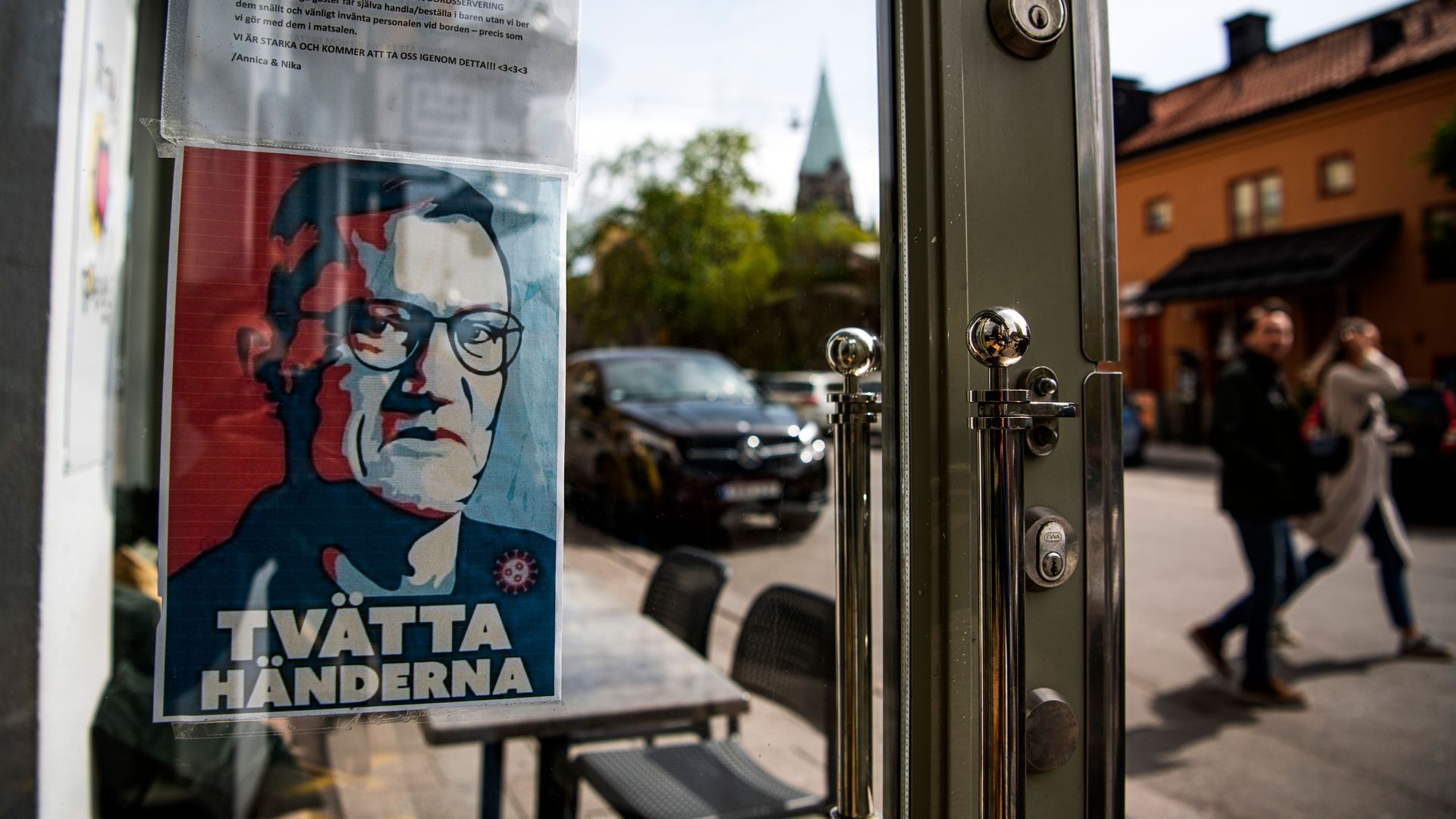
Sweden, which did not go into lockdown, has suffered 15 times as many deaths as has Norway, which did.
The other side: The scientist behind Sweden’s approach, Anders Tegnell, says Sweden also appears to have far more immunity in its population (25% vs. 1–2% in Norway, according to initial tests), and will therefore be well positioned for a potential second wave.
A poll of five countries — the U.S., U.K., Germany, Sweden and Japan — finds that concerns around getting sick or losing jobs are fading slightly, but realization is setting in that lives will be different even after the crisis abates.
Data: Kekst CNC; Note: Exact question wording was "Assume that a vaccine against coronavirus is eventually developed and rolled out universally. After the coronavirus crisis is over, how do you expect your own lifestyle to be different to your lifestyle before the outbreak?" Table: Axios Visuals
What to watch: More than one-in-five people in all five countries say that even after a vaccine is available, they will be less likely to travel by plane, use public transport and eat out at restaurants, according to polling from Kekst CNC, an international strategic communications firm, shared exclusively with Axios.

Belarus is now grappling with one of Europe's highest per capita coronavirus infection rates, even as President Alexander Lukashenko plays down the danger.
The big picture: Belarus, a country of about 9.5 million people where most live in urban centers, has been run by Lukashenko since 1994. He says a lockdown would be ineffective, unjustified and bad for business and society.
Israeli Prime Minister Benjamin Netanyahu announced today that he is going to appoint Gilad Erdan, currently minister of internal security, as Israel’s new ambassador to the UN.
Why it matters: Erdan is also expected to replace Ron Dermer as ambassador to Washington following the 2020 U.S. election, and will serve in both posts at the same time. That dual role is almost unprecedented.
The U.K. government released Monday a 60-page plan to reopen its economy by easing the coronavirus lockdown restrictions that it has maintained since March.
The state of play: The plan advises all people to wear face coverings in enclosed spaces and to avoid public transportation — but says that "all workers who cannot work from home should travel to work if their workplace is open."

Visitors in face masks streamed into Shanghai Disneyland as the park reopened today in a high-profile step toward reviving tourism, AP reports.
Why it matters: The House of Mouse's experience in Shanghai, the first of its parks to reopen, foreshadows hurdles global leisure industries might face. Disney is limiting visitor numbers, requiring masks and checking for the virus' telltale fever.
South Korea — a model for how to handle the coronavirus well — has had to re-tighten some of its commercial restrictions as on Sunday it reported the biggest-single day increase in cases it has seen in over a month with34 new cases.
Why it matters: The U.S., by contrast, is seeing roughly 25,000 new cases per day — a discrepancy that far outstrips the differences in population between the two countries.
U.K. Prime Minister Boris Johnson announced in a televised message Sunday that he is extending the country's lockdown measures, but unveiled a three-stage plan to reopen schools, some businesses and the hospitality industry in June and July.
Why it matters: The U.K. has the second-highest confirmed coronavirus death toll in the world and the highest in Europe. The country has reported more than 220,000 recorded cases and 31,000 deaths from the virus as of Sunday, according to Johns Hopkins University data.
The coronavirus pandemic could cause remittance payments around the world to drop by 20%, the sharpest decline in history — threatening the livelihoods of the families who rely on them, the World Bank projects.
Why it matters: Families across the globe are depending on remittances more than ever as the coronavirus crisis batters local economies. Without them, millions will struggle to pay for basic needs, such as housing, health care and education.
South Korea's President Moon Jae-in said the country should "brace for the pandemic's second wave," the BBC reports, as officials confirmed 34 new novel coronavirus cases on Sunday — the highest daily number in a month.
Why it matters: South Korea had the second-highest number of COVID-19 cases after China in early March. But diligent tracing, testing and strict lockdowns allowed the country to control the outbreak. The new cases could serve as a warning to nations grappling with how to reopen their own communities.
From Austria to Australia, countries have begun to relax lockdown restrictions introduced to combat the spread of the novel coronavirus.
The big picture: The number of COVID-19 cases continues to climb, but several countries are beating back outbreaks. The virus has killed almost 280,000 people and infected more than 4 million globally, per Johns Hopkins. With the IMF predicting the pandemic will cause global GDP to contract by 3% this year, governments are beginning to reopen economies with strict health measures in place.