Developers working on games for Google’s Stadia service, heard the streaming platform was shutting down when the news broke yesterday, according to public accounts and sources speaking to Axios.
Why it matters: Google’s abrupt move has sent developers scrambling, and raised numerous questions about the fate of Stadia’s games and the money spent to make them.
Government officials are warning defense companies and other organizations handling sensitive information about a potential new espionage campaign uncovered by cybersecurity firm Mandiant on Thursday.
Driving the news: A sophisticated, unknown hacking group has created a new malware that allows it to install backdoors in and out of a system on VMware’s virtualization software, according to a two-part Mandiant report.
Boston-based cybersecurity firm Recorded Future is planning to hire up to 100 employees in Ukraine before 2025, more than doubling its presence in the country.
Why it matters: Ukraine's success fighting off Russian cyber aggression during the war so far is due, in part, to the existing IT talent in the country, as well as Ukraine's partnerships with Western allies.
The U.S.'s once sleepy cyber diplomacy efforts are getting a jumpstart as a new State Department office gets its leadership.
Driving the news: The country's first cyber ambassador, Nathaniel Fick, started on the job last week after the Senate approved his nomination on Sept. 15.
The crypto C-suite and senior leadership have seen a rash of departures recently, with some stepping down amid scandal and others merely moving on.
The big picture: CEO turnover in the U.S. jumped 8% in August from the previous month, led by departures in the technology and fintech sectors, according to recent research from Challenger Gray & Christmas. Peak turnover tends to hit during economic highs and lows, senior vice president Andrew Challenger tells Axios.
Iranian citizens are flocking to tools designed to help citizens of blacked-out nations connect to the internet as their government tries to squelch protests.
Driving the news: "Daily demand for virtual private network (VPN) services in Iran is up over 3,000% compared to before the protests," Simon Migliano, head of research at Top10VPN.com, told Axios via email.
Apple VP Tony Blevins is leaving the company amid internal uproar over a TikTok video in which the procurement executive made an off-color remark about women.
Why it matters: Blevins, one of Apple's top supply chain executives, has been a famously tough negotiator at the tech company.
The House of Representatives Thursday approved a bill that will raise filing fees on large mergers and acquisitions.
Why it matters: Supporters of stricter antitrust regulation in tech cheered because revenue from these fees will help support enforcement efforts at the Federal Trade Commission and the Department of Justice.
Meta CEO Mark Zuckerberg told staffers Thursday that he is freezing new hires and plans to institute additional cost-cutting measures, Axios has confirmed.
Why it matters: Meta is the latest tech company to shift from slower hiring to a full-on freeze.
Google is shutting down its ambitious game-streaming service in January 2023, the company announced today.
Why it matters: What was once an intimidating entry of a tech giant to shake up the gaming industry has turned into yet another example of a project Google started then quickly killed.
Circle Internet Financial, the issuer behind the dollar-pegged USD Coin, is reinforcing its position as the stablecoin race heats up.
Driving the news: The second-largest stablecoin is getting a boost, per announcements made during Circle’s inaugural Converge22 conference, to make usdc available on Cosmos, a multi-chain ecosystem that has been looking to fill the hole that another, more dysfunctional stablecoin left behind.
Bitcoin had an immaculate conception, in that the conditions of its launch can never be replicated. That's mainly because no one cared about it then, which — looking back — has been a real boost to its credibility.
Why it matters: The distribution of any new form of money is important. The more people who have it and use it, the more people each person who has it can transact with. Money needs a big footprint. When a new cryptocurrency launches, creators put a lot of thought into how to get it into as many hands as possible (and outsiders put a lot of thought into how to game its distribution).
Saudi Arabia's government-funded gaming conglomerate The Savvy Gaming Group will invest $37.8 billion in gaming as part of a controversial effort to expand the kingdom's role in the sector.
Why it matters: Savvy is primed to buy up a lot of gaming companies and start many of its own.
Facebook parent company Meta Thursday announced Make a Video, an online tool that generates short movie clips based on a text description.
Why it matters: Text-to-still-image AI systems, including DALL-E 2, Stable Diffusion, and rival projects from Google, Meta and others, have advanced with great speed over the past year. Now, Meta appears to have won the race to extend AI-based content creation to videos.
Mackenzie Clifton, the Nintendo worker who filed a labor complaint earlier this year against the gaming giant, is stepping forward by name for the first time in an interview with Axios.
Why it matters: The veteran game tester alleges Nintendo and contracting firm Aston Carter had them fired in February because they asked Nintendo management a question about unions.
A group of lawmakers led by Sen. Elizabeth Warren (D-Mass.) is asking the Federal Trade Commission to reject Amazon's proposed acquisition of iRobot, per a letter shared first with Axios.
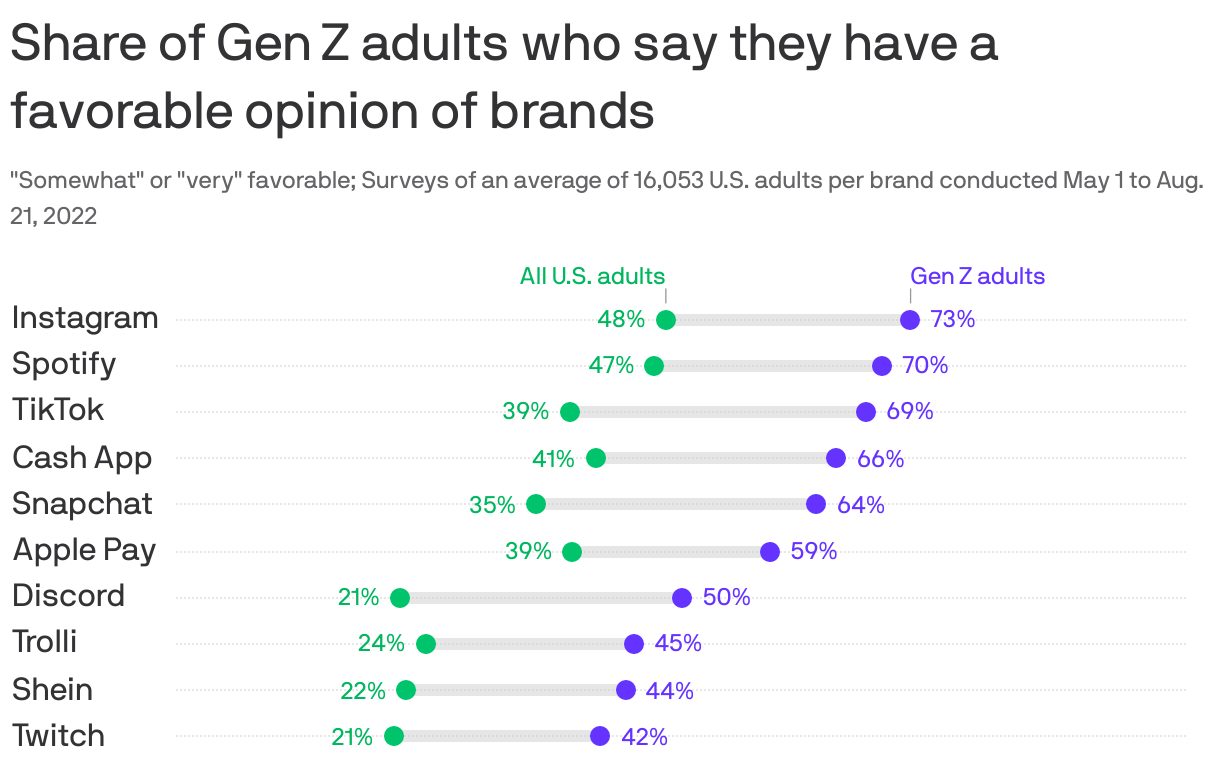
Data: Morning Consult; Note: Gen Z adults defined as ages 18-25; MOE ±1 percentage point for all adults, ±2 for Gen Z; Chart: Madison Dong/Axios Visuals
The youngest generation of adults is so crazy for tech companies that YouTube, Google, Netflix and Amazon are their four favorite corporate brands, a new Morning Consult survey finds.
Gen Z also loves junk food and mass retail: The other brands in their top 10 are M&Ms, Doritos, KitKat and Oreo, plus Amazon, Walmart and Target.
California's unprecedented new law to bolster protections for abortion-related personal information held by tech companies marks a new phase in the deepening legal fight between red and blue states over digital regulations.
Why it matters: With Congress deadlocked over national laws to govern online privacy and free speech, states are stepping into conflicts over abortion rights and censorship and setting their own, sometimes contradictory rules.