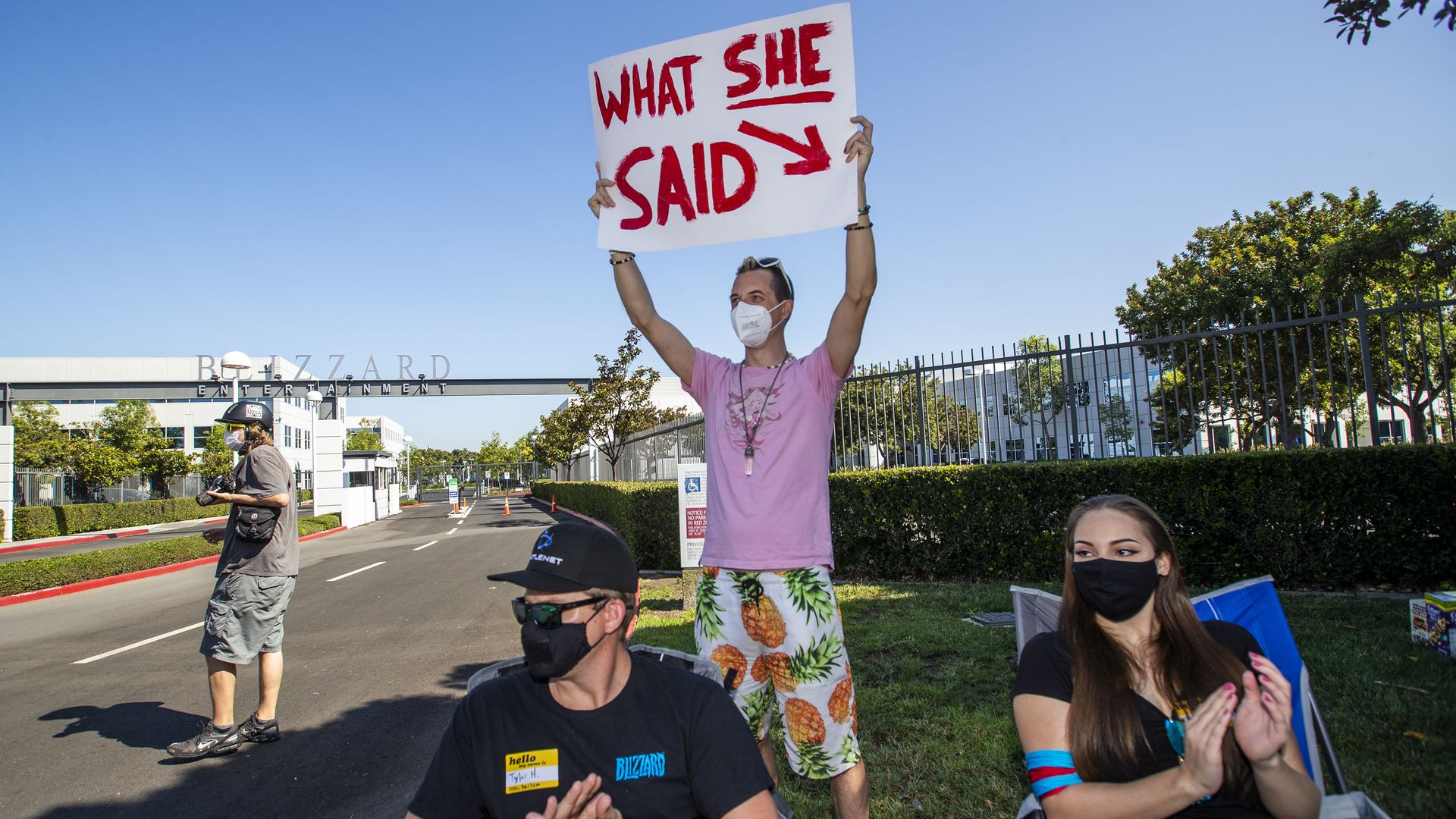
Jessica Gonzalez, a senior test analyst at Activision Blizzard who has been instrumental in employees' collective action efforts, is resigning from the company.
Driving the news: Gonzalez, who's been with the company for over two years, announced her resignation internally and via Twitter on Tuesday, noting that her last day will be Dec. 10: "I have made the decision to leave Blizzard by putting my wellbeing first," she wrote.
The two largest countries in the world seem intent on effectively banning their citizens from participating in crypto, which poses a serious threat to the crypto agenda.
Why it matters: The crypto world is global — but the real world is fragmented into nation-states, each of which claims control of what happens within its borders.
Two major quantum computing companies — one in hardware and one in software — are merging to create a new firm called Quantinuum.
Why it matters: The merger is a sign of the growing maturity of the quantum computing industry, as it begins to shift from the lab to actually solving difficult to compute problems in the real world.
In an unexpected twist, two conservative news networks — Newsmax and One America News Network— have come out in support of President Biden's progressive Federal Communications Commission (FCC) nominee Gigi Sohn, despite a broad conservative consensus against her.
Why it matters: If Sohn is confirmed, her appointment would give Democrats the majority they need to rewrite regulations for the communications sector. Some high-profile conservatives argue that could result in "censorship" against them.
Regulators in the U.K. on Tuesday said they have directed Facebook parent company Meta to sell Giphy after finding "the takeover could reduce competition between social media platforms and increase Facebook's already significant market power."
Why it matters: Facebook agreed to buy Giphy in May of last year for an estimated price of $400 million. The deal almost immediately invited antitrust scrutiny, given the increased attention to Facebook's growing market power.
The Biden administration is launching its first big effort on privacy policy by looking at how data privacy issues affect civil rights.
Why it matters: An administration perspective on privacy policy could be key in developing a long-awaited national privacy law by putting the White House stamp on how to regulate privacy.
CEO Jack Dorsey's departure from Twitter shows that, in Silicon Valley today, social media is becoming a field to flee.
Why it matters: Coming on the heels of Facebook's name change and new metaverse focus, Dorsey's resignation is another sign that the industry now views the massive social networks it built over the last two decades as buggy "legacy applications" mired in annoying social problems.
French officials are testing "flying taxis" that they plan to roll out for the 2024 Summer Olympic and Paralympic Games in Paris.
The big picture: The plan that's "unprecedented in Europe" isto create a "vertiport" to ferry passengers via the electric air taxis during the Olympics and Paralympics, per an Aeroport de Paris statement.
On her fourth day of trial testimony, ex-Theranos CEO Elizabeth Holmes described her 10-year romantic relationship with former president Ramesh "Sunny" Balwani as controlling, and said he would sometimes "force me to have sex with him when I didn’t want to."
Why it matters: While Balwani has also been similarly charged with fraud, the two are being tried separately, in part because some of Holmes' defense hinges on blaming him.
Early metaverse architect Philip Rosedale is no longer confident the metaverse will be a huge hit, despite the surging interest from Meta (fka Facebook) and many other companies.
Driving the news: Rosedale, who evangelized the concept of an immersive virtual world while overseeing the storied platform “Second Life” a decade ago, shared more tempered thoughts in an interview with Axios.
Jack Dorsey on Monday took aim at Silicon Valley's conventional wisdom that tech companies are best served when their founder retains control while explaining his rationale for resigning as Twitter's CEO:
“There’s a lot of talk about the importance of a company being ‘founder-led.’ Ultimately I believe that’s severely limiting and a single source of failure. I’ve worked hard to ensure this company can break away from its founders and its founding.”
Jack Dorsey is stepping down as CEO of Twitter, the company announced Monday. He will be succeeded by CTO Parag Agrawal, effective immediately.
The big picture: Dorsey is also the CEO of financial payments company Square, which he co-founded in 2009, and has become a crypto evangelist in recent years.
A well-funded and intensely motivated chunk of tech's hive mind is finding common cause in a vast new project: rebuilding the web on a foundation of cryptocurrency and blockchain tech. They call it "Web3."
The big picture: Developers, investors and early adopters imagine a future in which the technologies that enable Bitcoin and Ethereum will break up the concentrated power today's tech giants wield and usher in a golden age of individual empowerment and entrepreneurial freedom.
U.S. Commerce Secretary Gina Raimondo will call on House lawmakers to pass a bill boosting funding for semiconductor manufacturing during a speech in Detroit on Monday.
Why it matters: A global chip shortage is slowing production of everything from appliances to vehicles. The Senate in June passed a bill that includes $52 billion for domestic semiconductor manufacturing, but the House has yet to act.





















/2021/11/28/1638139328917.gif?w=3840)