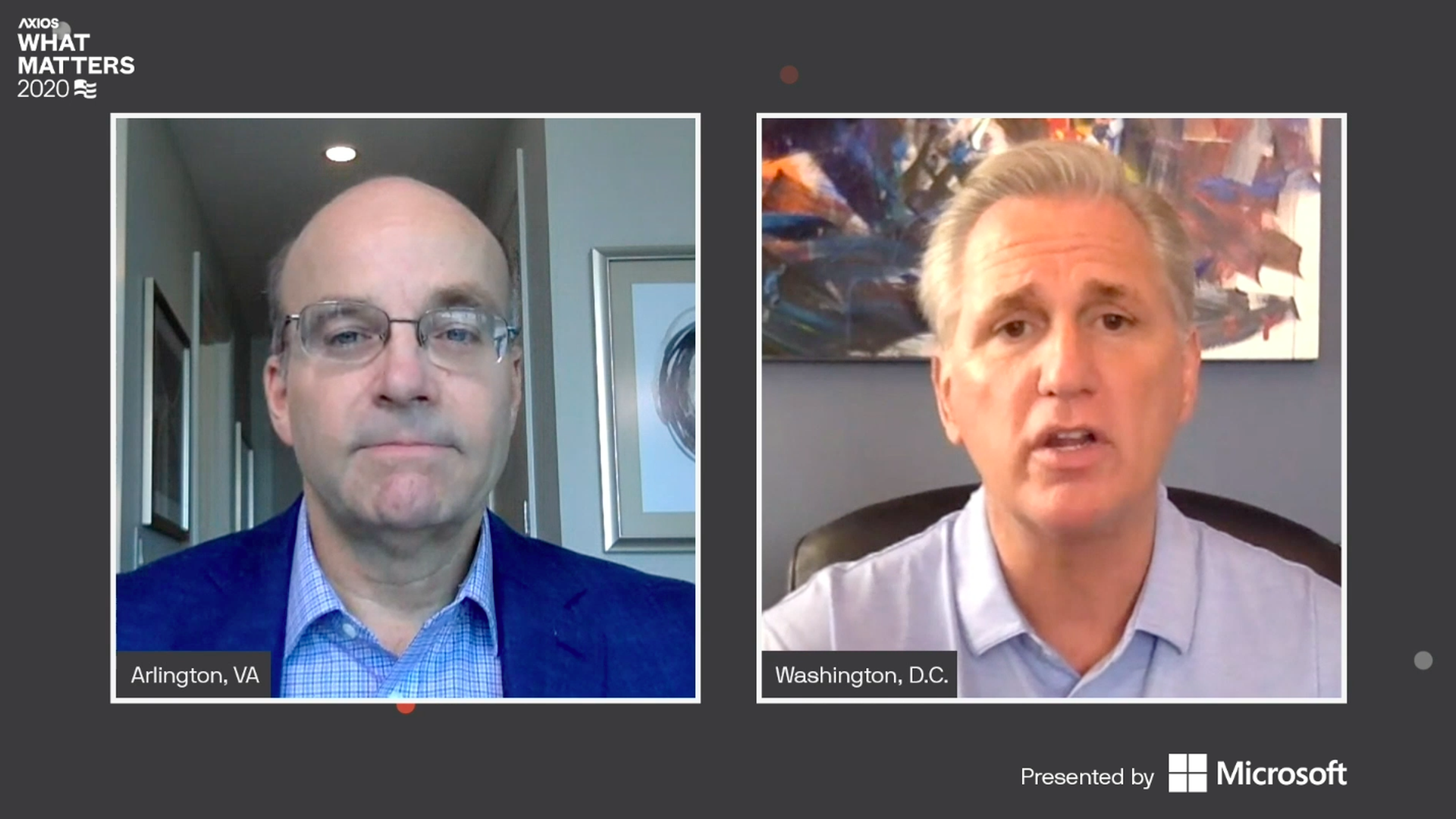
Congress is more worried about Big Tech now than it was a year ago, House Minority Leader Kevin McCarthy (R-Calif.) told Axios on Thursday during a virtual event.
What he's saying: "Their power is only getting larger, and in the world of COVID, it's getting larger because they have more influence. But I don't think they're forthcoming on a lot, I have real concerns on what Google has been doing."
Microsoft is working with Walmart on its efforts to buy TikTok's U.S. business from China's ByteDance, Axios has learned from multiple sources close to the process.
The state of play: The idea would be to helpturn TikTok U.S. into more of an e-commerce app for creators and users, much like what TikTok parent company ByteDance does with a similar app in China.
Flipboard on Thursday said it would bring its ad-supported video service "Flipboard TV" for free to Android and iOS devices.
Why it matters: The new venture expands and strengthens Flipboard's relationship with publishing partners and provides users with a new way to consume news and information on the app.
The U.S. Navy plans to tap Google's cloud and machine learning technology and use drone imagery, to modernize its process for determining when vessels and facilities are in need of repair.
Why it matters: The planned move comes amid internal and external scrutiny over the ties between Big Tech and the U.S. military.
Salesforce announcedon Wednesday it is cutting roughly 1,000 jobs, though it said it continues to hire for some growth areas.
Why it matters: The move comes just a day after the company announced blowout earnings and raised its guidance, sending shares up 26% on Wednesday. Salesforce had also pledged in March not to lay off employees for at least 90 days, but that was five months ago.
After initially taking no action on militia pages organizing an armed counter-protest in Kenosha, Wisconsin, Facebook said Wednesday that the pages and related comments violate a just-enacted policy that imposes stricter limits on QAnon, militia and other extremist groups.
Why it matters: Facebook's handling of the issue raises fresh question about its ability and willingness to enforce policies in time to prevent violence rather than after the fact.
A new fight between Facebook and Apple over the mechanics of ad tech is surfacing an industry divide over user privacy and spotlighting longstanding dilemmas about the tracking and use of personal information online.
Why it matters: Privacy advocates have been sounding alarms for years about tech firms' expansive, sometimes inescapable data harvesting without making much headway in the U.S. But the game could change if major industry players start taking opposite sides.
The U.S. Securities and Exchange Commission on Wednesday approved the New York Stock Exchange's rule change that will allow companies to raise new capital as part of a direct listing.
Why it matters: Though there's been growing interest in direct listings, especially from Silicon Valley tech companies, it has not been an appropriate path to going public for many companies that need to raise capital as part of the process.
In the not-too-distant future, motorists won't have to worry about finding a parking space. They'll leave their car at a drop-off location and the vehicle will park itself in a parking garage.
What's happening: Ford is working with a tech supplier, Bosch, and Bedrock, a Detroit real estate developer, to perfect the system as part of a pilot at a retrofitted garage in Detroit. The companies said it is the first infrastructure-based solution for automated valet parking in the U.S.
A new government initiative will direct hundreds of millions of dollars to support new centers for quantum computing research.
Why it matters: Quantum information science represents the next leap forward for computing, opening the door to powerful machines that can help provide answers to some of our most pressing questions. The nation that takes the lead in quantum will stake a pole position for the future.
The Senate Intelligence Committee detailed shocking new revelations about the 2016 Trump campaign's dealings with Russia in the landmark final volume of its report on the matter, but it missed an opportunity to recommend cybersecurity fixes for today’s campaigns and parties — perhaps by design.
Why it matters: The DNC and RNC could be considered a type of “critical infrastructure,” because without them and the presidential and congressional fundraising they facilitate, U.S. politics as we know it wouldn’t exist. But because they fall outside the government’s protective cybersecurity remit, they are also uniquely vulnerable to outside threats.
Facebook is warning advertisers that they can expect weaker ad performance from iPhone users once iOS 14 comes out next month and is telling them to create second advertiser accounts to contain the disruption.
Why it matters: Many of Facebook's advertising partners rely on Apple's "Identifier for Advertisers" (IDFA) user tracking feature to, for instance, target would-be users by interest and see if they actually clicked on a mobile ad directing them to install a particular app. Changes to IDFA coming with iOS 14 will have a big impact on the marketing strategies for many businesses, and on Facebook's bottom line.
As 2020 began, Scrum Ventures was already considering a new startup program focusing on tech for cities and the urban environment. Then the spring brought the coronavirus pandemic and a wave of protests following the killing of George Floyd, sealing the deal.
Driving the news: Scrum Ventures, in partnership with former NBA all-star player and investor Baron Davis, is debuting SmartCityX, a program aimed at helping startups connect with potential advisers and business partners.
Finix, a San Francisco-based payments infrastructure startup, raised an additional $30 million in Series B funding from Lightspeed Venture Partners and American Express Ventures.
Why it matters: Finix, which sells its software to B2B companies like Kabbage, has benefited from the pandemic-induced online retail boom.
Palantir CEO Alex Karp, who recently announced plans to move his company to Denver from Palo Alto, took aim at Silicon Valley in a letter to the software maker's investors, reports CNBC.
Why it matters: Karp's veiled broadsides at Facebook and Google belie a frustration with their business practices while Palantir has faced scrutiny for its secretive government contracts, often focused on intelligence and counterterrorism work.
Apple's longstanding rule for calculating its cut of transactions enabled through its iOS App Store depends on an apparently simple principle: If a good or service is digital, Apple takes 30%. If the good or service is physical, Apple doesn't.
The catch: Life doesn't divide neatly that way any more.
The White House this morning announced over $1 billion to establish 12 new federal research centers dedicated to AI and quantum sciences.
Why it matters: The two fields are among the most important in emerging technology, and the new initiative will help the U.S. assert its international leadership in an increasingly competitive field that will impact everything from national security to climate change.