Friday's technology stories

Samsung granted self-driving car testing permit in California
Samsung has obtained a permit to test self-driving cars in California, according to an update to the state's DMV website. A few months ago, the tech giant was granted a similar permit in its home country of South Korea.
Context: It's not surprising to see Samsung venturing into self-driving car technology—it recently acquired Harman, a maker of auto tech, for $8 billion. Rival Apple has also obtained a self-driving car testing permit in California and is reportedly working on a car project.
TechCrunch first spotted Samsung's testing permit.
Firefox co-founder Blake Ross to join Uber
Blake Ross, best known for co-founding Mozilla's Firefox Internet browser, will be working for Uber on product strategy, he wrote on Facebook on Thursday. However, he adds that it "won't be a full-time project." Uber confirmed his hiring to Axios.
The last several months have been tumultuous for Uber, including multiple lawsuits, board unrest, and the resignation of its CEO. It's also lost several notable employees, managers, and executives, so Ross's hiring shows it is still an attractive company to technologies. Ross got his start at Netscape in the early 2000s and eventually helped create the Firefox browser. After that, he co-founded a startup named Parakey, which he sold to Facebook. He left the social media giant in 2013.
Lawsuit over Uber's anti-Lyft program dismissed
On Thursday, a California federal court dismissed a lawsuit filed by a driver against Uber over the company's secret program that tracked Lyft drivers, an Uber spokesperson told Axios. The former driver sought compensation for breach of his privacy and violations of federal and state laws after a news report about the program emerged.
How it worked: According to the report, Uber created fake Lyft driver accounts and tracked each driver's habits. It then targeted drivers who work for both services with promotions to get them to spend more time driving for Uber.

Apple to FCC: Don't allow 'fast lanes' on the internet
Apple told the Federal Communications Commission that it doesn't care what legal structure it uses to protect open internet rules, "but only if they provide for strong, enforceable, and legally sustainable protections, like those in place today."
- No fast lanes: Apple focused its comments on the need for rules that allow consumers to reach all lawful online content, including banning ISPs from creating fast lanes.
- "Lifting the current ban on paid prioritization arrangements could allow broadband providers to favor the transmission of one provider's content or services (or the broadband provider's own online content or services) over other online content," Apple said.
- Why it matters: This is the first time Apple has formally weighed into this FCC proceeding, which asks for comments on Chairman Pai's plan to roll back the current net neutrality rules. This joins Apple with other tech heavyweights — including Google, Facebook, Netflix and Amazon — in lobbying for strong rules, including a ban no fast lanes, just as the legislative negotiations on this front also start to heat up.

Apple's Sept. 12 iPhone event to take place at new 'spaceship' campus
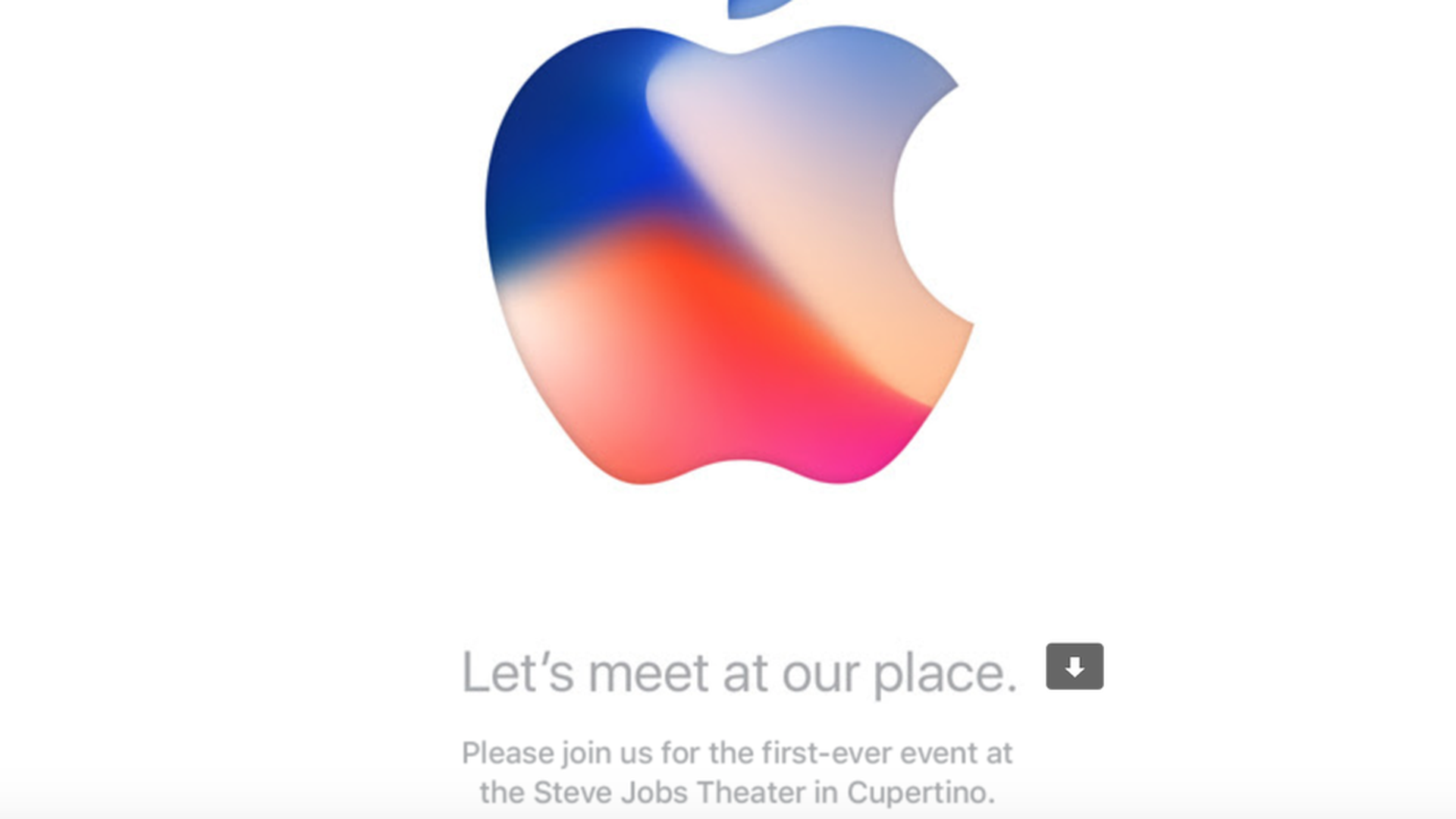
Apple on Friday sent invitations to a Sept. 12 event in the Steve Jobs Theater at its new "spaceship" campus in Cupertino.
"Let's meet at our place," reads the invitation to reporters. The most anticipate of the new products will be an all-new iPhone featuring an edge-to-edge screen, no physical home button and state-of-the-art facial recognition technology (which we wrote about this morning.)
Here's what to expect:
- Three new iPhones. Two will be modest updates to the iPhone 7 and iPhone 7 Plus, plus the high-end model detailed above
- Updates to the Apple Watch line, including models with built-in cellular connections
- An Apple TV set-top box capable of displaying 4K content
- A final version of iOS 11, an update to the iPhone/iPad operating system that supports augmented reality, among other new features
- The "High Sierra" update to MacOS
How Apple is changing facial recognition with the next iPhone
While the broad outlines of the new iPhone are now widely known, both literally and metaphorically, some of its new features have to be seen to really be appreciated, sources said. That's especially true with the facial recognition that serves as the primary means of logging into the new iPhone.
The bottom line: Those who have seen the technology say it is light years ahead of anything that has been tried commercially. A good parallel is the Touch ID fingerprint reader Apple introduced with the iPhone 5s in 2013. There had been fingerprint sensors on phones before, but none with the speed and accuracy Apple introduced. Now Apple is doing the same for faces.