Artificial intelligence algorithms can indeed create a world that distributes resources more efficiently and, in theory, can offer more for everyone.
Yes, but: If we aren't careful, these same algorithms could actually lead to greater discrimination by codifying the biases that exist both overtly and unconsciously in human society. What's more, the power to make these decisions lies in the hands of Silicon Valley, which has a decidedly mixed record on spotting and addressing diversity issues in its midst.
Streaming companies like Netflix, Amazon and Hulu snagged nearly 1/3 of Emmy nominations this year, the most ever awarded to tech companies. That's up from 91 nominations for streamers in 2016.
Why it matters: Streaming companies are pouring billions of dollars into content (around $4.5 billion this year for Amazon and Hulu and $6 billion for Netflix) and it's paying off. Earlier this year, Amazon and Netflix both took home Oscars, the first time for any tech company. Their bankrolls and massive audiences reflect a big shift in the television business from traditional TV companies to digital streaming companies.
Amazon's Alexa is gaining popularity in the U.S., but if you want to know the most popular chatbot in the world — by far — that would be Xiaoi, an intelligent conversational bot accounting for about 90% of the Chinese market, with some 500 million users, per Topbots' Adelyn Zhou.
Xiaoi, marketed by Shanghai-based Zhizhen, was introduced in 2004. In 2015, Microsoft won a major Chinese court battle against Zhizhen, which challenged patents for Siri, and now the U.S. company markets a rival text bot in China named Xiaoice, which has about 40 million users. But 40 of China's top 50 banks are Xiaoi clients, Zhou writes, and the 16-year-old company handles some 200 million interactions a day, the largest portion of which are from the financial sector.
Why it matters: Zhizhen appears to be exceedingly ahead of any western company in understanding the market for intelligent, natural language chat bots that interact smoothly with humans.
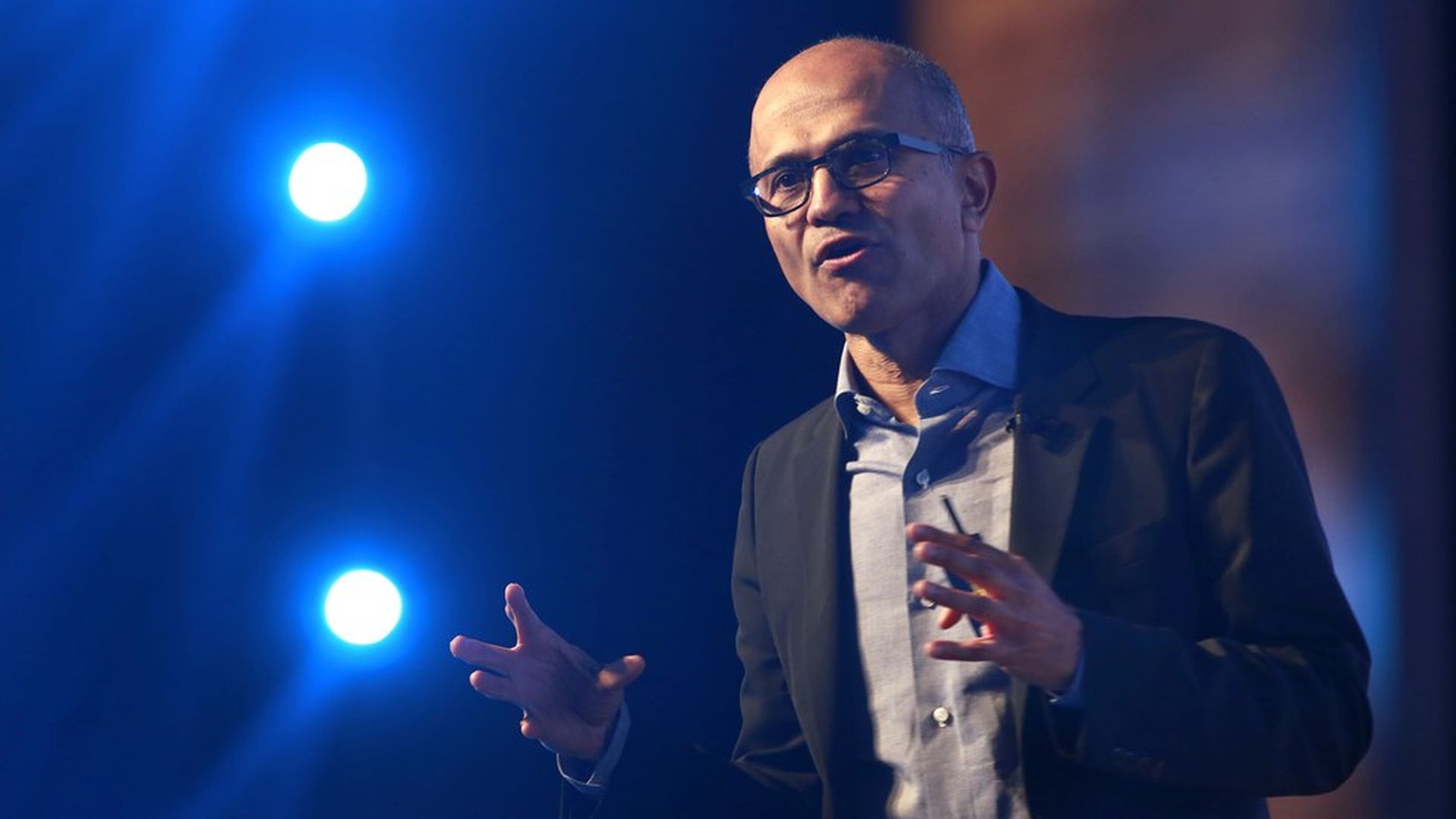
The contest for more sophisticated artificial intelligence systems has hotted up with an announcement of a big new lab — Microsoft Research AI, in which the software behemoth will employ more than 100 scientists to study how a single system of AI can tackle a wide range of jobs, rather than a single task, per Bloomberg. The new lab will partner with MIT, Microsoft said.
One of the new lab's initiatives is called AI for Earth, which will offer tools to environmentalists working on problems including climate and water shortages, Wired reports. As we've reported, Microsoft already was using its software to track pollution in places like Chesapeake Bay.
Why it matters: Microsoft is stepping up an already-fiercely competitive race toward smarter machines against Alphabet and Elon Musk's OpenAI.
Uber is continuing its search for a new CEO since co-founder Travis Kalanick resigned last month, and despite the company's many challenges, there is strong interest, according to a report from the New York Times citing anonymous sources.
The latest candidates under consideration:
YouTube CEO Susan Wojcicki, former Virgin America CEO David Cush
Former Yahoo chief executive Marissa Mayer
Former Disney COO Thomas Staggs
Adam Bain, Twitter's former chief operating officer is also being considered, which Axios had previously heard as well.
NYT notes that former SoftBank and Google executive Nikesh Arora, among others, is angling for the job.
Concern: With Kalanick still on the board and with considerable voting power, some candidates have reportedly expressed worries about the potential dynamic. And it's unclear how much interest each of the above have expressed in the job.
From robotics to cyber-war, developing countries are being lashed by the powerful new technological forces sweeping the globe — and seem likely to face worse.
Before cyber-attackers have struck targets in the U.S. and Europe, they have often tested out their strategies in India, Taiwan, South Korea, and other second- or third-tier powers, per the New York Times' Sheera Frenkel. The defenses in countries like India are often lower, and fewer security experts are watching.
Among malware tested: quasi-intelligent software that learns about the computer environment it's attacking as it moves. In addition, India has been hit with outsized waves of ransomware — Wannacry and Petya — that have struck some 60 countries in recent weeks.
The next fear: Robots will stymie the traditional pathway up the economic ladder for poor nations, said Daniel Runde, an analyst with the Center for Security and International Studies. As rich nations adopt more robots, they can economically keep assembly and manufacturing industries at home rather than shipping them abroad to low labor-cost countries, he said.
Why it matters: Cyber security experts are now increasingly looking to the developing world to discover what malware might hit the more sophisticated economies next. These second-tier economies are a playing ground — a pickup basketball court — where cyber criminals can practice.The economic side is perhaps more worrying because it means exacerbation of a dynamic already in play — what Harvard economist Dani Rodrick has called "premature de-industrialization," in which poorer countries barely or never get to see the fruits of a manufacturing economy.
New York City has an Office of Special Enforcement that spends 95% of its time investigating rentals for possible violation of state and local laws — many of which are arranged on websites like AirBnb, Bloomberg reports. And the hotel industry and labor groups are only too eager to help, hiring their own private investigators to rat out AirBnb hosts who flout a ban on short-term sublets.
Why it matters: These self-styled rental vigilantes are just one example of how incumbent industries are leveraging state and local regulators to resist competition from online upstarts and emergent technologies. In other cases, taxi interests have helped ban Uber in places like Nevada, and utilities have worked to stop the spread of rooftop solar panels for residential real estate.
Uber is teaming up with Russian search company Yandex to form a standalone ride-hailing company, the companies announced on Thursday. It will operate in Russia, Kazakhstan, Azerbaijan, Armenia, Belarus, and Georgia, covering 127 cities.
Snap shares closed below the company's $17 IPO price for the first time this week, and analysts downgraded the stock.
Morgan Stanley cut its price target to $16 from $28 saying that they were wrong about Snap Inc.'s ability to innovate and improve its ad product this year. Credit Suisse analyst Stephen Ju lowered his target to $25 from $30 citing raised volatility in Snap trading.
Why it matters: Advertisers say they haven't given up on the platform — which means Snapchat's revenue will continue to climb, but not at a rate that has investors convinced it could knock the growing threat of Instagram. WPP's Sir Martin Sorrell, the CEO of the world's largest advertising conglomerate, told CNBC Wednesday that while it plans to double its ad spend in Snap to $200 million this year, it plans to spend well over $2 billion on Facebook and up to $6 billion on Google.