Thursday's technology stories

Snapchat's billion dollar deal with Amazon
Snap's latest updated paperwork for its IPO includes this detail: The company has a $1 billion deal with Amazon for cloud services.
The details: The deal — first inked in 2016 — was updated this week to commit the company to spending more money each year with Amazon for five years, culminating in $350 in 2021. Amazon will provide Snap with "redundant infrastructure support of our business operations."
In context: Amazon isn't the only cloud provider Snap is relying on as it heads toward going public. The company also has commitments to Google worth $2 billion. That relationship is significant enough to get a mention in the company's list of risk factors for the IPO. Snap said in its filing that "disruption of or interference with our use of the Google Cloud operation would negatively affect our operations and seriously harm our business." That agreement is also notable for Google's business.

How Facebook makes its money, in one chart
Facebook is making the majority of its revenue off U.S. users, and it's not because of scale.
While the number of monthly active users in the U.S. is relatively low compared to other countries, the average revenue per user in the U.S. is 1314% higher. See the dark purple boxes below compared to the light purple.
Data: Facebook; Chart: Lazaro Gamio / Axios

Twitter vs Snapchat

Fair or not, the two companies are increasingly being compared to each other as Snap prepares to go public and Twitter looks for a big bounce in value:
- Both rely on convincing people they can massively grow their user.
- Both rely on ads alone to make money.
- Both are money-losers.
Recode: "Twitter's advantage is that it has a proven business. Sure, Snap is hot and exciting and young. But Twitter likely brought in more than $2.5 billion in revenue last year. The company has survived for a decade, and President Trump's obsession with the product means it has never been more culturally significant."
But then there's the business: "Even Donald Trump Can't Save Twitter," which released earnings earlier today, per the Wall Street Journal's "Ahead of the Tape" column: "[A]s has been made clear by Twitter's recent results and its battered stock price, there is a clear distinction between publicity and profitability. Monthly active-user growth continues to slow. Twitter is still losing money ... It has had constant churn in the C-suite."

Big in Business: Jose Cuervo's big IPO

Bloomberg reports one of the most painful regulatory thorns in the side of the banking industry is a consumer complaint database maintained by the CFPB, which tracks not only complaints against financial services firms, but the firm's response and the customer's satisfaction therewith. Watchdogs argue that the database is an essential tool in providing restitution for banking errors and alerting authorities of violations of law. But banks hope the Trump Administration and Congress will eliminate or reform the database so that it doesn't contain "unverified and potentially false information."
Jose Cuervo's big IPO: The spirit distiller on Tuesday sold roughly $790 million in shares in Mexico's biggest IPO in more than three years, per Bloomberg. The firm's success is evidence that some companies will be able to largely avoid the repercussions of a U.S.-Mexico trade war. Though Cuervo's dollar-denominated sales would fall if broad tariffs were put on Mexican goods, the decline in the peso's value from a trade war means that the remaining U.S. sales would be worth more in peso terms.
Earnings to watch before the bell: Viacom and its new CEO Bob Bakish hope to put the Sumner Redstone-succession drama behind them, and are planning to announce a new turnaround strategy Thursday morning. Twitter hopes to show progress on key metrics like monthly active users, and the market will be looking for any clues as to the veracity of recent takeover rumors.

Amazon's Alexa gets smarter every hour
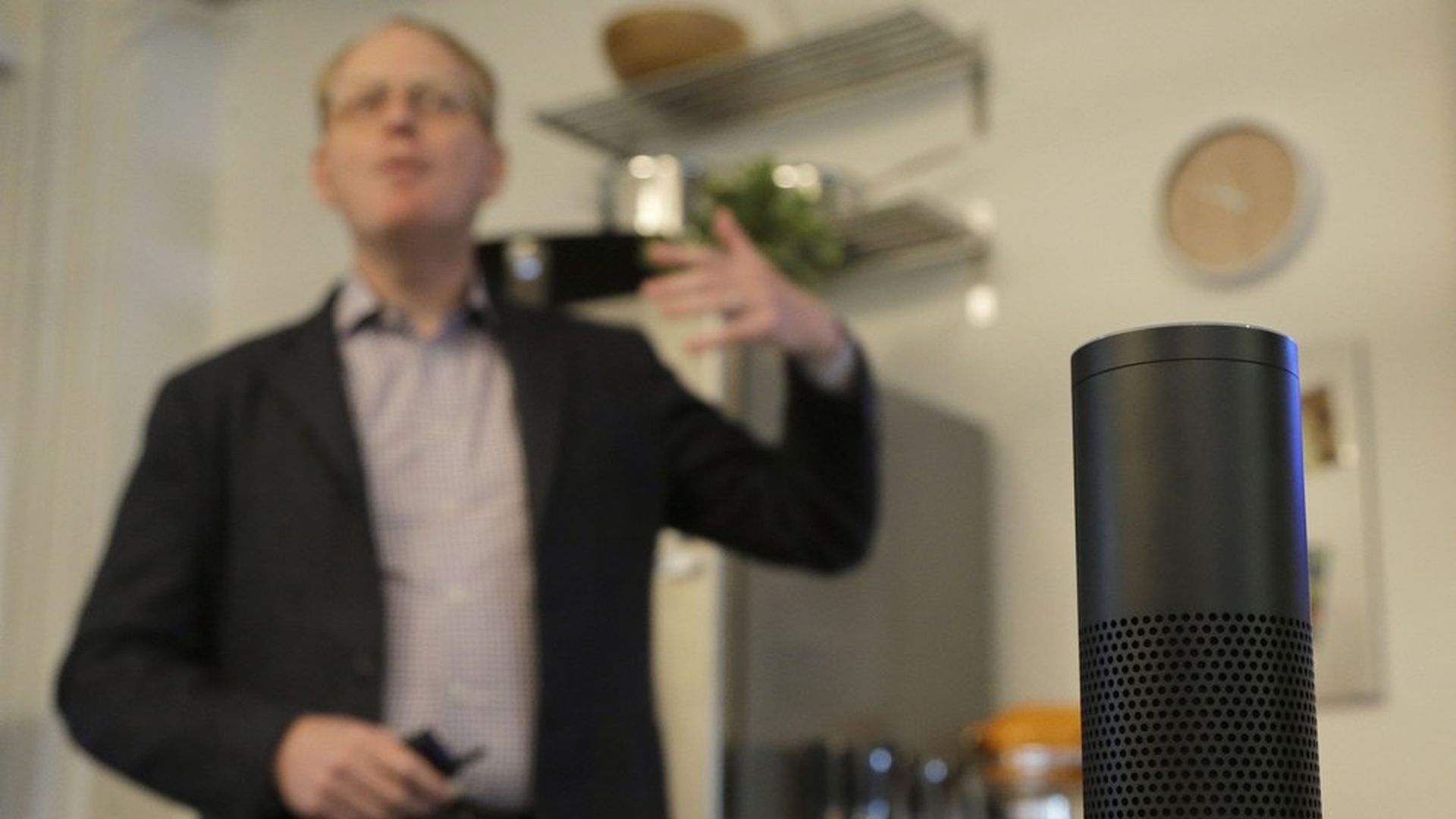
Amazon's Alexa, the voice-recognition digital service, is one of the fastest-growing tools that takes advantage of machine-learning capabilities. In a Deloitte analysis of 2017 tech trends released today , Amazon executives Maria Renz and Toni Reid gave some insight into Alexa's development. Since launching Echo in November 2014, Amazon has added more than 7,000 skills to Alexa, they said.
The original inspiration for the Amazon Echo was the Star Trek computer. We wanted to create a computer in the cloud that's controlled entirely by voice—you can ask it things, ask it to do things for you, find things for you, and it's easy to converse with in a natural way. We're not quite there yet, but that was our vision.
One of the key capabilities of Alexa, the voice and brain behind Echo, is that she's a cloud-based service that is always getting smarter, in both features and natural language understanding and with improved accuracy. Because her brain is in the cloud, she continually learns and adds more functionality, every hour, every day, which only makes it easier to innovate and add features on behalf of customers.
Why it matters: With Alexa and Echo, Amazon is trying to dominate how people interact with all the devices in their homes, cars and eventually offices. Alexa is also a prime example of how machine learning — or the process of automatically discovering patterns in data — are being used in consumer devices. As Deloitte points out, the data created by consumers doubles in size every year. So tools that can effectively sift through and analyze that data will be used in a number of different use cases, from hospitals to schools.
YouTube launches mobile live streaming
YouTube is creating a mobile live-streaming feature that is built directly into the YouTube mobile app, that allows users to make money on their content. This puts YouTube a step ahead of Facebook and Instagram, who haven't launched ways for users to make money on their live streams.

Facebook expands paid family leave
Facebook is extending its bereavement and family sick leave, COO Sheryl Sandberg said in a Facebook post on Tuesday.
New policy: Employees will now get up to 20 days of paid bereavement leave for the loss of an immediate family member, and, up to 10 days for an extended family member. Previously, employees only got half at many days.
Employees will also get up to six weeks of paid time off to care for a sick relative and three days in the case of a relative's short-term illness, such as a child having the flu.
Personal note: For Sandberg, bereavement leave is an especially important subject—her husband, Dave Goldberg, died suddenly in May 2015 while on vacation.
Why it matters: This latest expansion of Facebook's policy follows Sandberg's efforts to champion women's rights in the workplace. She was criticized for not being more openly supportive of the Women's March following Donald Trump's inauguration, something she later said she regrets. Continuing to advocate for benefits for women and families is also an easier way for Sandberg (and Facebook) to push this agenda without directly opposing Trump.