





Slowing an investment boom on the scale of the AI build-out is a tricky business — as Thursday's rout in the stock market demonstrated.
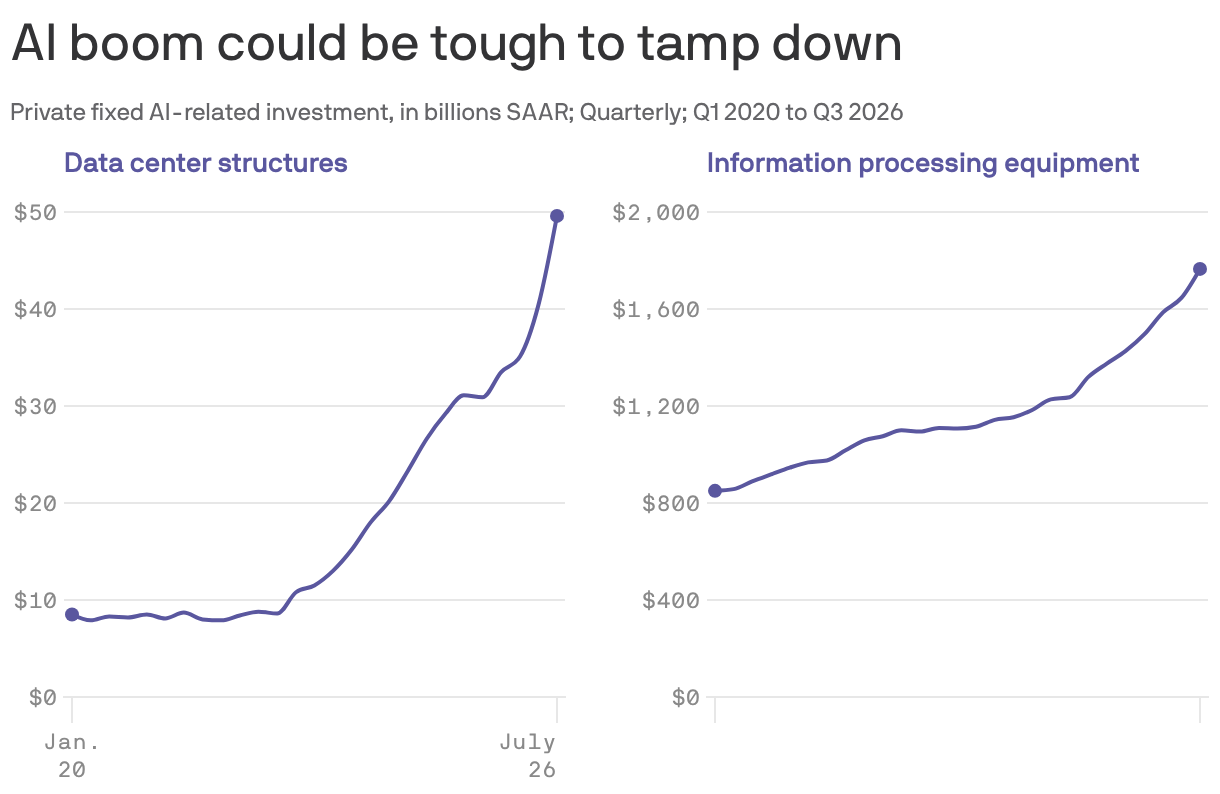
Why it matters: Americans may have voted in the midterms to tap the brakes on the AI race, but curbing the investment boom — or some might say, gently deflating the AI bubble — is easier said than done.
The big picture: The historical record shows that once major investment booms are in motion, it can be difficult to temper them without sparking a stampede of investors out of assets.
- That's why market collapses have featured prominently in past investment booms like those in canals, railroads and the internet.
- "We can't control it," John D. Turner, a finance professor at Queen's University Belfast who co-wrote "Boom and Bust: A Global History of Financial Bubbles," tells Axios.
- "People just get spooked, and as soon as they do, then, you know, prices head down. And that's what happens in historical bubbles, and it can happen quite quickly."
State of play: Tech stocks plunged Thursday as the week has developed into a major test for the market.
- The Nasdaq Composite Index fell 5.5% — its worst daily showing since the quasi-panic of President Trump's "Liberation Day" tariffs in April 2025 — and is down roughly 10% from the high it hit a month ago.
- On Wall Street, a drop of that magnitude is known as a "correction," a term of art indicating a sell-off more serious than a garden-variety decline.
- The Nasdaq 100, a measure of the largest tech stocks, is now down roughly 14% since its Oct. 7 peak. Its 6.4% drop Thursday was its steepest since the March 2020 pandemic panic.
- The SOX semiconductor index also endured its worst day since the pandemic, plummeting 12.3% on Thursday. The broader S&P 500 index slumped 4.4%.
Reality check: The 4-year-old bull market for the blue chips still holds: The S&P 500 is off 6% from its high and is up 7.4% on the year.
Catch up quick: The overwhelming rejection of AI in this week's elections — from wins for AI-cautious Democrats in governors' races in hotbeds of development to overwhelming support for ballot measures restricting data center construction — has pushed investors to reevaluate their previous bets on companies profiting from the data center boom.
Stunning stat: Over 50% of the planned data center capacity is in just three states, Ohio, Georgia and Texas — all states where Democrats just defeated Republicans in gubernatorial races.
- "If you were thinking that there might be some issues when it came to AI investment in the first place — and the AI build-out — well, now you have three key states, all with new governors-elect who are not friendly to the cause," says Steve Sosnick, chief strategist at Interactive Brokers.
Zoom in: Many of the proposed constraints on AI are limited in nature and do not apply to projects already underway. Even so, the market reaction has been ferocious.
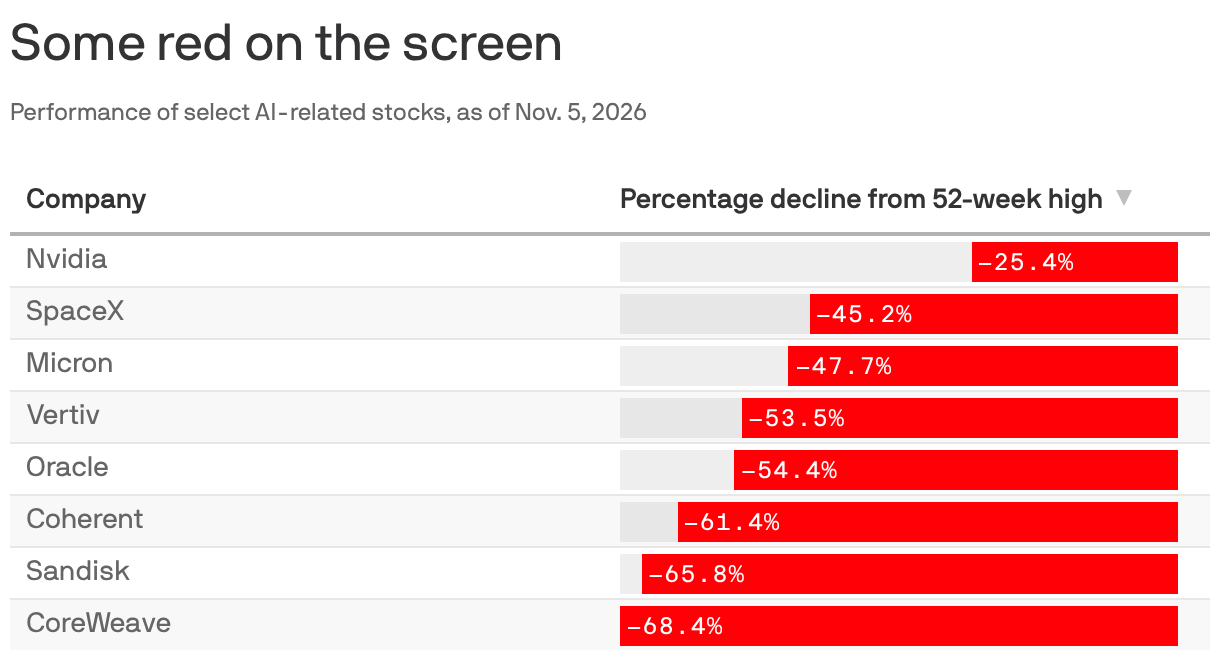
- Stocks tied to the AI build-out were hit particularly hard Thursday, with makers of everything from fiber optic connections (Coherent down 13%, Ciena down 15%) to HVAC systems (Comfort Systems, -11.6%), servers (Dell dove 15%) and semiconductors (Advanced Micro Devices, -17.3%) knocked down, some after enduring deep losses Wednesday.
- Engineering, electrical and industrial equipment stocks closely tied to the boom also collapsed. Quanta Services and Vertiv Holdings plunged 12% and 14%, respectively.
- The so-called hyperscalers — Amazon, Alphabet, Microsoft, Meta and Oracle — were all down, too, though their losses were less lurid, as they could benefit from any slowdown in AI spending as a result of increased regulatory scrutiny.
Between the lines: To some, the sudden tumble in the markets — futures were actually up a bit in premarket trading — suggested that a large institutional investor may have moved to sell a sizable chunk of a portfolio that had turned south after Wednesday's post-election slump in AI shares.
- Hedge funds had already been selling, as they unwound positions last month at their highest rate in over a decade, per a Morgan Stanley note cited by the Wall Street Journal.
- Elsewhere, retail investors, who in past market downturns have swarmed in to buy the dip, instead dumped shares, acting as heavy sellers of tech stocks Thursday, said Jai Malhi, senior equity strategist at Vanda Research, which tracks trading by individual investors.
What we're watching: For any indications that the volatility hitting the AI trade could prompt Anthropic and rival OpenAI to reconsider plans to offer shares to the public.
- And will the stock market jitters spread to the more sober-minded markets for corporate debt, where a large chunk of data center construction is expected to be financed?
The bottom line: To be continued.