Thursday's science stories

Axios House: Specificity is key to successful AI use, executives say

DAVOS, Switzerland — Clearly stating the goals of AI in an organization can be the difference between success and failure, two chief executives said at an event this week at Axios House.
The big picture: Companies that understand their AI objectives and tailor their use cases accordingly are best poised to win the AI race.
Axios' Courtenay Brown and Ina Fried moderated conversations with Google Cloud CEO Thomas Kurian and Honeywell CEO Vimal Kapur. They were sponsored by Qualcomm.
What they're saying: There are three key steps to getting a positive return on AI, Kurian told Fried — "organize your data, ensure you have a strong foundation … and rethink the process" for which you are using it.
- "When AI is driven as a pure technology project, often it fails because the business line doesn't understand — and doesn't agree on — the metric" it's trying to achieve.
Case in point: "Customer service" isn't a specific enough key performance indicator, Kurian said.
- He used "speeding up claims resolution" as an indicator that works in insurance claims processing because it "is the best way to retain customers."
Honeywell is taking it a step further, Kapur said, by using AI to automate parts of its engineering process — starting with specifications.
- Kapur likened Honeywell's level of customization for clients to a custom tailor, and the process "takes a lot of time."
- "So we are automating the generation of specifications using AI, so that engineers spend less time duplicating what they did 20 times before."
Content from the sponsor's remarks:
In a View from the Top segment, Durga Malladi, Qualcomm Technologies' EVP and GM, technology planning, edge solutions and data center, said he thinks about the spectrum of use cases when it comes to where to run AI.
- "For instance, something that is far more personal and contextual, you might want to run it immediately and locally, directly on the device. … We see a continuum of computing and connectivity," Malladi said.
Go deeper: Watch the full interviews on YouTube.


Dr. Oz: AI and robots can already provide medical care

AI and robotics could help reduce the obstetrics crisis in the U.S. in the next few years, Dr. Mehmet Oz, administrator of the Centers for Medicare & Medicaid Services, said Thursday at an Axios event in Davos.
Why it matters: It's a tangible use of AI that could bring real benefits soon — better than speculating on advances 10 years from now, Oz said.
Driving the news: Oz said AI and robotics can be part of the solution for parts of America that don't have access to critical medical care, like obstetricians and mental health services.
- "Within the next three years, before our administration is done, we will be using agentic AI to accelerate our ability to take care of people, especially when they're in places where we don't have access to care," Oz said at the Axios House event.
- More than one-third of U.S. counties don't have any obstetricians, midwives or birthing centers. More than 500 hospitals have closed OB units since 2010.
How it works: One idea that has been proposed is to "use robots to do ultrasounds on pregnant women," Oz said. "Robots can do it. We already have simple systems that are effective."
- There are also technologies under development "where you can take a wand, you don't even see the image, you get digitized insights back that tell you whether the child's OK or not."
- "And frankly, I don't have to see the image. I just have to know if the image is good enough to tell me the child doesn't have a problem," Oz said.
For mental health care, "we will never, ever have enough practitioners in those areas to do this" in rural America, Oz said.
- "We have AI systems now [that] augment the ability of doctors to take care of patients by fivefold, maybe more, without burning out," he said, "helping them do much of the laborious work of collecting information, and giving them some navigation tools and most importantly by allowing or empowering patients to control their own decisions."
Context: Some states already are experimenting with AI tools for expectant and new mothers, using smartphones and wearables to monitor vitals, provide maternal health advice, book vaccinations and order tests.
- Oz's agency finalized a proposal last fall to expand Medicare payment policies for digital mental health services to include payment for devices used to treat ADHD. It also solicited feedback on how it might pay for innovative software algorithms and AI.
The bottom line: "I think talking about AI in 10 years is almost a futile effort. I think most of the changes are going to happen in three to five years," Oz said.

AI is coming for cowboys, too

Cowboys in the American West are increasingly managing cattle not just from horseback, but from smartphones and with artificial intelligence.
Why it matters: AI won't be the end of cowboys. But AI-adjacent tools help fewer people manage more land, quietly redefining the job by turning cattle, fences and water systems into data streams.

Company boards scramble to adjust to AI

Nonprofit EqualAI is releasing its AI governance playbook during the World Economic Forum to help board directors grapple with the technology.
Why it matters: AI is rapidly reshaping corporate America, and board directors responsible for legal and compliance oversight have little practical guidance.
From back-office to AI‑powered strategy: Finance and procurement's evolution

Etosha Thurman, chief marketing officer for finance and spend management at SAP, explains how finance and procurement have evolved from back-office functions into strategic engines of resilience and business growth.

AI can help save fish, Nature Conservancy CEO says
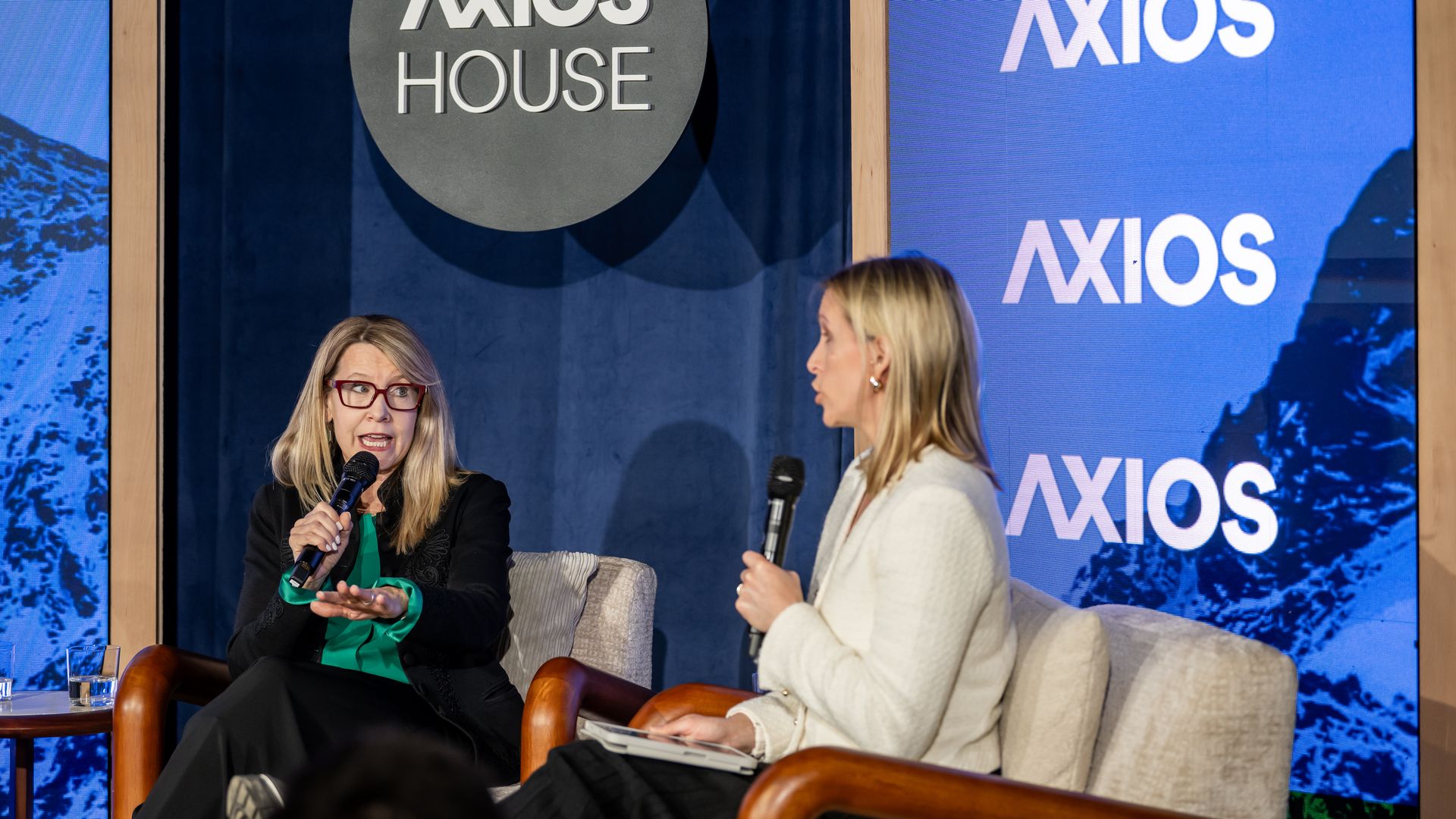
AI has an overlooked — but vital — role to play in helping to protect at-risk species, Nature Conservancy CEO Jennifer Morris said at an Axios panel in Davos Wednesday.
Why it matters: Morris and other environmentalists say AI already is proving it can help protect fish and other species.

Nvidia CEO Jensen Huang: Drug research will be transformed

Nvidia CEO Jensen Huang predicted Wednesday that drug research will shift from traditional labs to AI platforms, with pharma giants already making the leap.
Why it matters: The industry is betting the pivot could accelerate how fast new drugs reach patients.


Trump, AI at Davos: Living history — and the future

DAVOS, Switzerland — In a 24-hour span in the Swiss Alps, we're witnessing what future historians might mark as a hinge moment: The people building civilization-altering AI, a prime minister declaring America's global order dead, and an expansionist, defiant American president all sharing the same tense global stage.
Why it matters: It's hard to overstate the seismic shifts shaking this week's World Economic Forum in Davos.

Anthropic, Google and Microsoft fight to win teachers

The next major AI battleground is the classroom, as Google, Microsoft and Anthropic race to make their tools the chatbots of choice for teachers and students.
Why it matters: Whoever wins schools now could shape how Gen Alpha learns, studies and interacts with AI for years to come.