Axios Pro Rata

March 18, 2023

Congrats for surviving this unexpected week! The Silicon Valley Bank saga continues, so we're looking at this today again.
- 👋 Reminder: Feel free to send me tips or comments by replying to this email or on Twitter @imkialikethecar.
- 🚨 Silicon Valley Bank employees — drop me a line, I want to speak with you (confidentially)!
Today’s Smart Brevity™ count is 1,072 words, a 4-minute read.
1 big thing: Navigating SVB's new era

Illustration: Aïda Amer/Axios
Startups breathed a sigh of relief Sunday night when the Federal Reserve announced it would backstop Silicon Valley Bank deposits. Yet amid anxiety about the banking sector and the future of venture capital funding, this past week has been surprisingly busy.
The big picture: Among startup-land denizens and venture capitalists who were SVB clients, there hasn't been a uniform approach about what to do since the government takeover.
Why it matters: SVB’s temporary successor, Silicon Valley Bridge Bank — helmed by CEO Tim Mayopoulos — has been on the charm offensive this week, sending emails to customers and holding video calls to answer questions.
- "[P]lease keep a portion of your deposits and operating business at SVB as part of your diversification strategy. Bringing any portion of your deposits back to Silicon Valley Bridge Bank is a vote for us to succeed," the bank said in an email to customers seen by Axios.
State of play: Startups and VCs have opted for a couple of approaches:
- Move away from SVB: Others have fully pulled out their funds from SVB and moved to a bigger bank — “the scar tissue is very very deep,” says Logikcull CEO Andy Wilson.
- A mix of banks: A growing group of companies are doing it all, keeping some funds in SVB (typically $250,000 or less) and putting the rest in one or more other banks.
- Some are surely opting to stick with SVB, though it's unclear how popular this this approach is.
Between the lines: While not a universal sentiment, a non-trivial portion of the startup world says SVB should survive and remain a sustainable business. This would be a good outcome for the U.S. banking system, and because SVB itself is a unique startup friendly institution.
- A group of VCs put out a support statement, advising startups to keep at least 50% of their cash at the embattled bank (as of late Friday, it still hasn't found a buyer).
The intrigue: “I miss SVB” has become a growing refrain from folks who’ve opened new accounts at other banks and noticed the differences in the customer experience.
- Also, the minimum balances at other banks are posing a challenge for smaller companies looking for SVB alternatives.
Meanwhile: A slew of fintech companies providing various services, to startups and other businesses, have stepped in to offer alternatives to SVB, and banks in general. For example:
- Brex, best known for its corporate credit cards for startups, announced over the weekend emergency credit lines for companies. It also offers various other cash management options like the ability to split funds across several banks, in FDIC-insured $250,000 chunks.
- Arc, which also offers a similar slew of services and rolled out same-day payroll financing and venture debt this week, said on Wednesday that since the prior Thursday, it’s seen “15x growth in deposit volumes and 500+ applications for hundreds of millions in both short-and-long-term financing.”
- Ramp, yet another fintech startup focused on business cash management, set up a referral program to direct customers to alternative banks, facilitating over $1 billion in deposits within the first 48 hours after SVB shut down.
Yes, but: These fintech companies have some limitations — namely, that they aren’t banks.
- “[Banks are] always better at doing loans because they have the lowest cost of capital,” Brex CEO Henrique Dubugras tells Axios, adding that his company returned its SVB funds to the bank and even added a little more.
The bottom line: The past week has been an education in cash management for Silicon Valley.
2. Cheat sheet: Timeline

Illustration: Annelise Capossela/Axios
The past 10 days have felt like an eternity, so here's a handy timeline of what's happened:
March 8: SVB announced it has raised $500 million from General Atlantic and plans for a $1.25 billion common stock sale, plus another $500 million of depository shares.
- Earlier in the day, Silvergate, a bank popular with the crypto industry, announced it's shutting down operations, a harbinger to what's to come.
March 9: When markets opened, SVB's stock fell 30% (and eventually 60% that day and a growing number of VCs and startups started to pull their money out of the bank.
- SVB CEO Greg Becker attempted to appease VCs and startups in a conference video call, asking them to "stay calm." The bank also updated Goldman Sachs on deposit outflows, effectively killing the share offering.
- By the end of the day, customers had initiated $42 billion in withdrawals, making it the largest bank run in history.
March 10: U.S. regulators took control of the bank Friday morning, shutting it down.
- In the evening, the FDIC informed an unknown number of SVB employees that they’d keep their jobs as part of the newly formed bridge bank for the next 45 days.
March 12: Bids to acquire SVB were due on Sunday, but there was no sale (the FDIC reportedly declined the lone bid by an unnamed company).
- March 12: The U.S. government announced it would backstop all SVB deposits.
- Regulators shut down Signature Bank in New York, citing systemic risk.
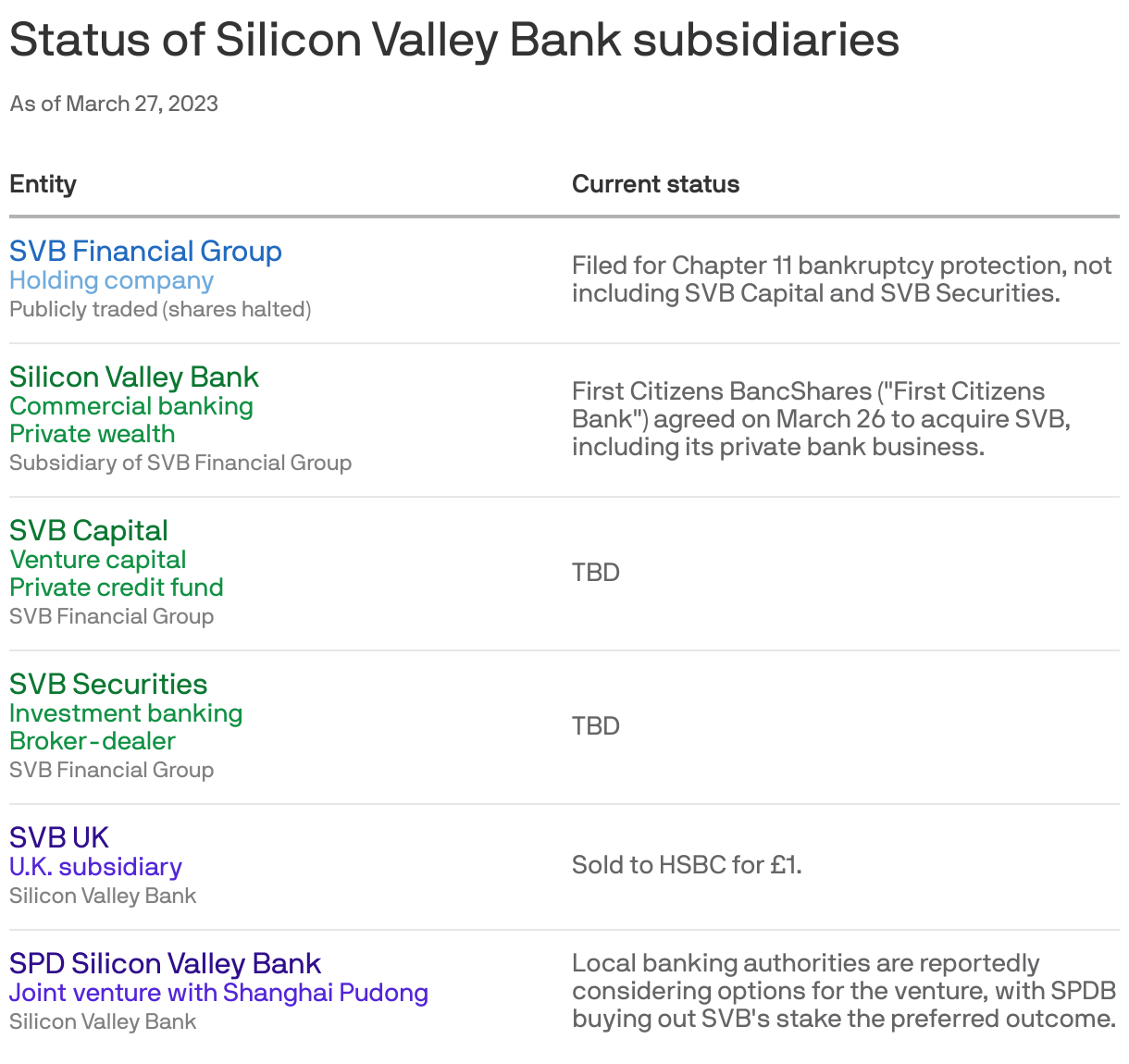
March 13: SVB’s U.K. arm is sold to HSBC for £1.
- First Republic Bank’s stock plunges 60% as the market got jittery about a broader banking crisis. Other regional banks also saw stock drops.
- SVB reopens for business as the newly set up Silicon Valley Bridge Bank.
- The Fed announces a review of SVB’s failure.
March 15: Credit Suisse, who’s had its own woes for quite some time, announced it will borrow up to 50 billion Swiss francs ($53.68 billion) from the Swiss National Bank to strengthen its liquidity.
March 16: Treasury Secretary Janet Yellen reassured Congress that the U.S. banking system is “sound.”
- 11 banks inject $30 billion of deposits into First Republic Bank as a show of confidence as it’s spent the week trying to avoid SVB’s fate.
March 17: SVB Financial Group files for Ch. 11 bankruptcy protection in the Southern District of New York.
- Bids in a second attempt to sell SVB are reportedly due.
🧩 Trivia
SVB is best known for its works with startups and VCs, but that’s not all it did over its four-decade history.
- Question: What other industry in Northern California did it forge deep banking relationships with? (Answer at the bottom.)
🧮 Final Numbers


🙏 Thanks for reading! And to Javier E. David and Lisa Hornung for editing. See you on Monday for Pro Rata's weekday programming, and please ask your friends, colleagues and startup bankers to sign up.
Trivia: SVB has been a go-to bank for NorCal's wine industry for three decades, as the San Francisco Chronicle notes.
Sign up for Axios Pro Rata

Dan Primack’s briefing on VC, PE & M&A for dealmakers.