Axios Media Trends

February 25, 2025

Good afternoon from Doha. Today's Media Trends, copy edited by Sheryl Miller, is 2,547 words, a 9½-minute read. Sign up.
🎧 I chatted with Puck's Dylan Byers about the megachanges happening at MSNBC and the TV news industry on his latest "Grill Room" podcast.
1 big thing: No Vox exit plan
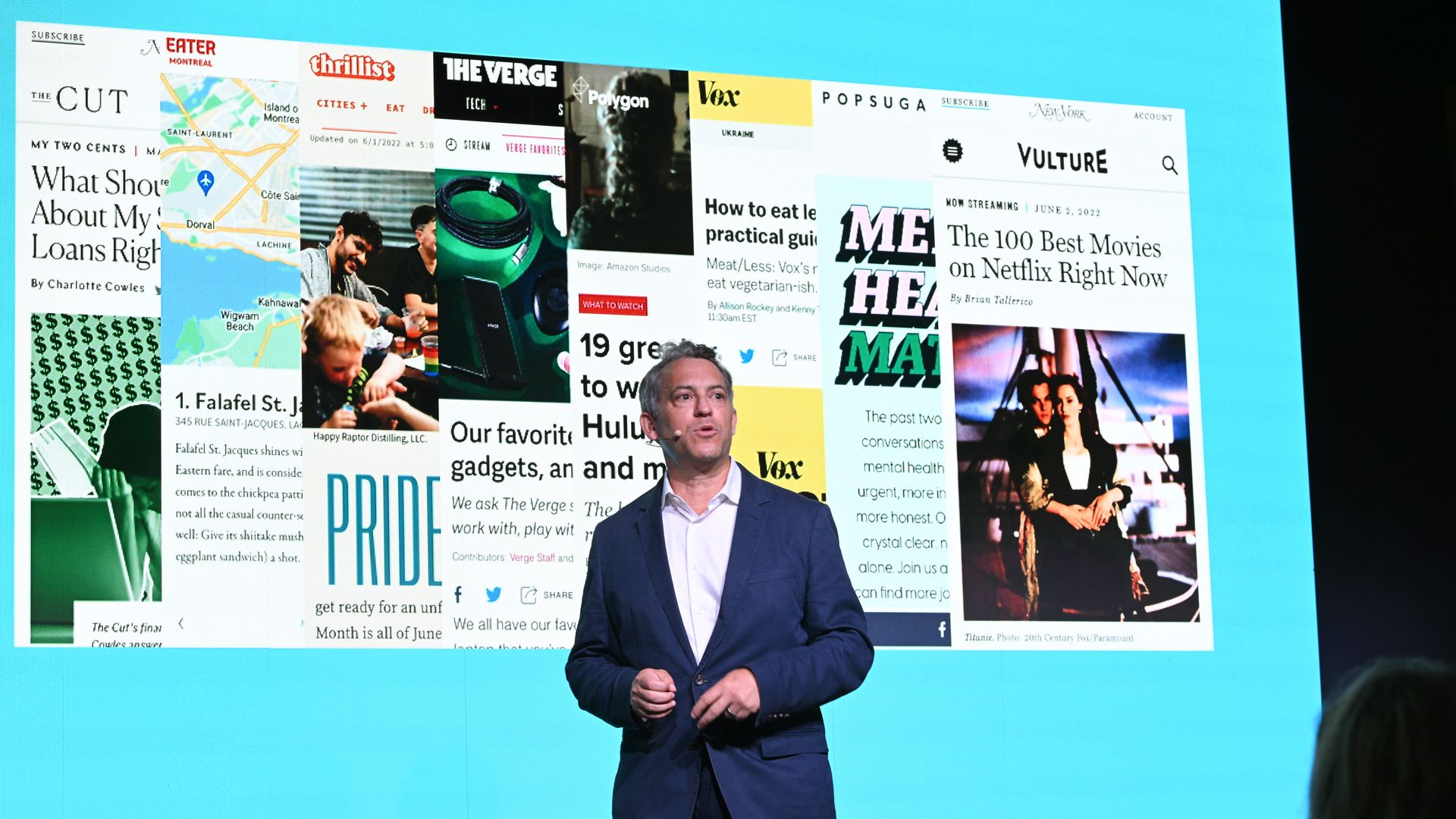
Vox Media isn't looking for an exit, CEO Jim Bankoff told me on stage in an interview this morning.
- "We are a successful, growing, sustainable company. And so the short answer is ... we're not [looking]," he said when asked about eyeing potential investors, buyers or acquisition partners.
Why it matters: Two years ago, Vox Media looked like it was in trouble. Today, it's one of the few privately owned digital media giants from the 2010s that hasn't collapsed or been broken up. It also continues to invest in journalism.
Case in point: BuzzFeed is currently valued at $76 million on the public markets, roughly 2x less than its revenue for the first nine months of last year. It shuttered BuzzFeed News in 2023.
- Vice Media ultimately went bankrupt after raising over $1.6 billion. It emerged from bankruptcy via a buyout last year, eliminated hundreds of roles and canceled its news shows.
Flashback: Vox Media raised $100 million at a $500 million valuation from entertainment publisher Penske Media Corp. in 2023. That deal, which valued Vox Media at less than its annual revenue at the time, helped Vox weather a brutal ad market while remaining independent.
- At the time, Vox Media had discussed other strategic options, including a sale of all or part of its business, Axios reported.
- Today, Bankoff says the company — which launched more than a decade ago — doesn't face pressure to find a buyer or new capital, although it has received outside interest.
State of play: Vox Media has survived and "managed to thrive" by investing in financial sustainability and prioritizing quality journalism, Bankoff said.
- The publisher, which has had multiple rounds of layoffs over the past few years, has streamlined its focus around the opportunities where it has a clear advantage, like podcasts.
- The Vox Media podcast network, Bankoff noted, is the company's fastest-growing business line.
Follow the money: Bankoff said the company's business is still growing, but he said certain parts of Vox Media's portfolio have been deprioritized in response to market trends.
- "Are we still going to continue to develop our intellectual property into streaming TV? Yes, but are we going to go after it with the same aggressive mentality as some of our other businesses? Probably less so," he said.
- The company has laid off staffers from some of the lifestyle businesses it inherited as part of its acquisition of Group Nine Media.
- It has doubled down on new print products and events for some of the brands it acquired through its purchase of New York Magazine's parent company in 2019, such as Vulture and The Cut.
Between the lines: While advertising remains Vox Media's biggest revenue source, Vox Media saw a significant increase in subscription revenue last year, Bankoff said.
- It added paywalls to sites where audiences are most passionate, like The Verge and Vox.com, but it plans to keep some of its bigger websites, like SB Nation, free.
Zoom out: Bankoff did not disclose Vox Media's revenue, but he said the company has continued to grow its business sustainably.
- "I'm not out looking to take any shortcuts or anything like that," he said. "If I do that successfully, we'll have optionality."
- Vox Media earned around $600 million annually in revenue when it did its deal with Penske in January 2023, Axios reported.
2. Rush radio fight is over

In being named deputy director of the FBI, conservative influencer Dan Bongino has officially given up his syndicated conservative talk-radio show that aired across hundreds of local stations during Rush Limbaugh's old weekday time slot.
Why it matters: The void left by Limbaugh's passing in 2021 was filled by three shows that aired simultaneously across different radio networks.
- Now, only two shows are vying for that audience, and one of them has a much bigger reach than the other.
- The lack of real competition in Limbaugh's old time slot speaks to the challenges conservative talk radio faces in a digital era that's booming with podcasts.
State of play: Local stations that were distributing Bongino's show have already started to express interest in syndicating "The Clay Travis & Buck Sexton Show" that hour instead, a source familiar with the discussions told Axios.
- That show is syndicated by iHeartMedia's Premiere Networks, which also syndicates conservative broadcasters such as Sean Hannity and Glenn Beck.
By the numbers: "The Clay Travis & Buck Sexton Show" is distributed to more than 400 local stations nationwide, making it the clear market leader during Limbaugh's old 12–3pm ET time slot.
- Bongino's show debuted in 2021 with President Trump as its first guest. It has grown its syndication to over 300 affiliates, per Cumulus Media.
- Dana Loesch's show, syndicated by Radio America over the same three-hour period, is broadcast to over 200 local stations, per a spokesperson.
- If "The Clay Travis & Buck Sexton Show" picks up more stations in Bongino's absence, it will become an even bigger market leader in Limbaugh's old time slot.
Between the lines: Conflict between Bongino and Cumulus Media's Westwood One, which syndicated his show, had been brewing for years.
- Bongino threatened to end his show because of Cumulus' vaccine mandates in 2021.
- Westwood One did not immediately announce a new host, but said in a public statement, "We look forward to welcoming Dan back in the future."
- Westwood One did not respond to a request for additional comment.
The big picture: Despite the competition from digital, radio still has sizable reach and clout within the Trump administration. "The Clay Travis & Buck Sexton Show" was invited to broadcast from the Pentagon, Axios reported.
3. AP loses first battle, but could win WH war
A federal judge on Monday denied the request from the Associated Press to immediately reinstate its reporters at White House events while he reviewed details from AP's lawsuit against the White House filed last week.
- He urged the White House to reconsider the ban but said AP hadn't proved it suffered irreparable harm, which would be necessary for the judge to order the government to halt the ban while the legal case plays out.
Why it matters: It's a small but significant setback for AP, which sued three Trump administration officials last week, citing First Amendment violations, for blocking its reporters from access to events like Oval Office meetings and Air Force One press pools.
- The White House argued in a court filing on Monday that access to the president is at his discretion and not a constitutional right. It said President Trump personally decided to bar AP.
- The White House Correspondents Association and the Reporters Committee for Freedom have filed amicus briefs on AP's behalf.
Yes, but: Efforts by Trump to block reporters during his first administration were challenged by judges when met with lawsuits from press freedom groups. Judges could seek to challenge the White House's actions again.
Case in point: In 2018, the Knight First Amendment Institute sued over Trump's practice of blocking critics on his Twitter account. A federal district court ruled that doing so was unconstitutional.
- The government appealed that decision, and in 2019, a Second Circuit Court of Appeals unanimously upheld the ruling. The case was eventually dropped in 2021 after Trump was banned from Twitter. (He was later reinstated after Elon Musk bought the platform in 2022.)
- A federal judge found that the White House's stripping of the security pass of CNN correspondent Jim Acosta was unconstitutional after CNN sued the president over the issue in 2018. The ruling established a principle that to revoke a press pass, future administrations and elected officials would have to provide a meaningful process and justification.
What they're saying: The principles established by previous court decisions should apply here as well, but "to determine the extent to which they do apply, they would have to be considered in court," said Katie Fallow, deputy litigation director at the Knight First Amendment Institute.
What's next: The next hearing on the case has been set for March 20.
4. Dow Jones quietly grows its own AI marketplace

Dow Jones, the parent company to the Wall Street Journal, has quietly built an AI marketplace for publishers to license their content to corporations, Dow Jones CEO and Wall Street Journal publisher Almar Latour told Sara in an interview yesterday.
Why it matters: The initiative, which sits under Dow Jones' business information and research company Factiva, now has nearly 5,000 publishing partners, up from nearly 4,000 in November and 2,000 six months ago, prior to launch.
- The company started having conversations with publishers for the Smart Summary revenue-sharing program in 2023.
Catch up quick: Factiva has existing relationships with over 30,000 news, data and information sources globally. It leverages that content to provide research and data tools to hundreds of enterprise companies globally.
- It launched a generative AI product called Smart Summary, which allows corporations to create short, informative summaries from a pool of Factiva's trusted content partners.
Zoom in: For now, Dow Jones doesn't work with any AI companies to license publishers' materials, but that's something it's eyeing for the future.
- "That's coming," Latour said.
- Publishing partners span 200 countries and 32 languages, Factiva has said, ranging from global and national news outlets like the Associated Press and the Washington Post to the leading Swiss business news agency AWP Finanznachrichten AG.
The big picture: Dow Jones is one of several companies working to build marketplaces that can help publishers get compensated for their work in the AI era.
- TollBit, a two-sided marketplace for publishers and AI companies, raised a $24 million series A round.
- ProRata has built its own search engine that utilizes only high-quality, licensed content to service user queries.
- Verify, a blockchain platform that helps media companies track how their content is being used online, was launched by Fox Corp. early last year.
5. Exclusive: New program brings D.C. reporting to local news sites
NOTUS, the nonprofit news outlet created by the Allbritton Journalism Institute, has launched an initiative to bring essential coverage of Washington, D.C., to local newsrooms that lack the resources to establish their own Washington bureaus.
Why it matters: With the lack of Washington coverage specific to local communities, elected officials aren't held to account by their local constituents for their work on Capitol Hill.
State of play: The NOTUS Washington Bureau Initiative will provide exclusive coverage tailored to specific local audiences, in addition to broader Washington coverage.
- Its pilot partners include Verite News in Louisiana, The Assembly in North Carolina, Oklahoma Watch, Times of San Diego, Santa Barbara News-Press, San José Spotlight, and Stocktonia in California.
- The initiative's pilot partners were selected because they are highly collaborative, independent and in close touch with their communities, said Tim Grieve, the editor-in-chief of NOTUS and executive director of the AJI.
Zoom in: Former Politico owner Robert Allbritton launched AJI in May 2023 and founded NOTUS in 2024.
- The initiative is supported by several philanthropies, including the Allbritton Foundation, Google News Initiative, Henry L Kimelman Family Foundation and Sandpiper Fund.
- Each of the newsrooms involved in the program has also committed to investing financially in the initiative to help cover some reporting and editing costs.
- The people helming the initiative's coverage are full-time staff editors at NOTUS and two-year fellows who are hired by NOTUS' parent AJI.
- The coverage will appear both on NOTUS' website as well as the websites of the initiative's local partner outlets.
6. ⚾ ESPN breaks up with MLB after 35 years

ESPN and Major League Baseball have "mutually agreed" to end their 35-year national TV rights deal after the 2025 season, MLB announced last week, calling ESPN's demand to reduce rights fees "simply unacceptable."
Why it matters: The breakup didn't feel mutual, despite what MLB said.
- MLB's ratings have been in decline for years. It will be challenging for the league to find another partner willing to pay as much as ESPN.
Meanwhile, ESPN faces a renewal deal with Ultimate Fighting Championship this year.
- Netflix, which has seen early success in its first two months in its partnership with WWE, is interested in UFC rights, as is rival Amazon Prime Video. Their interest will likely cause ESPN to shell out more cash if it wants to continue partnering with UFC.
Catch up quick: ESPN and MLB re-signed a seven-year national distribution deal in 2022, but that deal allowed either side to opt out from the deal in 2025 under certain conditions.
- ESPN's deal to pay MLB around $550 million annually to air MLB games exclusively started to look too high when MLB began striking smaller deals with companies like Apple and Roku.
The big picture: The heads of major national networks are eyeing local sports rights as part of their streaming and/or broadcast portfolios.
- At the same time, leagues like MLB are also eyeing ways to nationalize their local rights.
- ESPN chair Jimmy Pitaro told reporters last year that he's interested in a national streaming package for MLB, similar to what ESPN+ offers for the NHL.
7. MSNBC turns further left
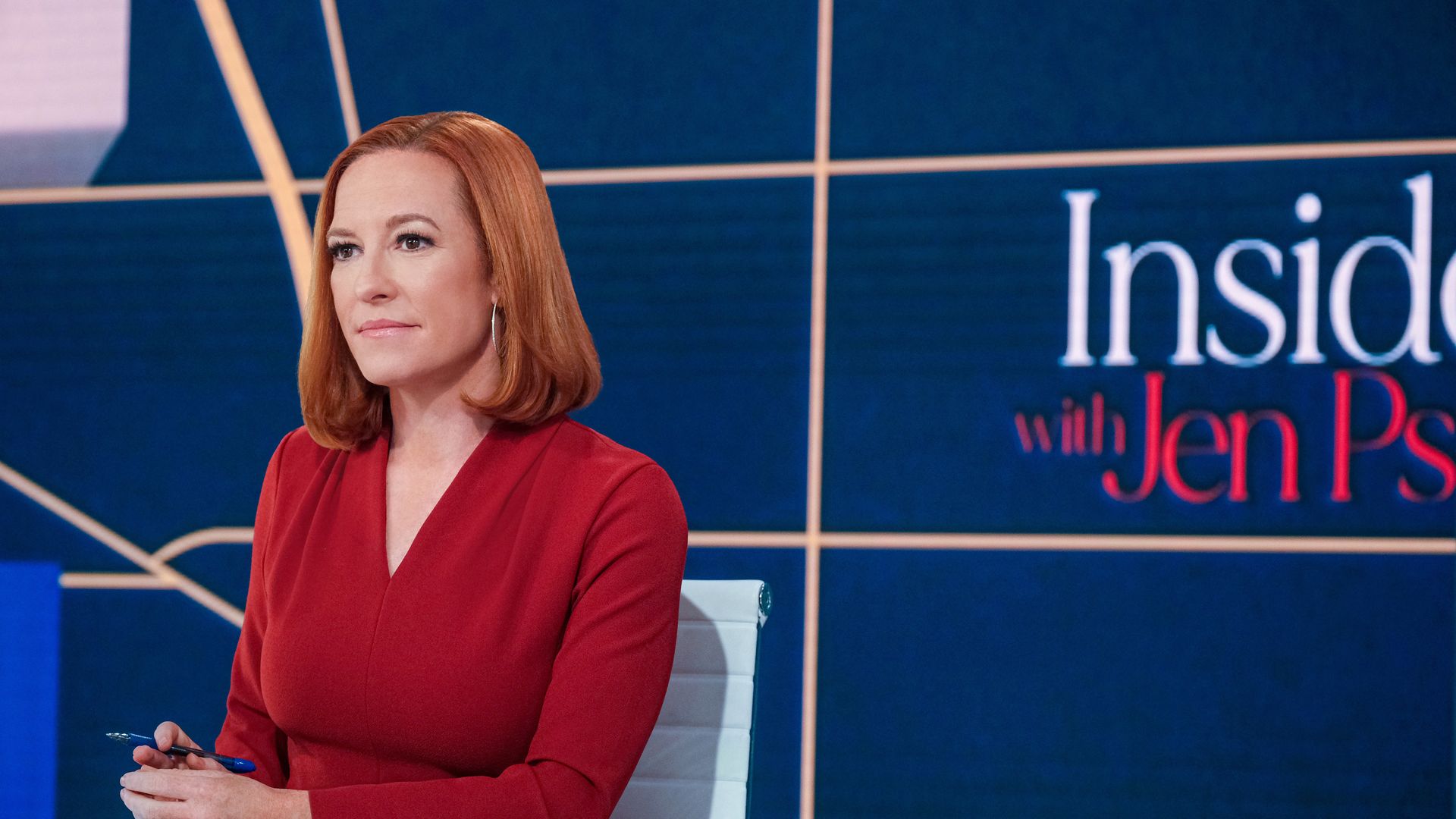
MSNBC's new president, Rebecca Kutler, announced a slew of broad programming changes to the network that elevate some of its most progressive voices.
- Why it matters: The changes signal the network's intent to double down on its liberal bent instead of moving toward the center in a new Trump era.
State of play: The shifts include moving former White House press secretary Jen Psaki, currently the host of the weekend show "Inside With Jen Psaki," to anchor one of the prime-time hours during the week.
- Psaki was named anchor of MSNBC's 9pm ET hour, helmed by Rachel Maddow every weeknight during the first 100 days of the Trump administration. Maddow plans to go back to anchoring just once per week on Mondays after that.
- Alex Wagner, who had been anchoring MSNBC's 9pm hour Tuesday-Fridays since 2022, will remain with the network as a correspondent, sources said.
👀 Other changes: Symone Sanders Townsend, Michael Steele and Alicia Menendez, the co-hosts of MSNBC's weekend program "The Weekend," will move to anchor a weekday program in the 7 p.m. ET hour.
- MSNBC's current 7pm host Joy Reid is leaving the network.
- "The Weekend" will include a new trio of co-hosts for the program, including Jonathan Capehart. Ali Velshi will expand his weekend show to three hours on the weekend.
- Sources said talks are underway for Kutler to add Politico's Eugene Daniels and NYU law professor Melissa Murray to the network's lineup.
Friction point: On her show Monday, Maddow called the cancellation of Reid's show a mistake and blasted the network for canceling shows with nonwhite anchors.
Between the lines: Kutler, a longtime producer and former head of content development and talent at CNN, has a history of developing reporters and commentators into cable news stars.
- Both Psaki's and Sanders Townsend's shows were the brainchild of Kutler. Psaki's show has become the network's most-watched weekend program.
The big picture: MSNBC and several of its sister cable networks are expected to be spun out from Comcast as part of a separate, stand-alone company that will be publicly traded.
- The split will force MSNBC to build up some of its own reporting and newsgathering infrastructure, especially in Washington, D.C., where Kutler is expected to announce a new Washington Bureau for the network in coming months.
Over at NBC, the broadcast network also announced changes yesterday.
- Lester Holt is stepping down as anchor of NBC News' "Nightly News" after a decade. He will continue to work for NBC News in a new, expanded anchor role at the network's crime news drama show, Dateline.
Sign up for Axios Media Trends