

Axios Latino

See ya, Monday. It's a new day!
🪅Please send us your pachanga nominations by filling out this form or replying to this email!
🚨Situational awareness: The U.S. government yesterday began accepting applications for the Biden administration program that creates an easier path to citizenship for undocumented immigrants married to U.S. citizens.
👀 En español 👀
This newsletter, edited by Astrid Galván, is 1,473 words, a 5.5-minute read.
1 big thing: Dems closing Latino enthusiasm gap

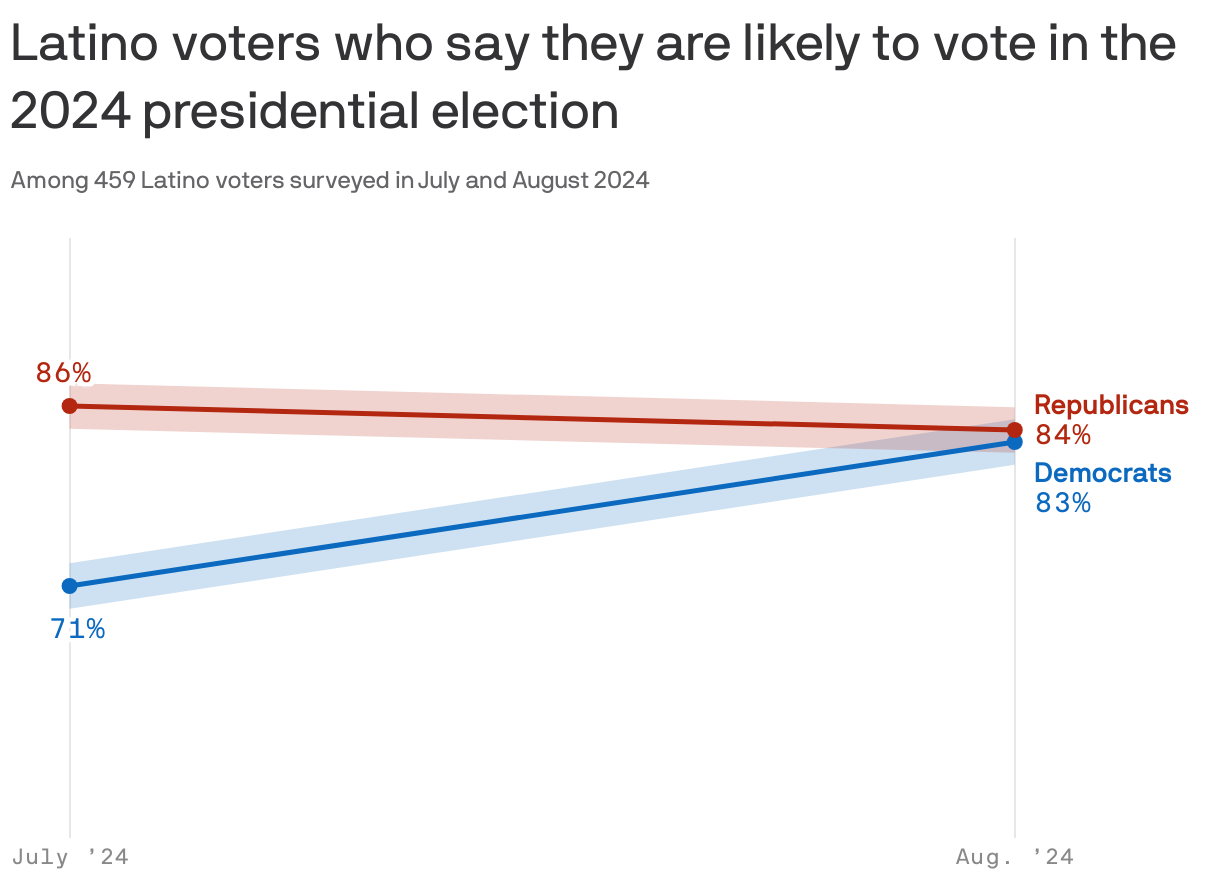
Democrats have closed a 15-point enthusiasm gap with Latino voters in the weeks since President Biden dropped his re-election bid, according to a new Axios Vibes survey by The Harris Poll.
Why it matters: The shift to a Kamala Harris-Tim Walz ticket has particularly energized women, millennial and Generation Z voters — those younger than age 43 — in this fast-growing demographic.
- Those voting blocs of Latinos appear especially motivated by having a new alternative to former President Trump.
- "It's back to a wide-open race," said John Gerzema, CEO of The Harris Poll, which is not affiliated with the vice president.
- "With Latinos, we were seeing this pronounced shift in enthusiasm toward Trump and a populist message. Now, this is a new race. It's a reset."
By the numbers: 83% of registered Latino Democratic voters and 84% of Latino Republican voters surveyed now say they're extremely likely to vote. In last month's survey, only 71% of Latino Democrats felt that way, compared with 86 of Latino Republicans.
- 63% of Latino voters in both major parties now say they're enthusiastic to vote. That closes last month's 16-point gap of 40% for Democrats and 56% for Republicans.
Asked how their views have changed in the past few weeks, 73% of Latino voters (and 67% of non-Latino voters) said they're more hopeful for the country's future, while 60% of Latino voters (and 53% of non-Latino voters) said they feel reinvigorated by politics.
- 79% of Millennial Latino voters now say they're extremely likely to vote — a jump of 16 percentage points from July.
- Not feeling the campaign's new energy quite as much: independent Latino voters. Just 52% of them said they're extremely likely to vote.
The intrigue: Perceptions on personal finances also bear watching: 48% of Latino voters in this survey described their own economic situation as good, 4 percentage points higher than in our July survey.
- Housing affordability and wages are outsized issues for Latino voters compared with non-Latino voters.
- The survey backs up what Latino voters in two crucial Central California U.S. House Districts told Axios last month: They want candidates to discuss housing and cost of living in one of the nation's poorest regions.
- Vice President Harris has proposed helping first-time home buyers cover $25,000 toward the purchase of a home.
2. Venezuelan regime cracks down on NGOs
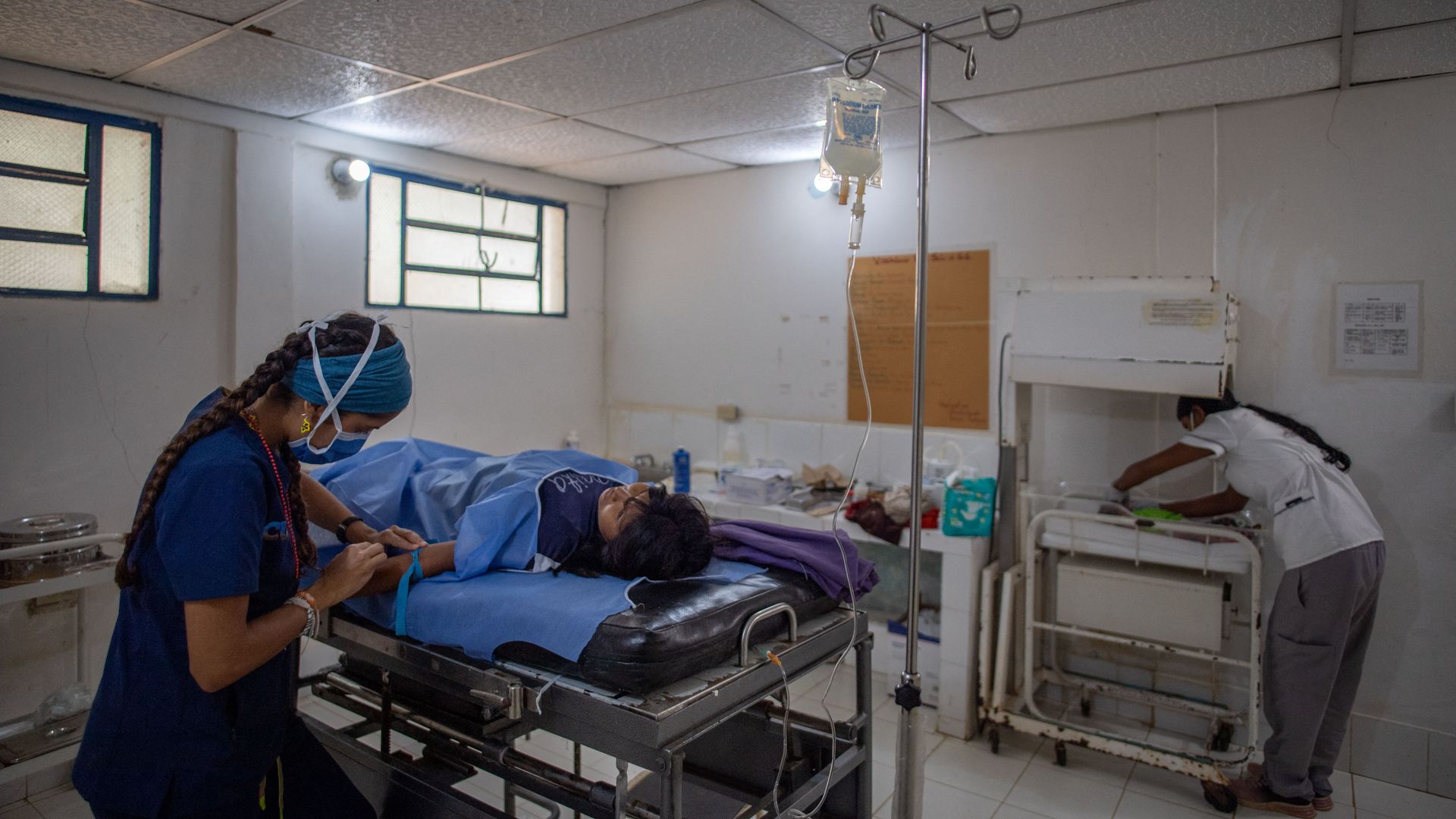
A new Venezuelan law could stifle the critical work of non-governmental organizations, aid groups and others, warn activists and international observers.
Why it matters: In a country marked by a yearslong medicine scarcity and hyperinflation that leaves few able to afford meals, food aid organizations are among those that could be shuttered.
- Amnesty International, the UN's Human Rights Office and the Inter-American Commission on Human Rights and other groups say the law, passed last week and set to take effect in 90 days, could be a death blow to freedom of speech and other civic rights.
- Other organizations that could be affected include those helping people arbitrarily arrested in protests over the disputed July 28 elections results.
Zoom in: Under the law, all organizations will need to register with the government for alleged financial auditing purposes.
- To stay in that registry, the groups will need to prove they don't do work that's "politically active."
- Authorities can close down any organization deemed to be "promoting fascism or intolerance" or "inciting violence," terms the Maduro regime regularly hurls at the opposition and human rights groups.
- International groups operating in the country, like the World Food Programme that gives meals to schoolchildren, will need to get a special permit from the government to continue their work.
- The law is very similar to one enacted in Nicaragua in 2021 that's forced more than 5,000 organizations there to shut down — 1,500 of them this week alone.
The other side: Lawmakers say the measure is meant only for regular accountability purposes and it would affect only organizations that commit "illegalities."
3. Exclusive: 🇲🇽 Mixing Hollywood and big issues
A new media company focused on social impact projects intends to open a first-of-its-kind movie studio in Baja, Mexico.
Why it matters: The Latino-founded venture, Phenomena Global, plans to tap Hollywood executives, Washington political players and advocacy groups to fund projects that are entertaining but also tackle issues such as climate change, mental health, and human rights.
Zoom in: Co-founder Adrian Eng-Gastelum, who was a campaign strategist for President Biden and a senior adviser to Health and Human Services Secretary Xavier Becerra, says this marks the first time a studio is being built in Baja jointly by Hollywood and political interests.
- Phenomena has its first Baja project in development — a murder mystery about dolphins that loops in a conservation and environmental message, according to Eng-Gastelum.
The big picture: Hollywood was hit hard by the pandemic and last year's labor strikes, and productions are down compared to the year before.
- Eng-Gastelum says many of the movies that are being made are intellectual property films such as "The Super Mario Bros. Movie," released last year, or "The Smurfs Movie," slated for release next year.
- Phenomena wants to finance "the films that actually end up becoming the Oscar winners, the cult classics that we all seem to know and love," Eng-Gastelum says.
4. Mexican American studies pioneer dies at 85
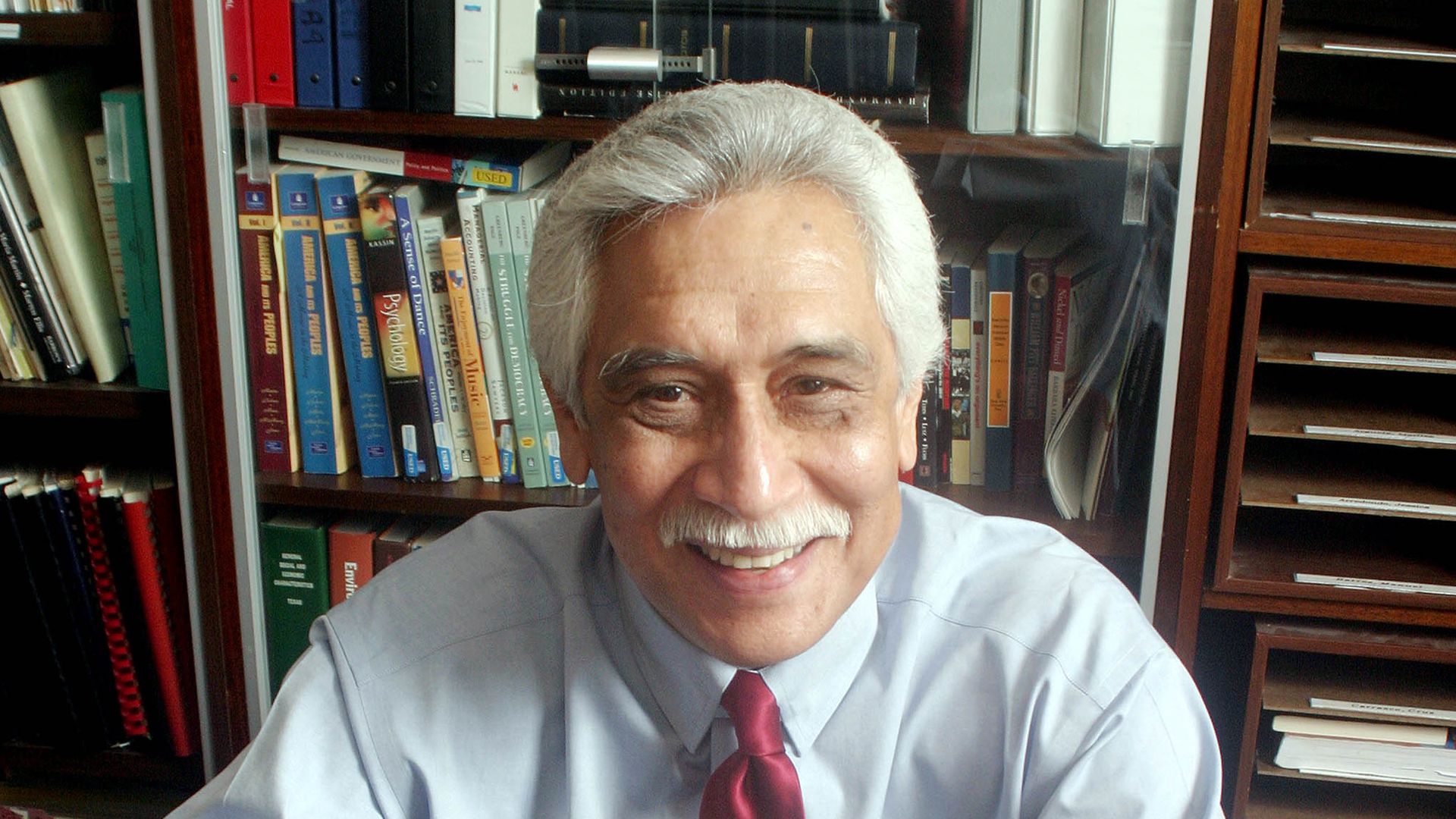
Tatcho Mindiola, a veteran of the 1970s Chicano Movement who went on to create one of the nation's most successful Mexican American Studies college programs, has died. He was 85.
The big picture: While a sociology professor at the University of Houston, Mindiola mentored thousands of Latino and Black students, including future state lawmakers, city councilors, business leaders and journalists.
- The University of Houston announced Mindiola's death on Sunday but did not release additional details.
- Mindiola, who was retired, is credited with starting an underfunded Mexican American Studies program and turning it into a multimillion-dollar entity with graduate fellows, visiting scholars and nationally known professors.
Zoom in: After the Chicano Movement, Mindiola became one of the first Mexican Americans to receive a doctorate from Brown University in Rhode Island at a time when few Latinos attended Ivy Leagues.
- On returning to Houston, he launched the Mexican American Studies program, which later became the UH Center for Mexican American and Latino/a Studies.
- Mindiola was able to get funding for the program by working with a state lawmaker and quietly getting a line item in the Texas state budget.
5. Stories we're watching
1. The Brazilian office of X, formerly Twitter, is being shut down by Elon Musk due to an anti-disinformation court order.
- Brazil's Supreme Court Judge Alexander de Moraes had ordered the social network to take down posts spreading lies about the country 's voting system, or face a fine.
- Musk responded by moving to close the local X office, alleging the judge's order is censorship.
2. Puerto Rico suffered losses of around $23 million in its agricultural sector during last week's battering from Hurricane Ernesto.
- Coffee and banana crops were among the most affected.
- The island, still vulnerable after the effects of 2017's Hurricane María, also relies on imports for a lot of produce, but distribution could be hampered as Ernesto left several roads flooded or closed off by debris.
6. Smile to go: ⚽️ A cup for asylum seekers

A soccer tournament organized for asylum seekers and other immigrants waiting in Ciudad Juárez, Mexico, ended last week with a team from Venezuela taking the win.
State of play: Dubbed the Migrant Copa América, the tournament was born last year as a way to give some of those people huddled in shelters a chance to decompress and have fun.
- This second edition of the Copa included immigrants and shelter workers representing Guatemala, Honduras, Nicaragua, El Salvador, Colombia, Ecuador, Venezuela and Mexico.
- The final was played by the men's Venezuelan and Ecuadorian teams, with Venezuela winning 2-1.
Zoom out: Hundreds of people are regularly waiting in Juárez for an appointment with U.S. immigration authorities to enter the country.
💔 Russell is remembering riding in a car with his late mentor and professor Tatcho Mindiola the day Selena died and seeing all the cars in Houston with the words "Viva Selena por vida."
🫠 Marina keeps adding to her to-read pile, thanks to the Booker Prize longlist.
🧐 Astrid has been trying to read this piece on a mysterious brain illness for days now.
Many thanks to Carlos Cunha, Alison Snyder, Noah Bressner, David Lindsey and Axios Visuals for their help with this newsletter!
Editor's note: Item 3 of this newsletter has been updated to remove an incorrect reference to where in Baja the studio will be.
Sign up for Axios Latino