Why Washington appears to be the only state to shift blue in 2024

Add Axios as your preferred source to
see more of our stories on Google.
Update: The final tally shows Washington did shift to the right slightly. Read a new Axios analysis here.
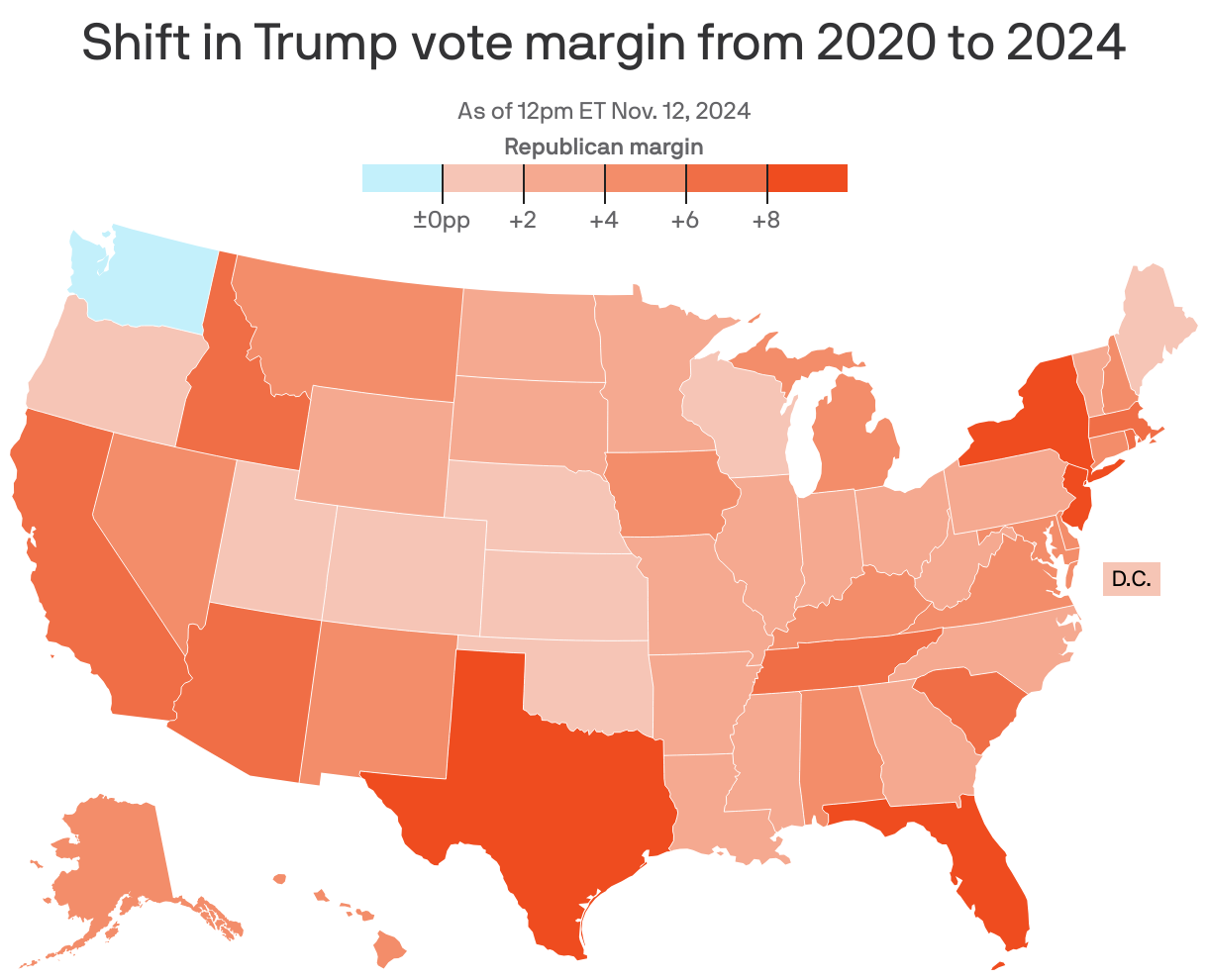
After a week of vote counting, Washington still appears to be the only state that got slightly bluer in the 2024 presidential election — and political observers have several theories why.
Why it matters: As Democrats assess why they lost the presidency and potentially both chambers of Congress, politicians in left-leaning Washington state are preparing to help lead the resistance against the next Trump administration.
State of play: Washington's support of abortion rights, tech-heavy economy, recent wage growth and high share of college-educated voters likely contributed to it being the only U.S. state where Democrats gained ground last week, experts tell Axios.
- In every other U.S. state, Trump's vote margin in the presidential election grew between 2020 and 2024, per an Axios analysis of vote totals through Tuesday morning.
- Axios calculated each state's Republican vote margin by subtracting the percentage of the state's voters who voted for Vice President Harris from the percentage that voted for Trump, excluding votes for third-party candidates.
By the numbers: As of Tuesday, 38.71% of Washington voters had cast ballots for Trump this year.
- That's a slight decrease from the 38.77% of votes Trump won in the Evergreen State in 2020.
What they're saying: In recent elections, tech-heavy regions have broken for Democrats, and "Washington is exceptional in how technologically intensive our economy is," Victor Menaldo, a University of Washington political science professor who co-wrote a book on the topic, told Axios.
- Washington's reliance on international trade — another marker of a tech-centered economy — is another likely factor in its presidential results, Menaldo said.
- "When you hear the word tariff, you're really scared if you depend on imports and exports," Menaldo said, referencing some of Trump's economic policies.
- Washington has also seen wage growth that has helped counterbalance recent inflation, which wasn't the case everywhere, Menaldo said.
- "Our general population hasn't suffered as much as in a lot of other states that have more blue-collar workers," Cornell Clayton, a political science professor at Washington State University, told Axios.
Between the lines: Democrats' messaging on abortion rights may also have landed better in Washington, which "has always been one of the most liberal states on abortion," Mark Alan Smith, a political science professor at the University of Washington, told Axios.
- Washington voters have twice approved ballot measures protecting or expanding abortion access — once in 1991, and once in 1970, three years before the Supreme Court's Roe v. Wade ruling.
Yes, but: Washington's statewide results obscure the increasing divides between some of the state's counties.


While many counties on the west side of the state — including Clark, Clallam, Jefferson and Thurston — went further to the left this year, the opposite was true of several more rural counties in central and eastern Washington, which trended more toward Trump.


- Clayton said that reflected the rural versus urban divide we're seeing in the rest of the country. "It's just that we have a lot more people in the urban and suburban areas than the rural areas of our state," he said.
What we're watching: While national experts have often looked to Washington's top-two primary as a predictor of how the nation will vote in November, the state's outlier status this year may change that going forward.
Editor's note: The headline on this story has been corrected to note that as of when it published, Washington appeared to be (not was) the only state to shift blue in 2024.