Where the Denver mayor candidates differ on the key issues


Add Axios as your preferred source to
see more of our stories on Google.
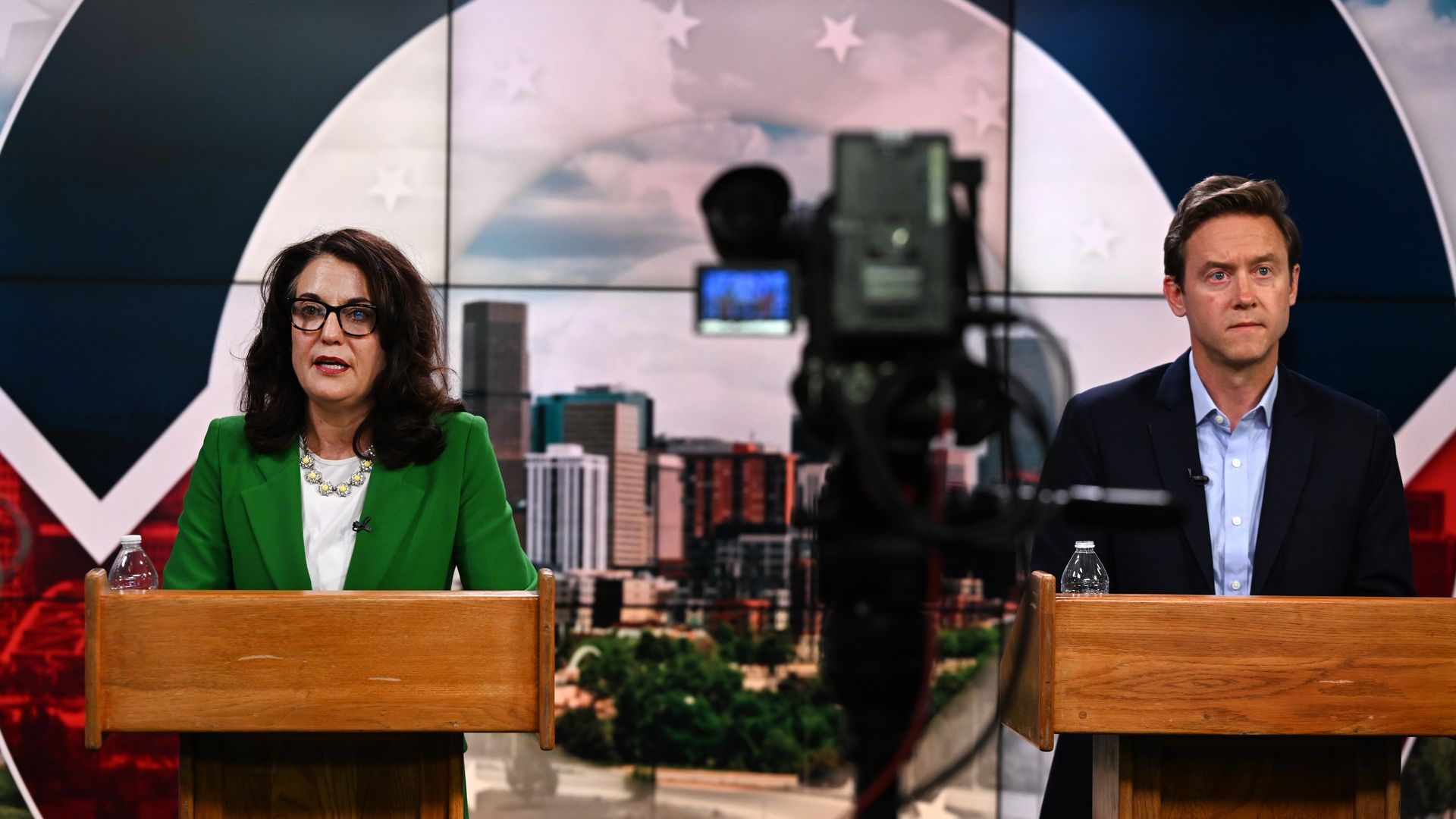
Denver mayoral candidates Kelly Brough, left, and Mike Johnston during a televised debate May 23. Photo: Helen H. Richardson/Denver Post via Getty Images
The Denver mayor's race is entering the final stretch, and the differences between the final two candidates are becoming readily apparent.
State of play: Mike Johnston and Kelly Brough may sound similar in speeches but their approach — and records — show divergent paths on five key issues.
1. Homelessness
Both candidates are pledging to end homelessness in Denver — and say it's more than just aspirational.
Johnston is planning to provide housing to all who need it within his first term by building up to 1,200 tiny homes in "micro-communities" located mostly on city land and converting more than a thousand motel rooms to permanent housing.
- Reality check: It's not enough to house the roughly 7,000 people experiencing homelessness, and advocates say it will take significant financial investment that remains uncommitted.
- He also is pledging to end evictions, but that requires controversial new laws.
Brough is vowing to eliminate homeless encampments in her first year and enforce the city's camping ban by building more sanctioned locations for tents. But the most controversial part of her plan is the involuntary commitment or arrest of people who are living on the streets. She says it's the humane thing to do to keep people from living in squalor.
- Reality check: In order to forcibly arrest people living on the street, the city must provide an alternative location, whether a shelter or tent site. That will prove difficult — and expensive to do — and it's still unclear if people will relocate.
2. Public safety
The candidates plan to hire more officers and expand alternative programs to varying levels.
Johnston wants to hire 200 more "community-focused" first responders — police and mental health workers — to support people in crisis. He aims to curb crime through early intervention with diversionary courts dedicated to mental health, drugs and firearms.
- Of note: Johnston is also pushing for a new unit focused on auto theft in Denver's police department, as well as for more mental health and addiction support in city jails.
Brough — who is endorsed by Denver's law enforcement labor unions — aims to strengthen the police department to its full force of 1,600 officers and improve the agency’s recruitment and retention efforts, particularly for women and people of color.
- Of note: Brough also says she will expand the city's Support Team Assisted Response (STAR) program and Denver police's co-responder program to free up officers to focus more on violent crime.
3. Affordable housing
The two hopefuls are promising immediate action amid rising rent and pricey homes, yet relief will take much longer than the candidates suggest.
Johnston has pledged to build 25,000 permanently affordable housing units and require the city to approve affordable housing permits within 90 days. Additionally, he wants the city to provide residents with more down payment assistance to build wealth.
- Reality check: The city is facing a backlog of construction permits due in large part to staffing shortages, which means many developers are waiting up to two years for the greenlight — only adding to the time it takes to build new units.
Brough wants to build housing on city-owned property, incentivize landlords to convert vacant office space into residential units and empower more residents to build accessory dwelling units.
- Of note: To speed up Denver's construction permitting delays, Brough will consider hiring external contractors, but it's unclear how she will pay for it.
4. Downtown
Both candidates agree more action is needed to revive downtown, but they take varying approaches.
Johnston's plan requires more city workers to return to the office and improve safety with more law enforcement patrolling the area. He also would make commuting downtown on public transit free for workers and college students.
- Yes, but: He can't force private sector workers to return, so foot traffic will likely remain muted.
Brough wants empty office buildings converted into residential units, and she's prioritizing completion of the massive 16th Street Mall rehab project and rapid bus service on Colfax Avenue.
- Reality check: It remains unclear if either project can speed up its timeline, given cost questions and other factors.
5. Climate
This is one area where the candidates are diametrically opposed.
Johnston wants to ban natural gas connections in new construction to "get us off of fossil fuels" and electrify all buildings. He also supports city-level incentives for electric vehicles and a charging network, and is proposing an expansion of public transit to reduce the reliance on cars.
- Reality check: In prior bids for higher office, Johnston set ambitious environmental goals, but he's likely to face opposition to new building mandates that critics say will increase the cost of construction.
Brough does not take such a hard line toward natural gas, but supports moving toward 100% renewable energy by 2040, as the governor has outlined. She also wants to focus on electrifying the city's fleet of vehicles.
- Of note: Brough's backing of the oil and gas industry during her tenure as CEO at the Denver chamber is undercutting her arguments on the issue. She says she doesn't support drilling for oil and gas within city limits, though.