Chicago Fire stadium funding plan draws West Loop backlash

Add Axios as your preferred source to
see more of our stories on Google.
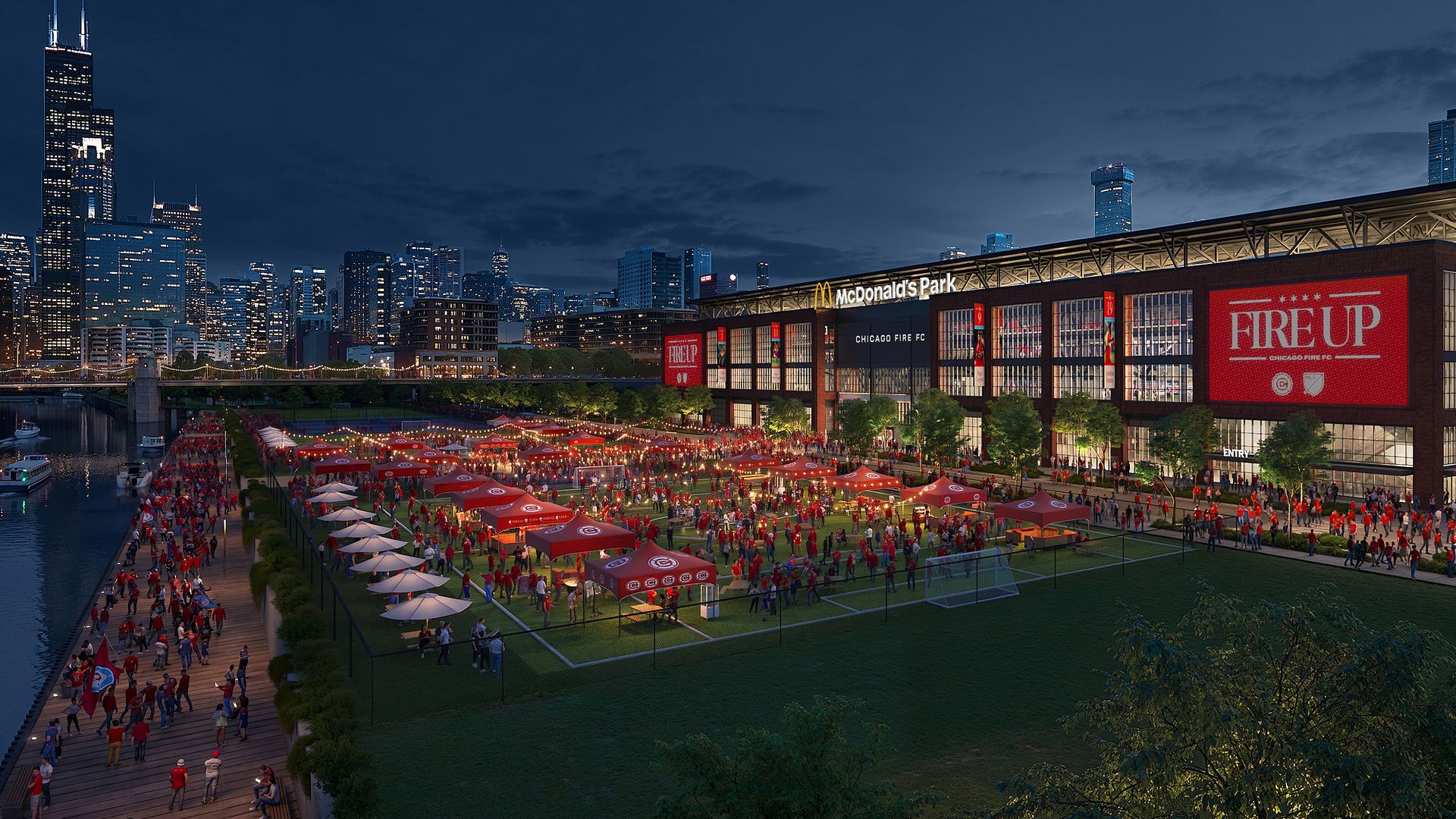
Rendering of the new Fire FC stadium in the South Loop. Rendering: Courtesy of Chicago Fire FC
Chicago's plan to help pay for infrastructure around the new Chicago Fire stadium is sparking backlash from West Loop leaders, who say City Hall is raiding their neighborhood's TIF fund.
Why it matters: The city's plan to shift up to $287 million from a neighboring West Loop TIF district could affect funding for other upcoming projects.
The latest: Chicago lawmakers passed a nearly $425 million package last week to build and improve infrastructure around the new soccer stadium in the South Loop.
- It includes a bold idea to bridge the 40-foot gap between the site and Roosevelt Road near the Chicago River and connect the project to the Chicago street grid. It's a move that Ald. Pat Dowell (3rd) says will connect the South Side to the rest of the city.
- Other improvements include a 1,200-space parking garage, new roads, Metra track upgrades and public parks and plazas.
Driving the news: The taxpayer-funded infrastructure package would pay for improvements surrounding the 62-acre development, while Fire owner Joe Mansueto is financing the $750 million stadium itself.
- The city plans to tap the Canal/Congress TIF district, which spans much of the West Loop west of the Chicago River.
What they're saying: "I think it is a terrible time to ask taxpayers who are struggling right now to tell them we found $250 million to build a stadium parking lot and plaza when we are having problems with public safety with funding the CTA," Ald. Bill Conway (34th) told Axios.
- Conway says he doesn't object to using Canal/Congress TIF money for stadium infrastructure. What he opposes is spending hundreds of millions on improvements he believes aren't necessary.
- He's also concerned the move could delay plans for a new concourse at nearby Union Station and make it harder to cover cost overruns on other downtown projects, including bridge repairs.
Catch up quick: TIF districts capture the growth in property tax revenue within a designated area and reinvest it in local redevelopment projects, including infrastructure, parks and schools.
- The West Loop has shrewdly used its TIF money to build up the neighborhood in the past few decades.
Yes, but: It is legal for the city to take one neighborhood's TIF money and use it for another neighborhood project. It's called "porting," and it's allowed if the neighborhoods share a boundary. In this case, Harrison Street.
Reality check: The city and South Loop Ald. Pat Dowell argue the stadium is a citywide asset, not just a neighborhood project, making the infrastructure investment appropriate.
Zoom out: The 78 has been repeatedly reinvented over the past decade. Related Midwest first envisioned the former rail yard as a mixed-use neighborhood. It was later floated as a site for Bally's casino and a new White Sox stadium. The Fire stadium is now the project's centerpiece.
The bottom line: The Fire stadium may be billed as a citywide project, but the fight over who pays for it is becoming a neighborhood battle.