Chicago flocks to condos as housing costs surge

Add Axios as your preferred source to
see more of our stories on Google.
Illustration: Annelise Capossela/Axios
Big condos are a hot commodity in Chicago's tight market.
What's happening: With fewer homes to choose from, units that offer the home office space people want are selling fast, local broker Mary Jo Nathan tells Axios.
- It took about three months for a condo to sell in the cramped Near North Side, compared with roughly one month in Uptown and North Center, where there are fewer high-rises, per second-quarter sales data Nathan tracks.
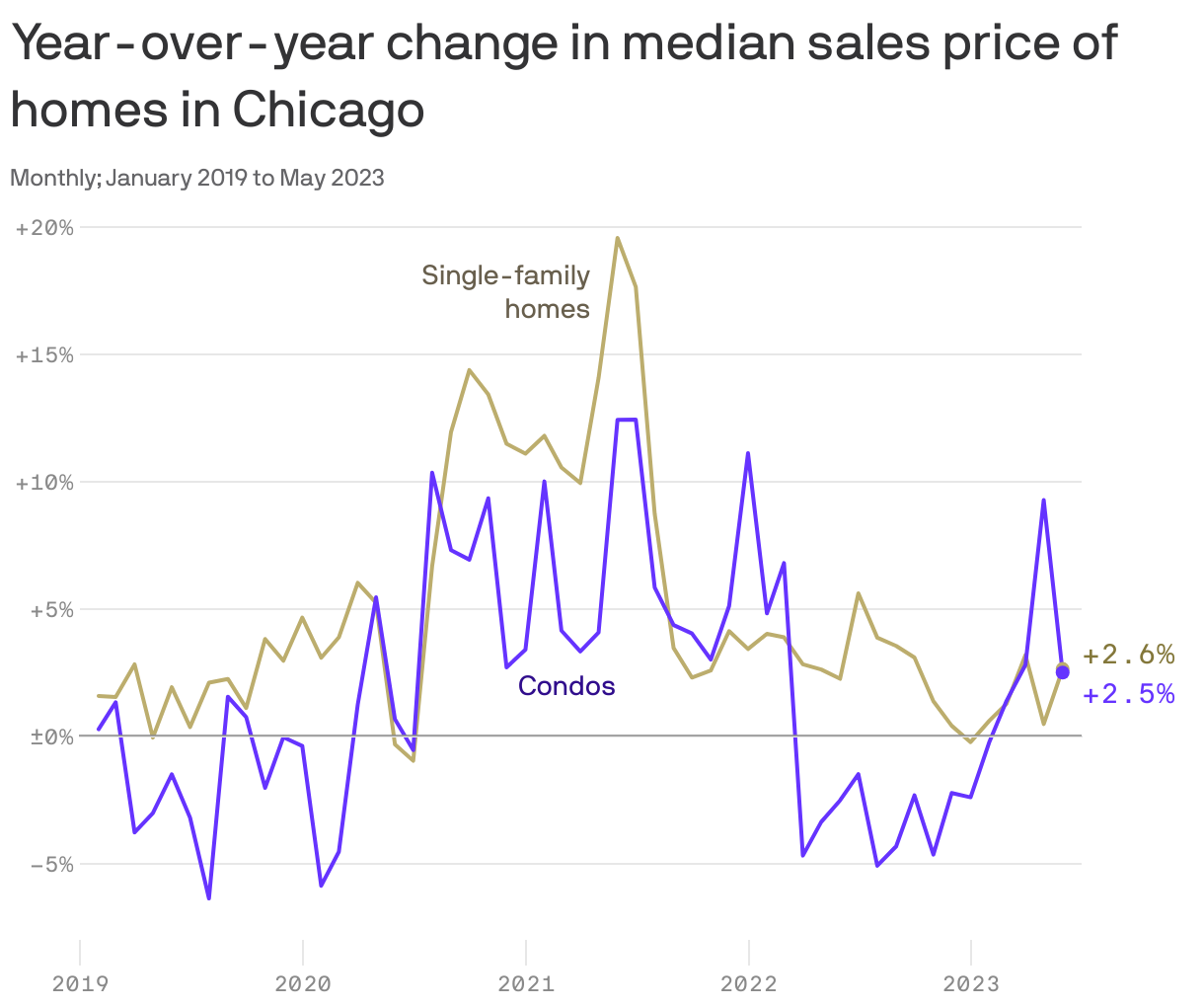
The big picture: More buyers have turned to condos and townhouses as home prices surge, Realtor.com analyst Hannah Jones tells Axios.
- Across the U.S., that segment's prices are now climbing at a faster clip than single-family homes, the real estate company's data shows.
Between the lines: Condos' growing appeal comes as younger buyers look for more affordable homes, and empty-nesters want to downsize to a maintenance-free lifestyle.
- The median sales price for a metro-area condo was about $92,600 less than a single-family home here in May, according to Zillow.
- Yes, but: Homeowners association fees, which vary building to building, factor into the cost of owning a condo.
- Also, condos sell at a premium in the city, where a typical unit sold in May for $53,900 more than a single-family house, per Illinois Realtors.
State of play: Chicagoland condo inventory is down 90% from pre-pandemic levels, according to Zillow. There were only 1,193 active condo listings across the entire metro in June, the data shows.
What they're saying: After months of searching, Naperville's Maura Connor and her husband purchased an East Lakeview condo in late May. The two-level unit has a private rooftop, home office and an extra bedroom for when their daughter visits.
- And, they'll never have to clean the gutters again, she tells Axios. "It's been fun giving away our lawn tools."
Go deeper: The post-pandemic housing shortage is keeping prices high across the country, and the Chicago metro is way below the U.S. average for new homebuilding.