A Senate panel voted Thursday to hold Anthony Fauci in contempt for repeatedly declining to answer questions last week from lawmakers investigating the origins of the COVID-19 pandemic.
Why it matters: Sen. Rand Paul (R-Ky.) has said he will refer the contempt resolution to the Department of Justice for possible prosecution.
A Stanford-led research team has used generative AI to design a synthetic virus — the first time artificial intelligence has been harnessed to create an organism that has never been seen in nature.
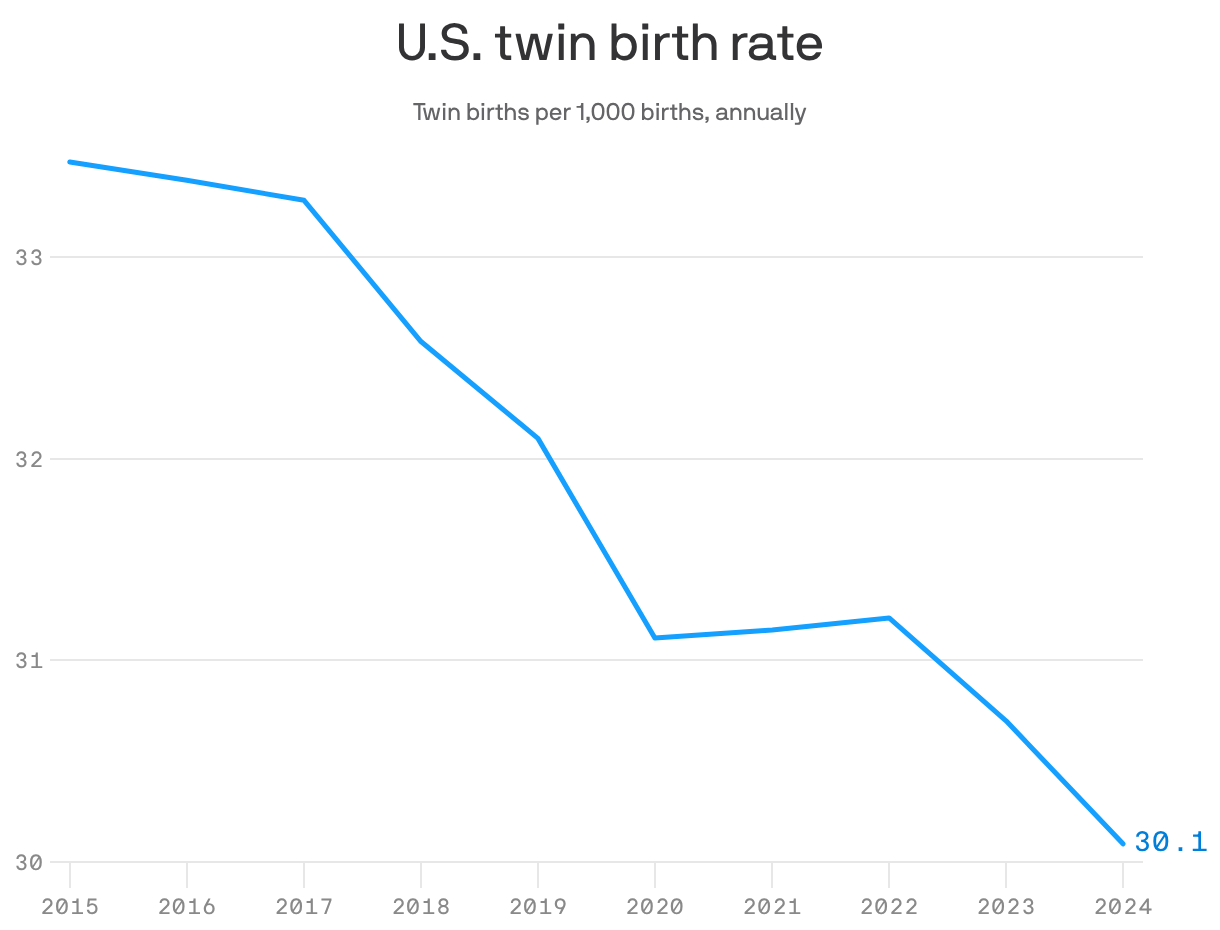
In the last decade, the rate of twin births has declined in the U.S., per CDC data.
The big picture: Early use of IVF contributed to a national twin baby boom. But once fertility treatments got more advanced, doctors increasingly recommended transferring a single embryo to reduce pregnancy risks.
Abdul El-Sayed's victory in Michigan's Democratic primary for Senate raises the prospect of a rare new addition to the upper chamber: a progressive doctor — albeit one who doesn't practice medicine.
Why it matters: El-Sayed's medical degree and his experience in public health could bring a powerful new perspective to Washington health care debates — particularly those around Medicare for All, which he staunchly supports.
As America's dry spell stretches on, one of our most reliable forms of social glue is drying up with it: hanging out at a bar.
Why it matters: Americans are drinking less to protect their health, improve their sleep and feel sharper. But we still need "third places" outside home and work where people can gather without much of a plan.
The Senate confirmed Erica Schwartz for Centers for Disease Control director on Wednesday, giving the beleaguered agency its first full-time political leader in almost a year.
Why it matters: While the 51-44 vote marked a step toward refilling the depleted ranks of the Trump administration's health care leadership, it didn't fully resolve questions about whether Schwartz could steer clear of political interference.
At Axios House in Cannes, France on June 24, Eric Weisberg, global chief creative officer at Havas Health Network, sat down with executive vice president of Axios Live Kristin Burkhalter to discuss Havas' latest report on the "superaging" era.
Drawing on data from the network's prosumer research, tracking insights from 10,000 forward-thinking consumers across eight countries, Weisberg broke down how global attitudes toward growing older have transformed, turning the $33 trillion longevity economy into an engine for brands across every industry.
Senate Republicans' planned vote this week on whether to hold Anthony Fauci in contempt of Congress is the latest escalation in their attempt to right perceived COVID-era wrongs and further disempower the federal health care bureaucracy.
Why it matters: Critics fear the Senate Homeland Security Committee's efforts will deter scientific talent from taking government jobs, weakening America's public health infrastructure and ceding its dominance in biomedical innovation.