Friday's health stories

Medicare Advantage premiums, benefits look stable for 2025
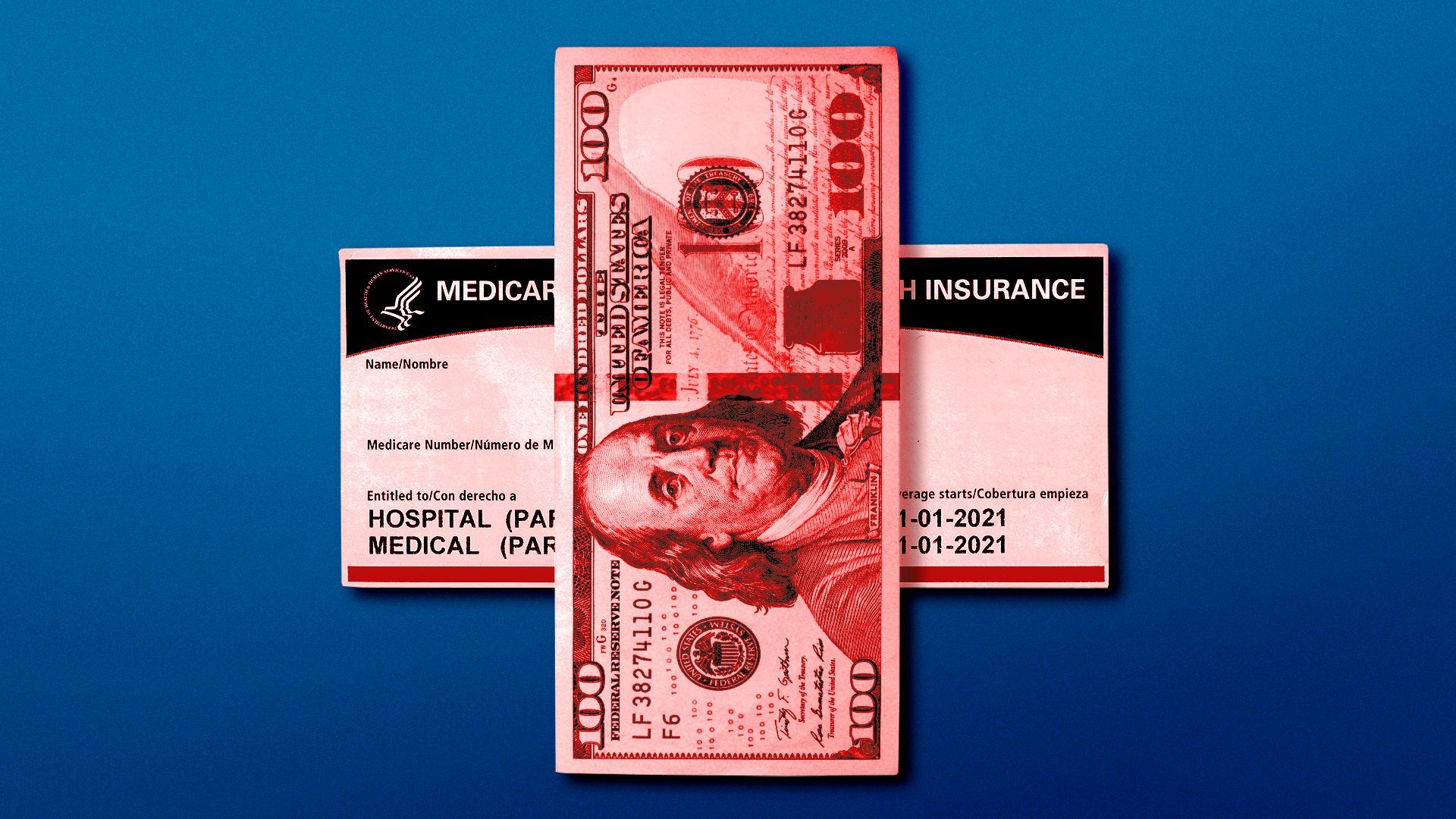
The average monthly premium for privately-run Medicare plans will fall slightly to $17.00 next year, down from the current average of $18.23, federal officials said Friday.
Why it matters: Despite insurers' warnings of benefit cuts, the Centers for Medicare and Medicaid Services expects Medicare Advantage enrollees' benefits and access to coverage to remain stable in 2025, based on plan bids submitted to the federal agency.

WeightWatchers CEO is suddenly out of a job

The CEO of WeightWatchers is abruptly out of a job amid growing uncertainty about the company's future following its pivot under her leadership to embracing weight-loss drugs.
Why it matters: Tech executive Sima Sistani sent WeightWatchers in a new direction after she took over in early 2022, acknowledging that weight loss isn't necessarily a matter of willpower and acquiring a telehealth company that markets anti-obesity drugs.

Tom Brady joins blood donation campaign with the Big Ten conference

NFL legend Tom Brady is partnering with medical device company Abbott and universities in the Big Ten conference to boost blood donations.
Why it matters: Thirteen of the 19 community blood centers in the Midwest (where most Big Ten schools are located) have less than two days of blood supply.

Why medical debt relief isn't a cure-all

Relieving patients of medical debt is en vogue around the country, but preventing it from accumulating in the first place is much harder because it requires addressing some of the U.S. health system's fundamental problems.
Why it matters: Medical debt is ultimately the result of high U.S. health care prices and the choices made to manage them, including by insurers' use of deductibles and other out-of-pocket cost sharing.

America's loneliest states
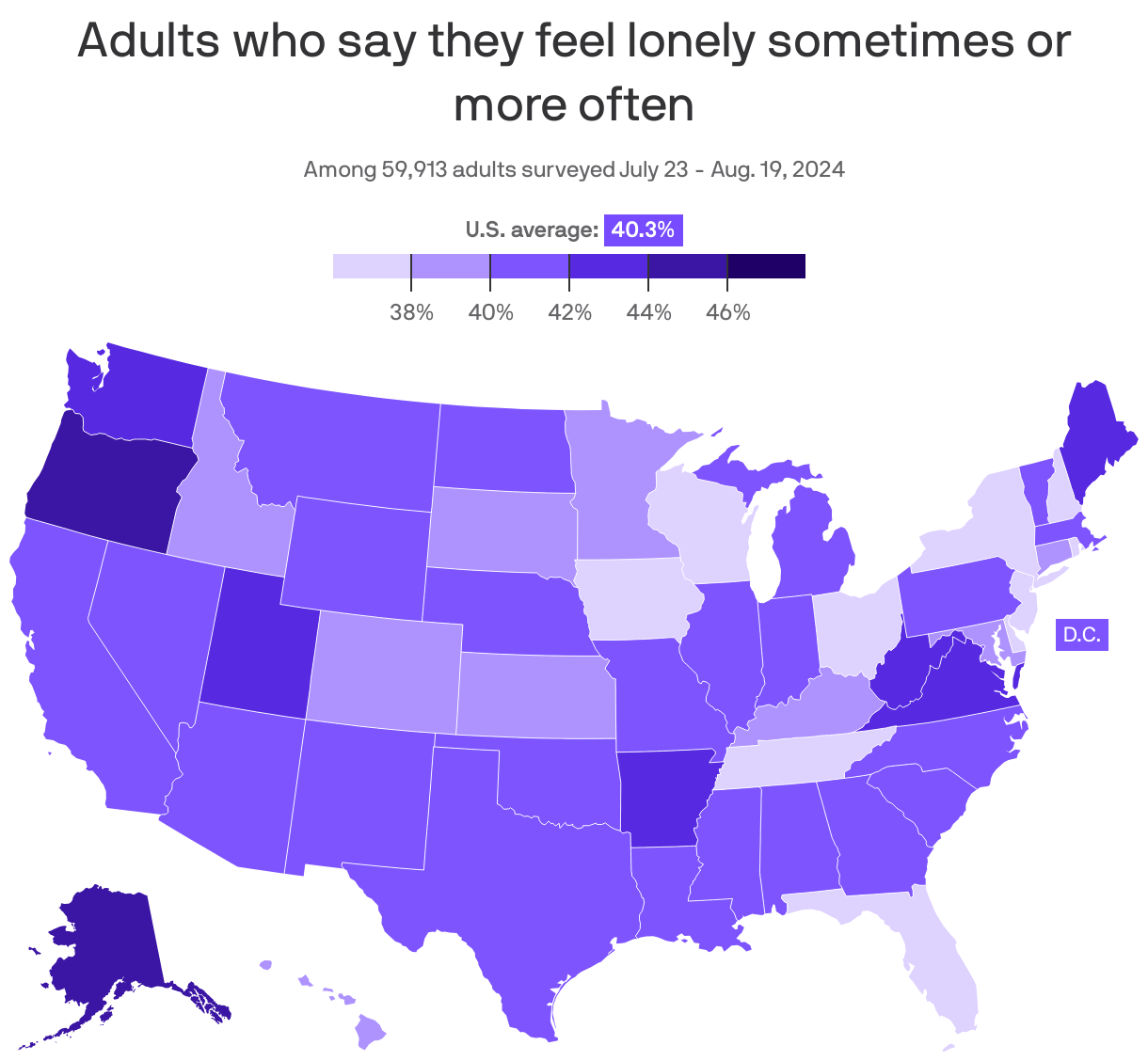
Nearly half of Americans reported feeling lonely at least sometimes in the latest vibe check from the U.S. Census Bureau.
Why it matters: Feelings of isolation and loneliness are a real public health threat — so much so that Surgeon General Vivek Murthy last year issued an advisory on the matter.

Axios House: Climate change is creating a human health crisis

NEW YORK – Climate change is increasingly recognized as a global health crisis, said attendees at an Axios House Expert Voices roundtable on Sept. 23.
The details: Health care and climate leaders gathered for a private roundtable at Axios House during Climate Week and UNGA to discuss sustainable innovation within the healthcare system.
- Axios health care reporter Maya Goldman and host/editor Niala Boodhoo moderated the event, which was sponsored by Philips.
Climate change is a "human health crisis," said Climeworks global head of healthcare partnerships Hussein Dhanani. "0.2 degrees has a big impact on human life."
As much as climate change impacts people's health, Philips global head of sustainability Robert Metzke noted that "health care is also extremely polluting and contributing" to the issue.
- Emmie Mediate, U.S. chief program officer for Health Care Without Harm, said the healthcare industry is "used as the exception" by the fossil fuel industry.
- Companies often say that plastics save lives, and fossil fuels are essential to treat patients. "That is certainly true to an extent, but we can't let ourselves off that easy," she said.
- "Of course, we want to continue to provide care to patients and that's going to take energy to do that. We don't want to deny anyone care…during this transition process. But that doesn't mean we shouldn't try to get to a place and we shouldn't let ourselves off just to sort of give the fossil fuel industry that excuse."
Health care systems around the world are "under-resourced [and] overstretched," said Pam Cheng, AstraZeneca's EVP of Global Operations and IT and chief sustainability officer. However, early disease detection and treatment can help alleviate some of that burden on the system and environment, said Pam Cheng, AstraZeneca's EVP of Global Operations and IT and chief sustainability officer.
- The climate crisis "impacts quite a bit disproportionately the underserved population in certain geographies."
- "If we can keep the patients out of the hospital…it's better for the patients, it's better for the system and it's better for the environment."
When it comes to government regulations helping usher health care into a sustainable future, HHS Office of Climate Change and Health Equity director John Balbus said until the "industry is ready to accept regulations, those regulations will not be successful."
- "The role of the government is to show the way, is to document success, is to create community of practices, is to develop technical assistance, is to create the models and document that they work, and move towards a setting where we understand the optimal practice and it's generally accepted to the point where we're making it a requirement where everybody will succeed."
AI is transforming every sector, including health care, but it doesn't come without its own environmental risks.
- "There's so much possibility and hype around AI, but not enough discussion about the energy consumption needed to drive it," said National Academy of Medicine president Victor Dzau.
- Cornell Tech's Health Tech Hub clinical innovation director Chethan Sarabu said the rapid pace the industry is implementing AI highlights the importance of prioritizing sustainability.
- "Focusing on 'how do we sustainably advance healthy AI', I think is a critical care and important aspect of the time we're in," Sarabu said.
- He suggested that health care systems could pledge that "all of [their] new AI initiatives need to come from renewable energy" to balance the need to innovate while also being sustainably-minded.


Free COVID tests available to order again from government

U.S. households can order four free COVID-19 tests from the federal government with the Sept. 26 relaunch of the at-home test distribution program.
The big picture: High or very high levels of the virus are still present in some parts of the U.S., even though the summer COVID surge has decreased over half the country.

Ending ACA subsidies could affect 2 million chronically ill
A decision by Congress to let enhanced Affordable Care Act subsidies expire next year could leave 2 million people with chronic conditions uninsured, a new analysis from consulting firm Oliver Wyman shows.
Why it matters: The fate of the subsidies is shaping up to be one of the biggest health care issues facing the next Congress.
Ozempic linked to drop in opioid overdose risk: study

The active ingredient in the popular diabetes and obesity drugs Ozempic and Wegovy could be linked to a drop in opioid overdoses, a study published in JAMA Network Open found.
Why it matters: It's the latest evidence that buzzy drugs known as GLP-1s could be used to address psychiatric disorders, including addiction.