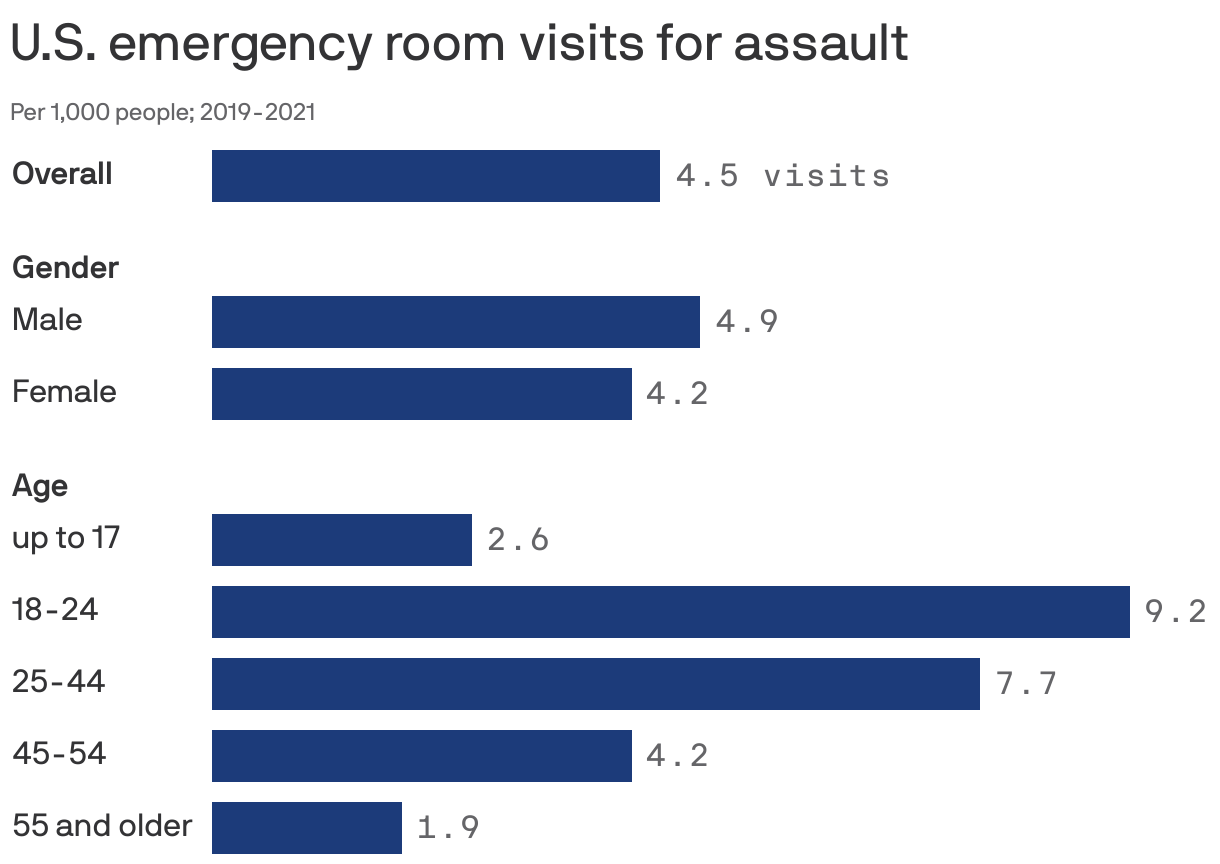
Assaults accounted for more than 1.3 million — or roughly 6% — of all injuries treated in emergency departments in 2020, according to new figures from the CDC's National Center for Health Statistics.
Why it matters: The data, which doesn't include sexual assaults, provides a snapshot of the burden violence-related injuries places on the health system.
Harvard and University of Oxford researchers are harnessing AI to predict threatening new strains of COVID-19 and other viruses.
Why it matters: The approach could prove more efficient than lab-based testing, because it doesn't rely on people becoming infected or getting vaccinated to develop antibodies.
Nearly two years after a surprise medical bill ban took effect, the process for settling billing disputes between insurers and providers is still mired in litigation and many cases remain unresolved.
Why it matters: Uncertainty around how providers get paid for disputed out-of-network services isn't likely to ease as multiple challenges to the Biden administration arbitration rules continue to work through the courts.
Radiation therapy has saved countless lives, but the way its effects are commonly described as "brutal" or "toxic" makes some cancer patients avoid it as an option, according to a commentary published in JAMA Oncology.
What they're saying: While radiation therapy can leave damaging side effects, major improvements have made it safer, more precise and more effective, Narek Shaverdian, an author of the viewpoint and a radiation oncologist at Memorial Sloan Kettering Cancer Center, told Axios.
Sen. Bernie Sanders and one of the biggest hospital lobbies on Tuesday offered clashing views on how much nonprofit health systems benefit the communities they serve.
Driving the news: Sanders (I-Vt.), who chairs the Senate HELP Committee, issued a report that found six of the biggest nonprofit hospital systems dedicated less than 1% of their total revenue to charity care in 2021 — a key criteria for maintaining their tax-exempt status that Sanders wants tightened.
The number of abortions performed in North Carolina fell 31% the month after the state implemented a 12-week ban and required in-person counseling before the procedure, according to the Guttmacher Institute.
Why it matters: The ban, which took effect July 1, changed the landscape in one of the South's last havens for women seeking abortions.
A trio of new studies paints a grim picture of how overdose deaths, depression and barriers to care are weighing heaviest on disadvantaged and minority groups — and are aligning to widen health disparities as the U.S. emerges from the pandemic.
Why it matters: While behavioral health issues seep into nearly every corner of American life, many experts say interventions have to be built around "precision psychology" that factors social determinants and can predict which subgroups benefit the most.