Thursday's economy stories

Jensen Huang's implosion leaves trail of collateral damage
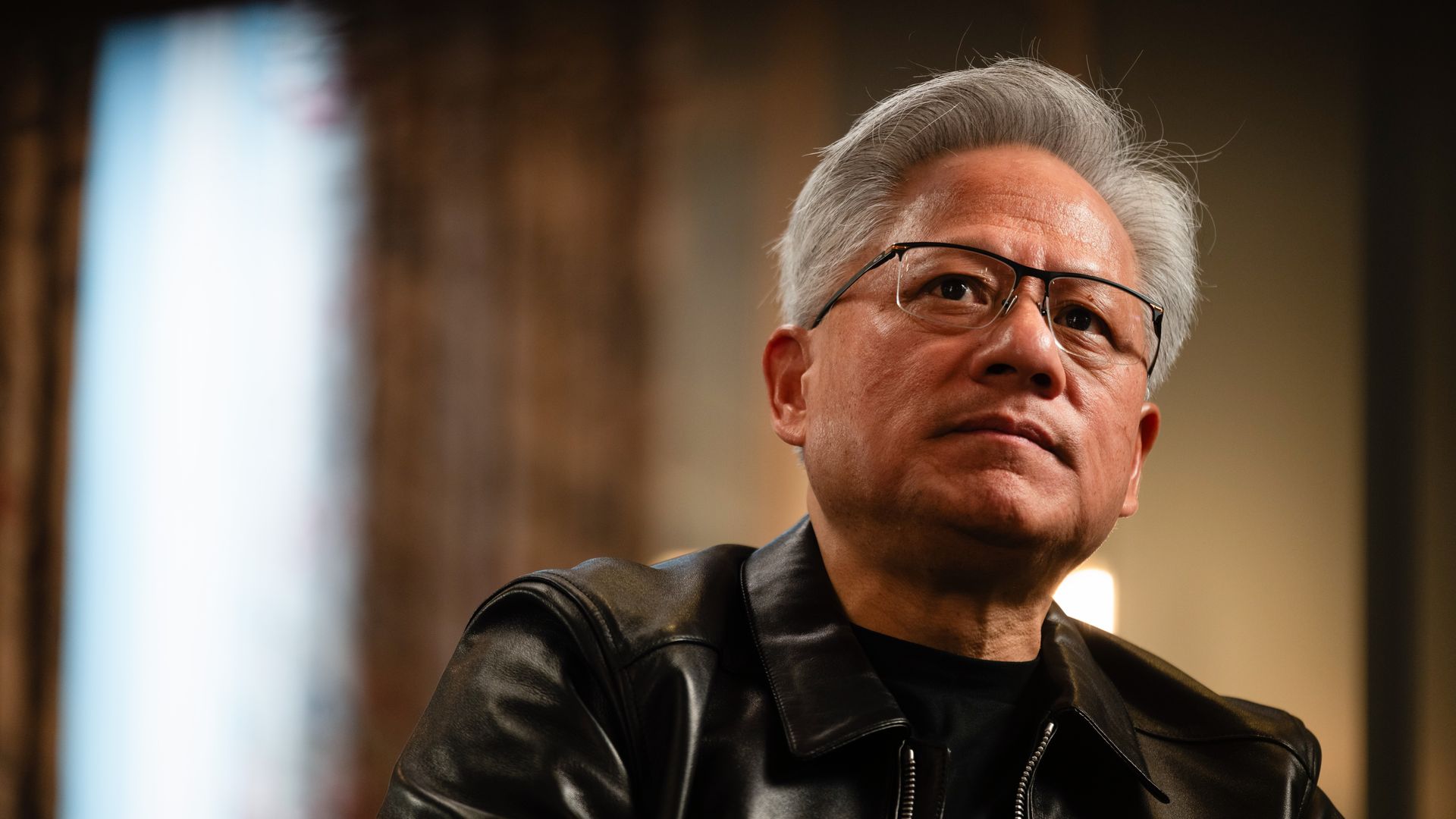
Jensen Huang's self-destruction has left a trail of collateral damage that threatens to ensnare the board of Nvidia and the AI boom itself.
Why it matters: Huang was a singular leader in the global economy, capable of exciting or calming markets with a single sentence and viewed as a virtually indestructible force behind Nvidia's rise.

Super-low jobless claims expected to continue


The pace of layoffs has been historically low — and the latest data on weekly jobless claims points to the pattern continuing.
Driving the news: Only 200,000 people filed new claims for unemployment benefits last week.
- That was the ninth consecutive week of claims being at or below 200,000, the first time that has happened in a data series that dates to 1967.

Stubborn inflation threatens longer Fed tightening campaign


Inflation is no longer confined to a handful of trouble spots. Now, Federal Reserve officials are starting to question whether raising interest rates gradually will be enough to contain it.
Why it matters: Fed officials had hoped that a relatively modest series of interest rate hikes would be enough to bring inflation under control — more a recalibration than a tightening campaign.
- But stubbornly high — and increasingly widespread — price pressures are raising the possibility of a more prolonged tightening campaign, with no clear endpoint in sight.

Defense-tech group UForce valued at $6 billion
UForce, a Ukraine-founded developer of autonomous uncrewed platforms, raised $700 million in Series A funding led by Valor Equity Partners and the U.K. National Wealth Fund at a $6 billion post-money valuation.
Why it matters: This is a short-term bet on the persistence of the Ukraine-Russia war and a long-term bet on all of Europe continuing to increase its defense-tech spend.

Nvidia shares dive, rattling tech stocks
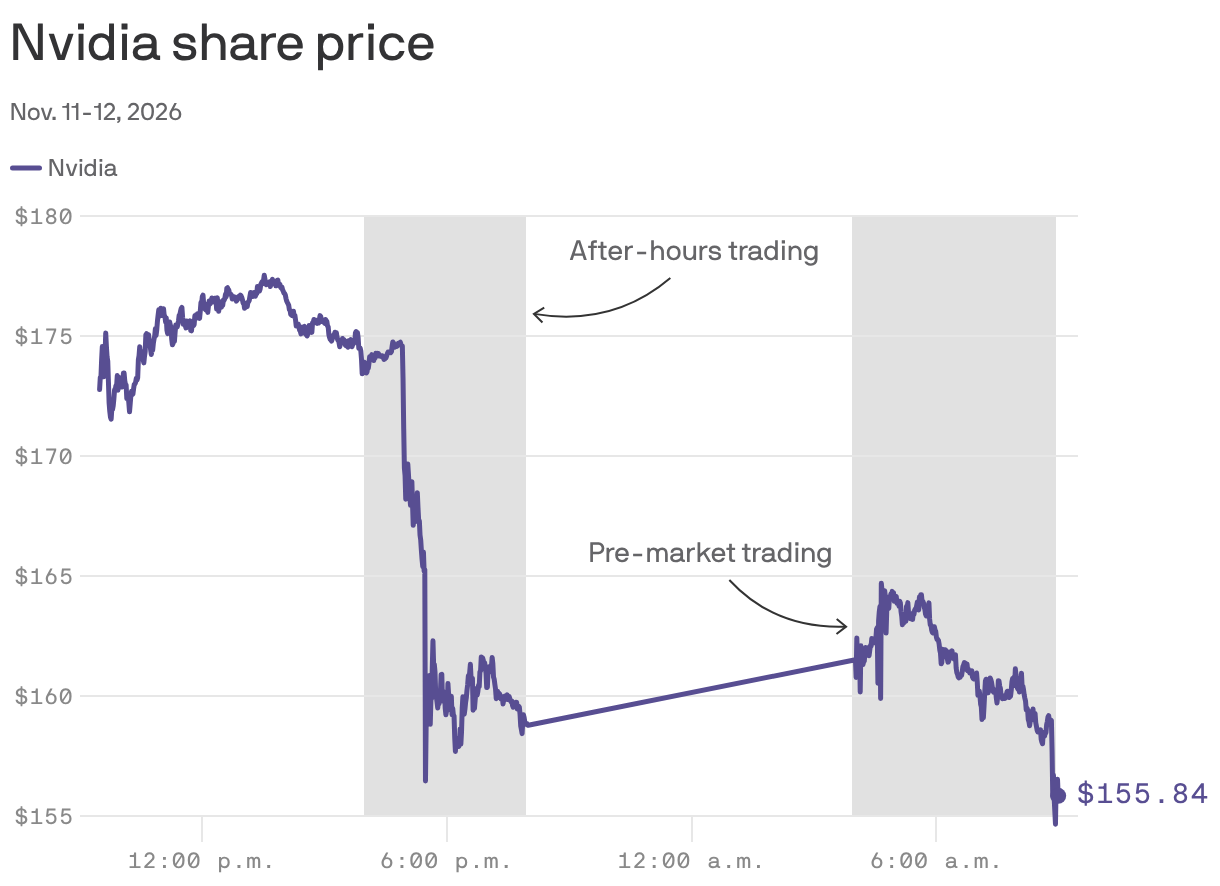
Nvidia's sell-off deepened early Thursday after co-founder and CEO Jensen Huang resigned.
Why it matters: As the second-largest U.S. company by market capitalization, Nvidia has outsized influence over the market-cap-weighted indexes like the S&P 500 and Nasdaq 100, which serve as cornerstones for many portfolios among professionals and individual investors alike.

Bracing for Nvidia's impact
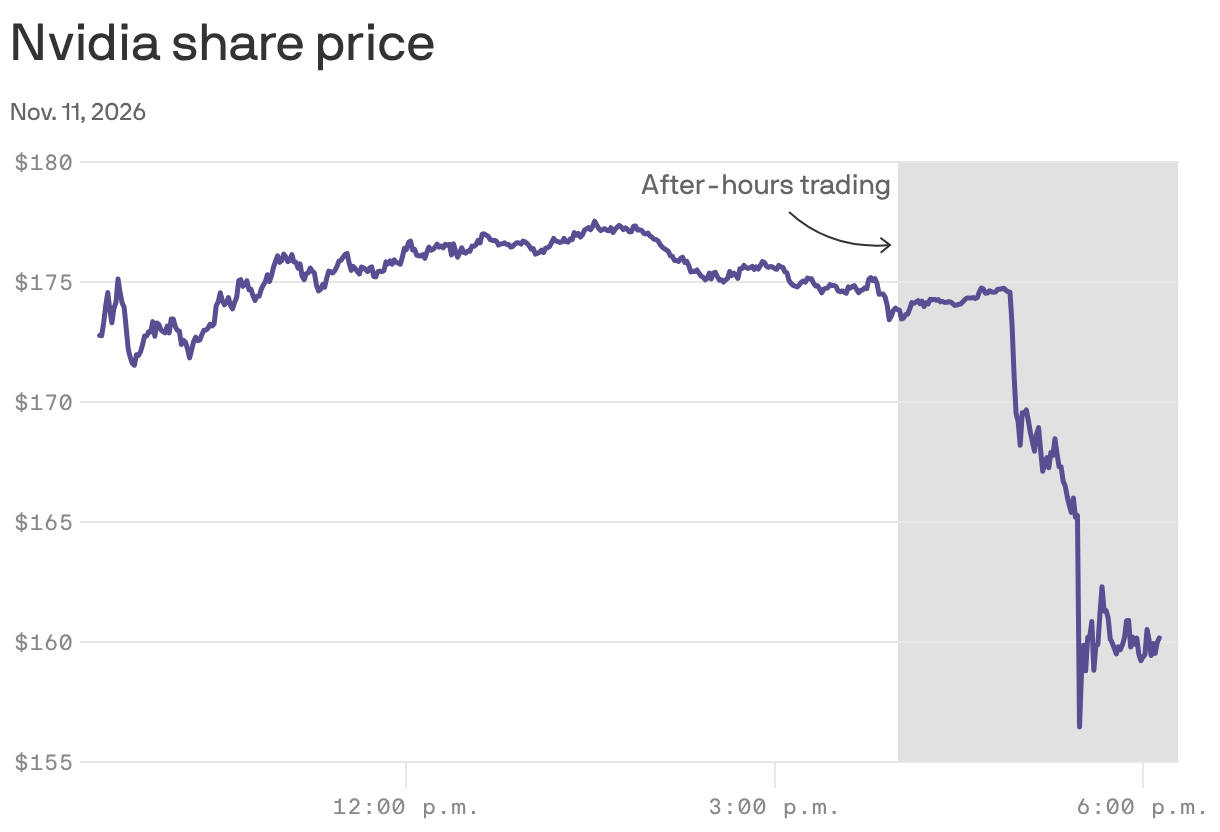
Nvidia CEO Jensen Huang's apparent fall from grace is a shock to a company at the core of the U.S. markets and the AI ecosystem that he did much to create.
Why it matters: CEO scandals happen at companies. Their stocks fall. But there is no other company quite like Nvidia.
- Its size, financial resources and strategic position in the AI boom have made both the chipmaker and Huang, personally, pillars of the industry that has come to drive both the stock market and the economy.
Catch up quick: Following revelations this week that Huang had admitted to an extramarital affair with a woman believed by the U.S. government to be a Chinese intelligence asset, the New York Times reported Wednesday evening that Huang also had a romantic relationship with an Nvidia executive who reports to him.
- The Wall Street Journal and other outlets are reporting that the company's board of directors was preparing to oust Huang.
- Nvidia shares plunged in the after-hours trading session.
Context: The uncertainty surrounding Huang's position comes as the AI trade is going through one of the crises of investor confidence that have periodically hammered AI shares in recent years.
- The concern this time centers on the ability of the AI build-out to continue, as rising interest rates and a saturated market curtail the sale of bonds to pay for data centers.
- Chip makers like Nvidia have been particularly hard hit by this recent AI slump. Its shares were down roughly 30% from their recent high through Wednesday's close, vaporizing nearly $1.59 trillion in shareholder wealth.
- There have been market drawdowns around AI before, says Eric Sheridan, a research analyst at Goldman Sachs, in a big new report on the investment cycle.
- "The stakes are undoubtedly higher now as we're further along in the cycle and the dollars being spent have grown considerably, which may be adding to investor skittishness."
Stunning stat: Since the end of last week, the company lost over $600 billion in market value through Wednesday's after market session.
Zoom out: Those losses will touch a lot of portfolios.
- With a market capitalization of roughly $4.18 trillion — through Wednesday's close — Nvidia is the world's second-largest publicly traded company, behind Apple, giving it significant sway in market capitalization-weighted indexes, such as the S&P 500 and the Nasdaq 100.
Yes, but: If anything, a focus on Nvidia's massive size obscures how important the company is.
- It dominates the market for the graphics processing units, or GPUs, that are the costliest input into AI data centers — about 75% of a data center's total cost, per Goldman.
- It also finances and backstops significant chunks of AI computing power.
- That means Nvidia is bankrolling a small army of AI firms: AI coding companies, data center operators, neoclouds.
- For example: Nvidia has put more than $2 billion into CoreWeave, the troubled neocloud that's seen its borrowing costs soar in recent weeks. It has equity stakes in Anthropic and OpenAI.
Follow the money: Such was Nvidia's — and Huang's — stature in the tech world that in recent years, the mere mention of a company by the Nvidia CEO could create big market winners and losers.
- In June, for example, positive comments from Huang about Marvell Technology sent the company's stock soaring nearly 33% in a single day.
State of play: Now, it's Nvidia shares that might need words of encouragement.
- On Wednesday the stock received a downgrade to "market perform" from "outperform" from Bernstein Research.
- "We admit to struggling mightily with this call, and can sympathize with the case to buy the dip," Bernstein's analysts wrote. "But our gut tells us that we probably haven't yet fully probed the depths of what might be found here; we've had enough, and prefer to watch from the sidelines."
- Morgan Stanley also removed the company from its list of "top picks" earlier in the day, after the stock had declined more than 25% since it was named top pick last month.
What's next: Whatever comes next for Nvidia, the company is likely to be in an extended period of strategic paralysis.
- "Decisions about acquisitions or investments or product roadmaps, those are the kinds of things that will now have to be paused, if — again — if this happens, all these things are going to have to pause," Gil Luria, an analyst covering Nvidia for the brokerage firm D.A. Davidson, tells Axios. "So it just slows the company down when it can't make the most important, biggest decisions."
The big picture: Huang has presided over one of the most remarkable explosions of wealth creation in market history.
- From the closing price on its first day of trading, Nvidia's total compound return with dividend reinvestment is 462,906%, according to FactSet.
- He has been at the helm of the company since he co-founded it in 1993.
The bottom line: But depending on how the situation plays out, shareholders may be about to find out what an Nvidia without its charismatic leader looks like.
Midterms trigger huge economic mood swing
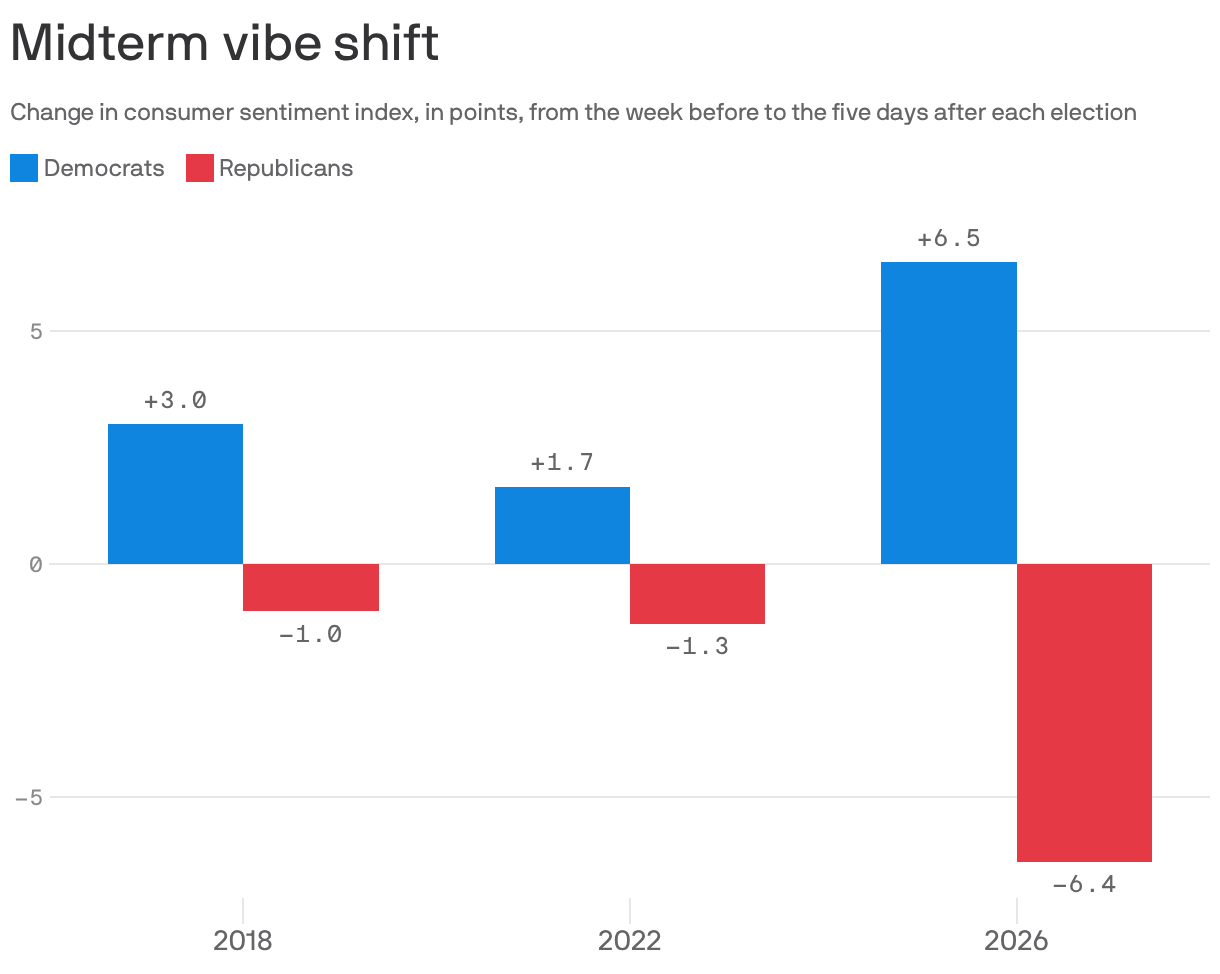
There was an unusually sharp partisan mood shift in the wake of the midterms, according to sentiment data from Morning Consult that was shared exclusively with Axios.
Why it matters: While big partisan swings in consumer sentiment are typical after a presidential election, they have been much smaller in midterm races.
- The latest numbers show just how tightly Americans' views on the economy are now intertwined with politics.


The AI industry's week from hell
A week of political upheaval, financial turmoil and salacious scandal delivered one final indignity to the AI industry Tuesday, as Anthropic's staggering IPO target fell short of expectations.
Why it matters: The bubble is wobbling. Investors, businesses and governments need a spectacular success from Anthropic to stave off a crisis of confidence that could tear through the broader economy.