Sunday's economy stories

Why Wall Street still needs human traders
A rush into algorithmic trading is setting up a concentration of faith in computerized investment, a trend that could backfire in intensified volatility and lowered returns.
What's going on: By 2025, Wall Street firms are expected to shed 10% of their work force — 230,000 jobs — as they embrace intelligent algorithms, trading that relies on crunching mountains of data and sometimes anticipating the actions of human traders (see chart, below), according to the financial consultancy Opimas.


Migrants, big cities, and our direst problems
Our age is one big contradiction:
- Around the world, people are flocking to big cities. But we are abandoning other cities — our rust belts and rural towns.
- The developed world — the number of Europeans, Japanese and Americans — is shrinking and aging. But Africa's population is doubling and young.
- We face a potential jobless future because of automation; but we have an acute current shortage of workers.
And these are not mere statistical curiosities:
- Alienation in rust belts and secondary cities underlies the anti-establishment wave roiling the U.S. and Europe.
- The cost of supporting and caring for our growing elderly populations could overwhelm state budgets.
- Chaos and worsened political instability could erupt in the gap before we fully adjust to vast automation.
In a NYT op-ed today, Kai-Fu Lee, the CEO of Sinovation, a venture capital firm, writes that we will have no choice but a gargantuan transfer of wealth from rich individuals and nations to the poor. But Jose Lobo, a professor at the Santa Fe Institute, told me that things that look like enormous problems may actually be answers.
In that vein, Lobo said:
- Migration, such as the massive flow of Middle Eastern, Afghan and African migrants into Europe starting in 2015, should be embraced as a large part of the solution to a fast-shrinking work force, he said. Until now viewed as an acute crisis, they are actually a way to have the taxes to support European pensions. "We are going to have less Spaniards, less Russians, less Italians. But migrants tend to be young, and to have babies," Lobo said.
- Urbanization — the historical shift of the planet's population to big cities — could result in a massive reduction in poverty. We spend much time attempting to "save" our rust belt towns and cities, and to help prop up their continued population level. But these people are much more likely to obtain reasonable jobs and services in bigger, prosperous cities (Lobo cites this 2015 paper by World Bank economist Paul Romer).
Bottom line: In Lobo's scenario, Africa's over-population problem becomes a solution to Europe's and Japan's depopulation; and the ultra-massive growth of cities becomes a poverty alleviation program.

New startup trend: sell one digital currency for another
Entrepreneurs have a new trick to raise money quickly, and it all takes place online, free from the constraints of banks and regulators. Since the beginning of 2017, 65 startups have raised $522 million using initial coin offerings — trading a digital coin (essentially an investment in their company) for a digital currency, like Bitcoin or Ether.
One recent example: Bay Area coders earned $35 million in less than 30 seconds during an online fund-raising event, NYT reports. They sold Basic Attention Tokens (BAT coin) which will grant buyers access to an innovative ad-free web browser the coders are intending to create, but have yet to launch.
And that's the catch: these investors are buying promises in the form of coins for a product or service that doesn't exist.

Volkswagen quickens job cuts with an eye on electrics, self-driving
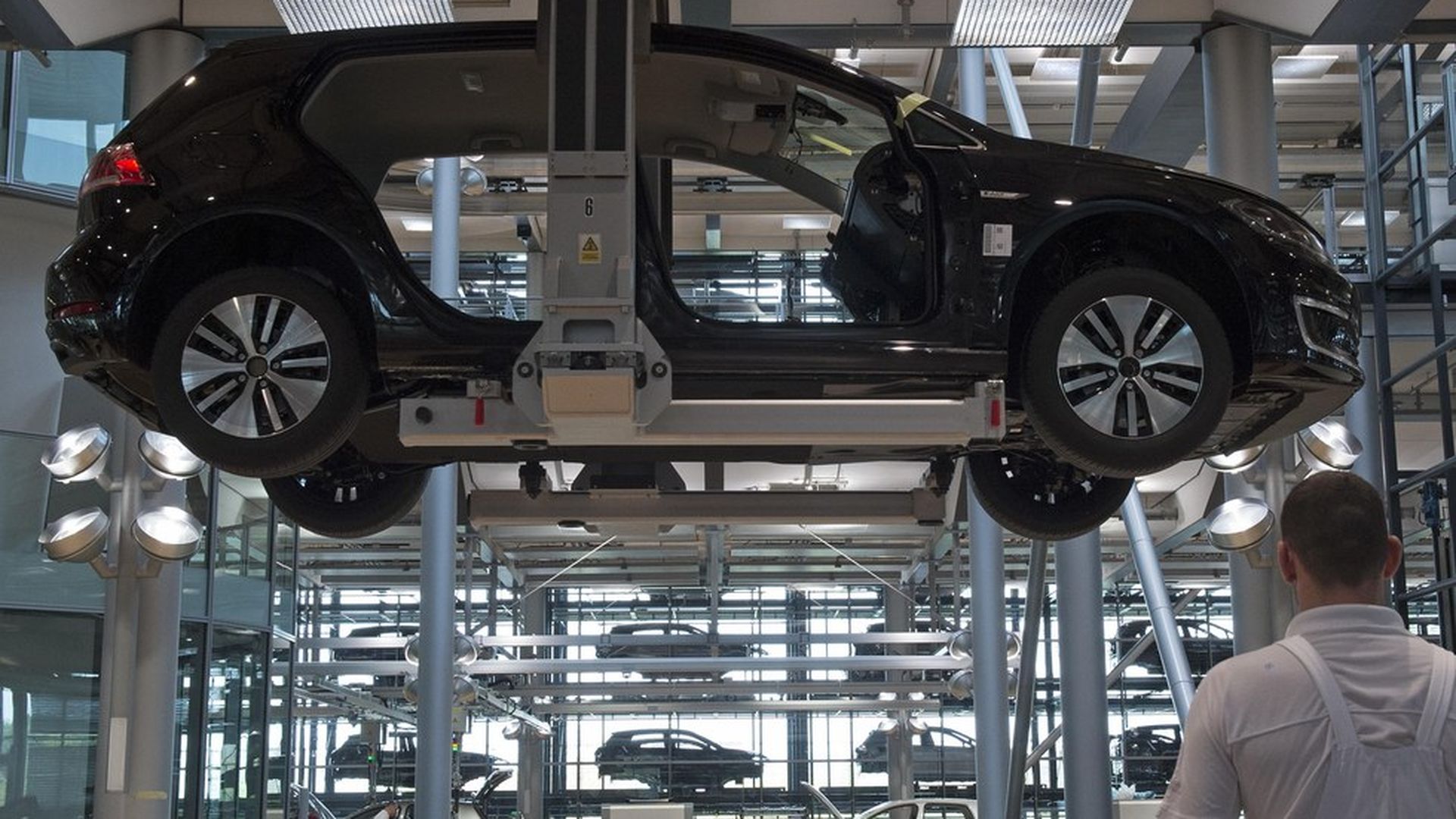
Volkswagen is moving faster to cut up to 23,000 jobs and shift the savings to electric and self-driving car technology, Reuters reports. The company plans to create 9,000 new positions in advanced batteries and mobility services.
Volkswagen isn't alone among carmakers cutting jobs — GM and Ford have both announced significant layoffs, also with an eye toward increasing their focus on electric-car and self-driving technologies. Last month, Ford abruptly fired CEO Mark Fields and replaced him with Jim Hackett, head of its automated-vehicle division.
Why it matters: The U.S. car market peaked last year, but these cuts are about more than the ebb and flow of auto sales. The globe's top auto executives see an existential threat in the form of upstart electric and self-driving car technologies. They know that winning the next five or ten years won't be about building a better internal combustion engine or creating the best marketing campaign, but the next-generation of automotive technologies.