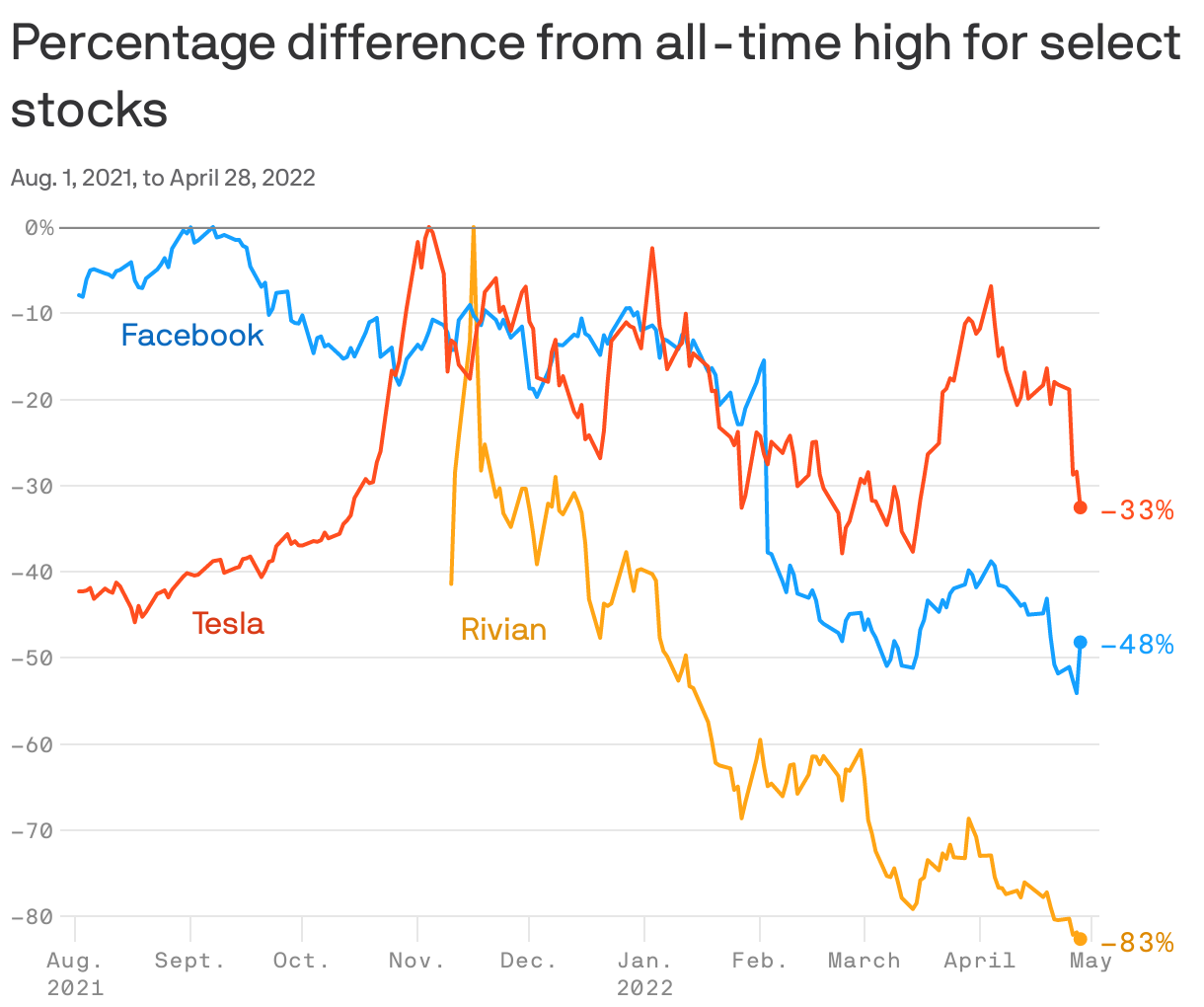
Amazon reported a weak first quarter Thursday with an overall loss of $3.8 billion thanks to excess capacity, higher shipping costs, and a $7.6B write-down of the firm's investment in electric-vehicle maker Rivian.
Driving the news: Amazon continues to grow, but the reported loss, along with a pessimistic forecast for revenue growth next quarter, drove shares down about 10% in after-hours trading.
On Thursday, Netflix laid off staff from Tudum, a fan-centric editorial website it launched in December.
Why it matters: Netflix is in the midst of a crisis of investor confidence following its earnings report of stalled subscriber growth. The streaming service warned it would soon begin to cut back on its spending.
Times Square is mounting a comeback after the pandemic devastated Manhattan's tourist economy.
Why it matters: Hotels, tourist attractions and entertainment venues are flocking to the once-office-heavy neighborhood, bringing something of a Las Vegas feel, the Wall Street Journal reports.
The recent decline in Tesla stock, possibly caused by worries about Musk's successful bid for Twitter, has raised concerns that he barely has the liquidity to raise the $21 billion he needs to provide in cash to pay for his new platform.
By the numbers: If you exclude stock that Musk has pledged to secure loans, the value of his freely-sellable Tesla shares is only about $11 billion. In order to find the extra $10 billion, he might have to exercise some of his stock options. That's expensive, since he'd need to pay income tax, rather than lower long-term capital gains tax, on such sales.
Snapchat now has over 600 million monthly active users (MAUs) and more than 330 million daily active users (DAUs) globally, executives revealed in a presentation Thursday.
Why it matters: Snapchat now has over 100 million more DAUs than Twitter, which reported 229 million DAUs Thursday morning.
Over 4 million people have used Snapchat's in-app technology that helps young users find local political races to run in, CEO Evan Spiegel announced at the top of his keynote presentation to Snapchat partners Thursday.
The big picture: The number was revealed the annual "Snap Partner Summit," where the company typically debuts new products. The presentation had a heavy focus on ways new technologies could be used to promote the company's values, like civic engagement, accessibility and inclusivity.
Decentralized autonomous organizations (DAOs) might be this bright new future for how people organize each other, or they might be another way for rich people to manufacture consent.
Why it matters: DAOs present an alternative method for people to coordinate activity toward shared goals. It's a little bit democracy, a little bit oligarchy, and it's fluid. To decide the question above, it helps to understand how they work.
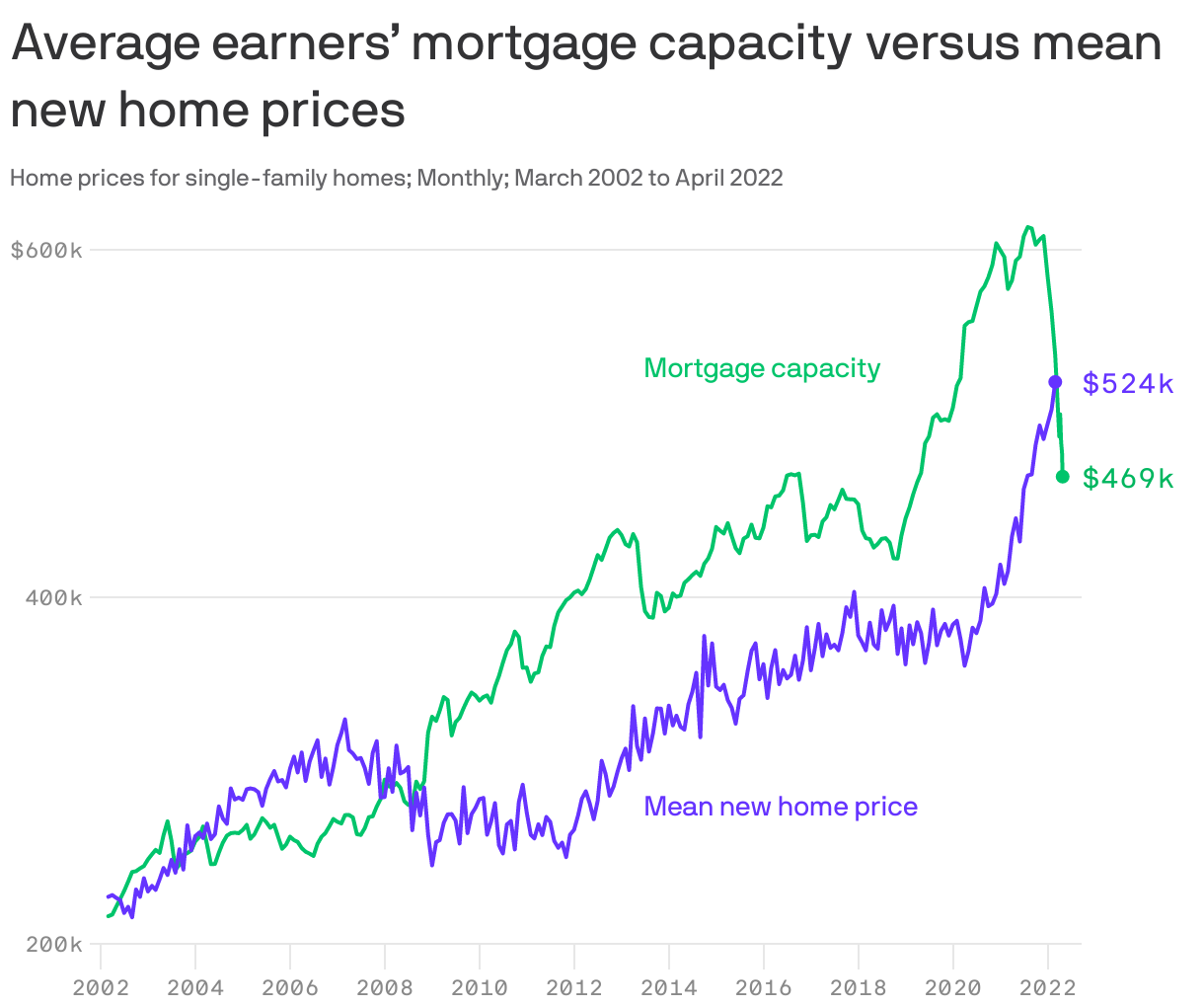
Note: Affordability based on a 30-year fixed-rate mortgage payment of 28% of the combined earnings of two 40-hour/week workers. Data: FRED, Census Bureau; Chart: Erin Davis/Axios Visuals
Not since the housing bubble of 2007 has there been such a big gap between the cost of a new house and the amount a two-earner household can borrow in order to buy it.
Why it matters: Homebuyers are facing a double whammy of higher prices and higher mortgage rates, which reduce the amount of money they can borrow to buy a house.
The business news site Quartz has sold to G/O Media, formerly Gizmodo Media Group, its CEO Zach Seward announced Thursday.
Why it matters: Quartz has exchanged hands multiple times in the past few years, including most recently being taken private via a management buyout. Seward said management "sought to raise money and remain on our own ... but it became the very best path for Quartz" and its employees.
Gross domestic product fell in the first quarter, as businesses slowed their inventory buildups and exports declined. It is the first negative growth number for the U.S. economy since the spring of 2020 at the onset of the pandemic.
Driving the news: The economy contracted at a 1.4% annual rate in the first three months of the year, the Commerce Department said Thursday. That compares with 6.9% growth in the fourth quarter of 2021.
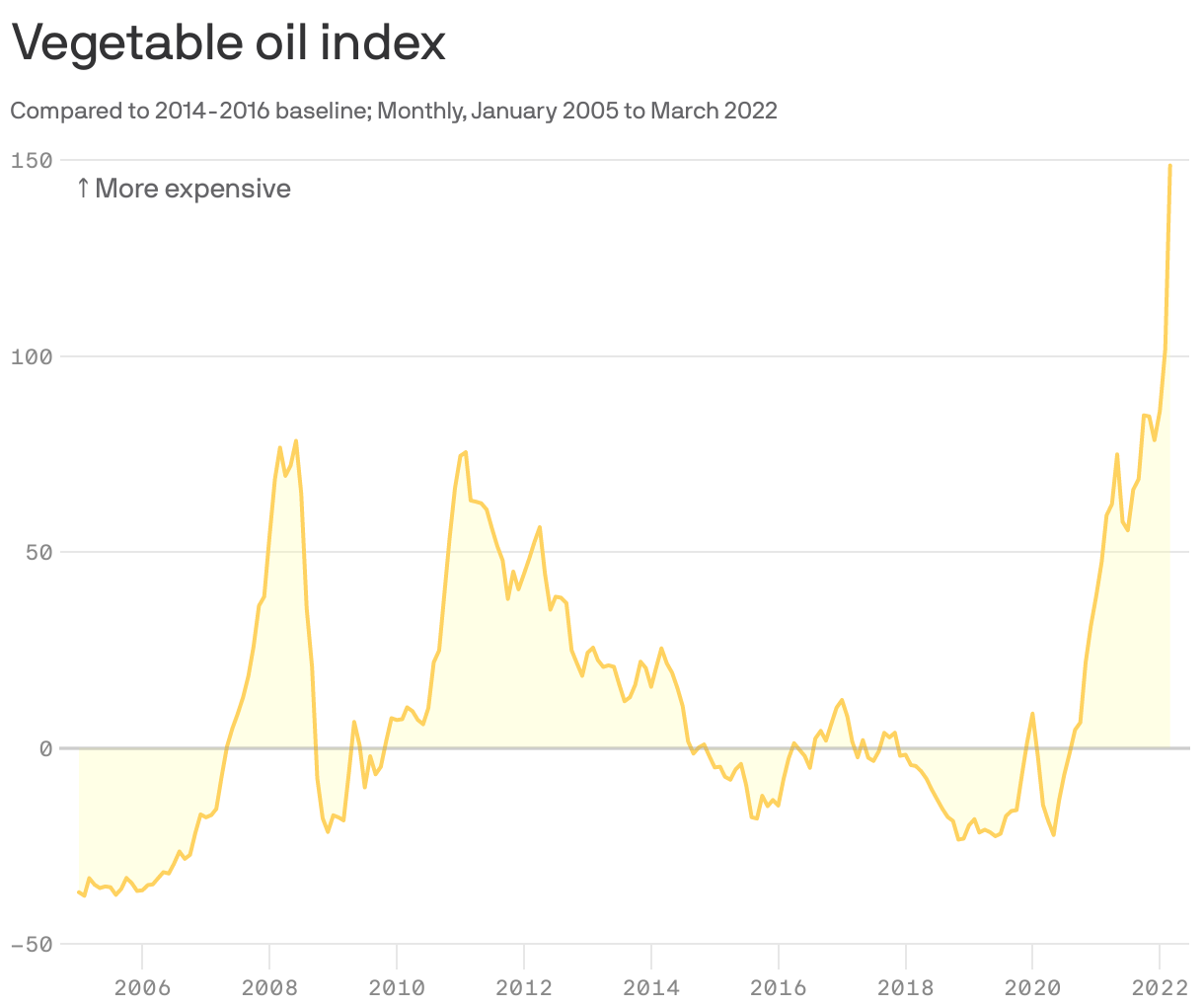
Data: UN Food and Agriculture Organization; Chart: Jacque Schrag/Axios
Vegetable oil priceshave surged over the last few months, as the war in Ukraine drove up their already rising costs.
Why it matters: The situation is worse now. Indonesia said it would suspend exports of palm oil this week, sending markets for cooking oils into chaos, as Bloomberg reported.
Relentless inflation, geopolitical turmoil and slowing growth have drawn comparisons to the “stagflation” of the 1970s. Yet the more apt comparison might be the year 1982.
Like today, 1982 was characterized by “tense" Russia relations, surging commodity costs, and contentious midterm elections. Then, as now, soaring prices had consumers in a glum mood and the Fed on a tightening path.
Bill Hwang's indictment on Wednesday alleges a remarkably simple route to defrauding some of the world's most sophisticated financial institutions. It says he and his family office, Archegos, simply lied to them.
Driving the news: In a criminal indictment and a civil complaint, Federal authorities said that Hwang and his associates used Archegos as "an instrument of market manipulation and fraud" — and offered new details on how, they allege, the firm fraudulently convinced major Wall Street banks to extend Archegos billions of dollars worth of credit.
After two years of unprecedented growth in social media and streaming, a post-pandemic reality is beginning to set in.
Why it matters: Huge revenue gains during COVID inspired media and tech titans to take big bets. As growth stalls, Wall Street wants them to pivot from promise to profit.