Rather than react one story at a time to negative media coverage of the transgender community, producer, activist and writer Andrea James wants to map out the bias, in hopes of eventually eliminating it.
What's new: For the past year, James has been working on a data visualization project tracing connecting threads and shared sources in biased coverage. On Monday, James is going public with the effort, called The Transphobia Project, and launching a Kickstarter campaign in hopes of being able to fully fund the effort.
Consumers find voice-based ads on their smart speakers to be more engaging and less intrusive than pitches in other media, according to a new survey by Adobe.
By the numbers: According to the findings, 43% of consumers found smart speaker ads to be less intrusive, compared to 26% that held the opposite view. (About 31% were neutral on the question.)
Investors aren't buying the idea of a potential Organization of Cocoa Exporting Countries, and cocoa prices sank late last week after rallying to an 11-month high.
Driving the news: Ghana and Ivory Coast reached an agreement not to sell cocoa for less than $2,600 a ton for the harvest that will begin in October 2020. The two African nations account for 60% of the world's cocoa production. That sent cocoa prices to $2,552 Wednesday.
Ukraine sold 1 billion euros of 7-year bonds in its first offer to international markets under new president — and former comedian — Volodymyr Zelensky, who was elected in April.
Why it matters: Ukraine's latest offering comes amid a flurry of new bond issuance, particularly from emerging markets, as declining interest rates in the U.S. and Europe (where German government bond yields have hit all-time lows) are encouraging countries to load up on new debt.
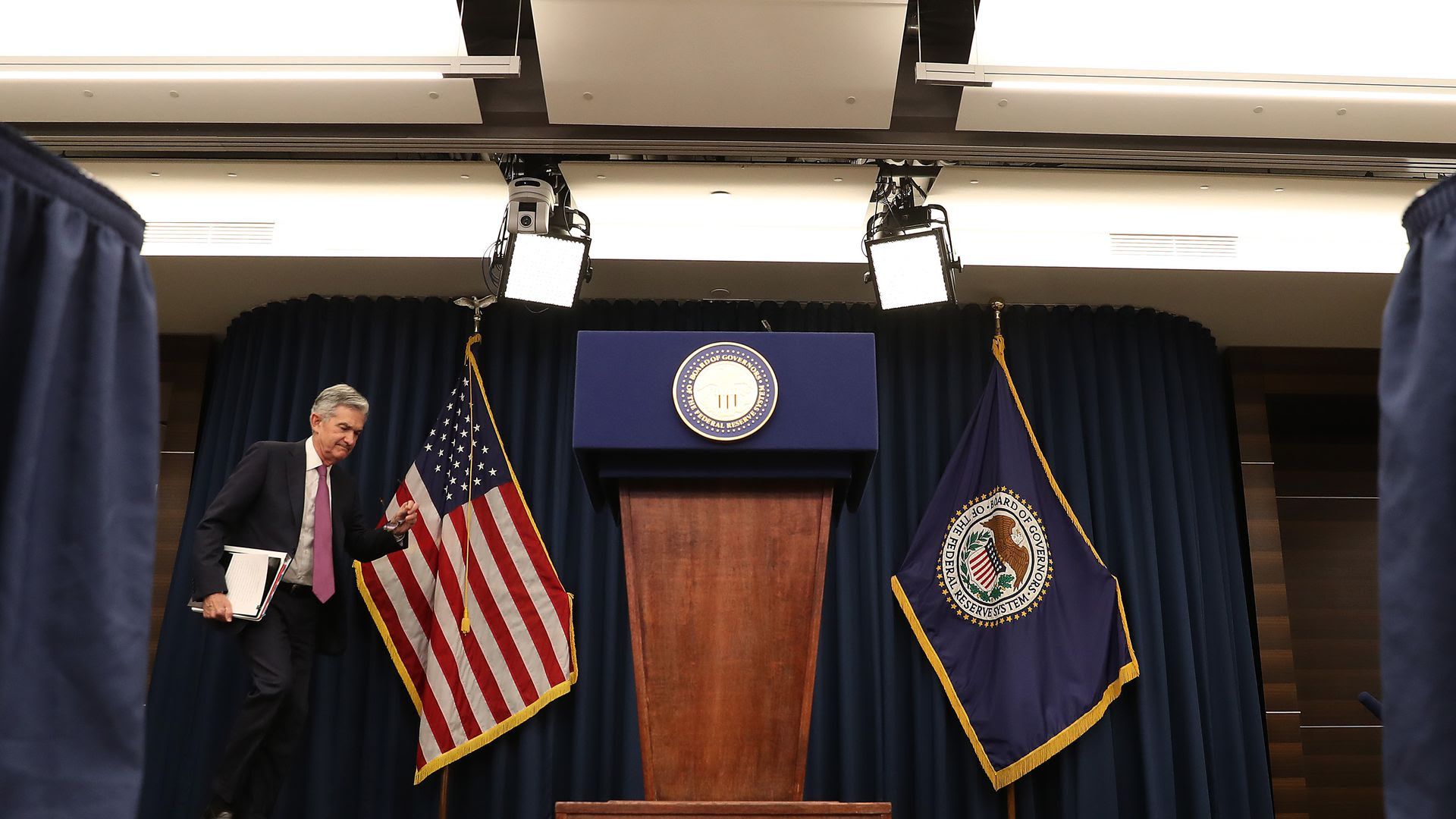
The market has stopped paying much attention to Fed Chair Jerome Powell's long-range forecasts and the Fed's future guidance and will merely be looking for confirmation of its expectations at this week's Fed meeting.
The state of play: Markets are now looking to data — including the value of the stock market — rather than central bank predictions as the road map for policy.
Amgen, Eli Lilly, Merck and the Association of National Advertisers are suing the Trump administration over its rule forcing pharmaceutical companies to display drugs' list prices in TV commercials.
Context: They say the rule violates the First Amendment and exceeds the government's authority.
The legacy media business hasn't seen an IPO for a very long time. Instead the big trend is the other way around: public companies being taken private.
The big success story is the Washington Post, which traded under the ticker symbol WPO before it was bought by Jeff Bezos for $250 million. Under his aegis, investments no longer need to generate an immediate improvement in the bottom line. The result is a revitalized property that's almost certainly worth much more than Bezos paid for it — were he to want to sell it, which he doesn't.
They were called "unicorns" for a reason: No one really knew whether Silicon Valley's fabled billion-dollar valuations were real, or whether they were a mixture of delusion and financial engineering that would evaporate upon contact with harsh public-market realities.
Flashback: An influential paper in 2017 declared that, properly valued, most so-called unicorns were actually worth less than $1 billion. The paper downgraded Zoom's valuation to $500 million from $1 billion. Other unicorns imploded either before they went public (Theranos) or afterwards.
India announced it's imposing higher tariffs on 28 U.S. products from Sunday, after Washington withdrew the South Asian country's preferential trade status.
Why it matters: It's the latest escalation in President Trump's trade war, designed to cut U.S. deficits. The tariffs on products including almonds and apples are as high as 70% on some items and are in response to Washington's refusal to exempt Delhi from higher taxes on steel and aluminium imports, the BBC notes.