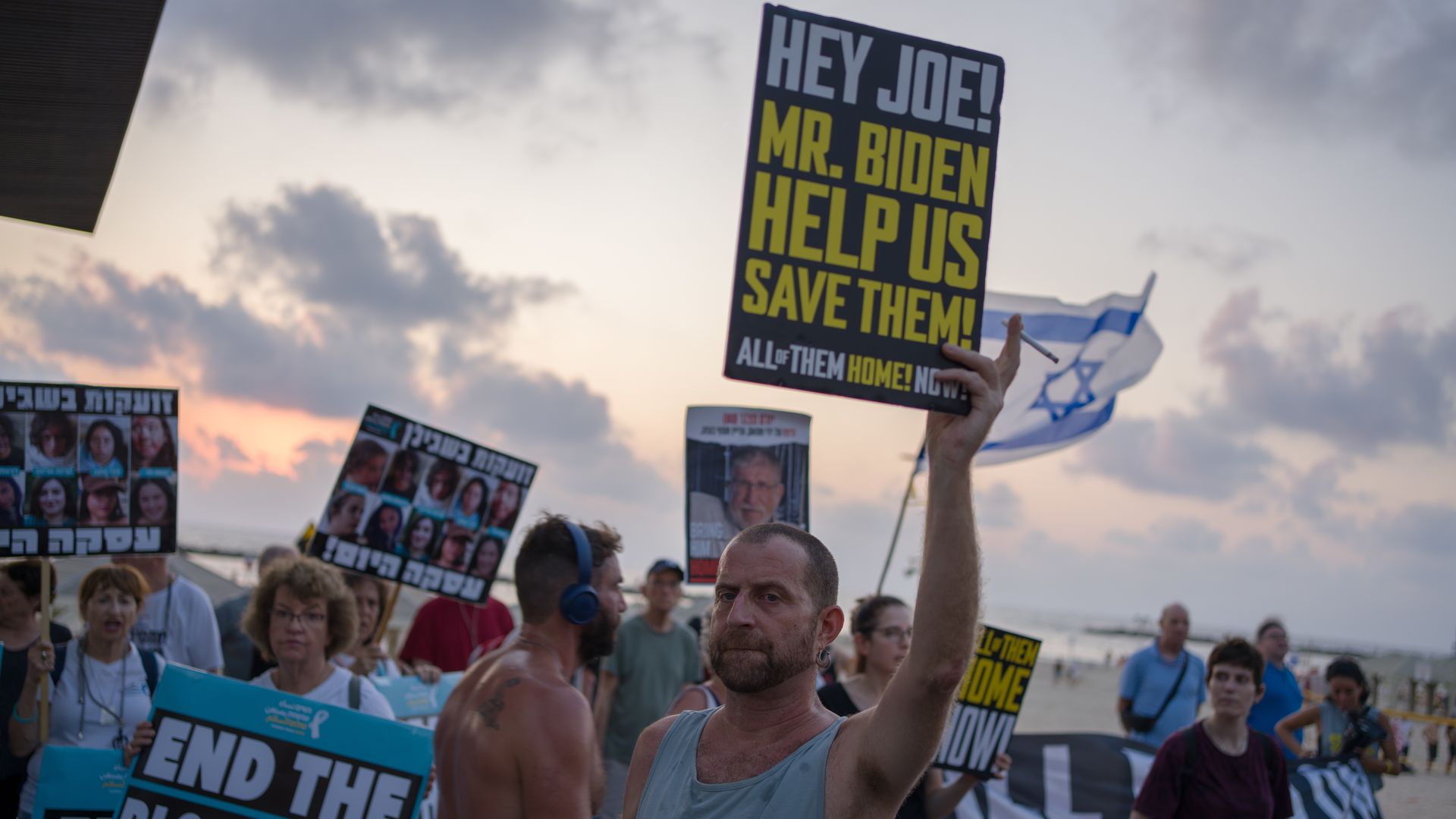
President Biden is going to convey the message to Israeli Prime Minister Benjamin Netanyahu in their Oval Office meeting tomorrow that "there is no time to waste" in getting a hostage and ceasefire deal in Gaza, according to U.S. officials.
Why it matters: Netanyahu's visit to Washington takes place at a critical moment in negotiations over the deal, which is the key to Biden's foreign policy strategy and legacy.
With thousands of protesters outside the U.S. Capitol Building and in front of a partially empty chamber, Israeli Prime Minister Benjamin Netanyahu spoke to a joint session of Congress for nearly an hour and called for more U.S. support for Israel in its war against Hamas in Gaza.
Why it matters: Netanyahu tried to use the speech to reassert his leadership in Israel, where polls show that more than 70% want him to resign, and in the U.S., where a dramatic presidential election campaign is captivating the public and overshadowing the Israeli leader's controversial visit.
Former House Speaker Nancy Pelosi (D-Calif.) is among dozens of lawmakers who are planning to skip Israeli Prime Minister Benjamin Netanyahu's joint address of Congress on Wednesday.
Why it matters: The list of lawmakers boycotting the speech is growing rapidly, with one Republican saying they will not attend.
A Ukrainian campaign to persuade its weapons benefactors to "lift all bans" on hitting military targets inside Russia is underway, the besieged country's defense minister told the Aspen Security Forum.
Why it matters: Domestic political plays and worries of reprisal abroad influence how and when the American arsenal is tapped for sales and security aid.
The complementary scheming of Russia and China dominated discussions among some of the world's highest-ranking military and political officials at the Aspen Security Forum.
Why it matters: To hear the national security brain trust tell it in Colorado, Western primacy is in a vise, with Moscow and Beijing together applying the pressure.
By 2050, a majority of the world will be too hot in the late summer to safely host the Olympics, according to an Axios analysis of data from CarbonPlan, a nonprofit climate research organization.
Why it matters: The Paris Olympics shines a spotlight on extreme heat, with Athletes raising concerns about scorching temperatures, which could not only affect the health of athletes and attendees, but also impact performance.
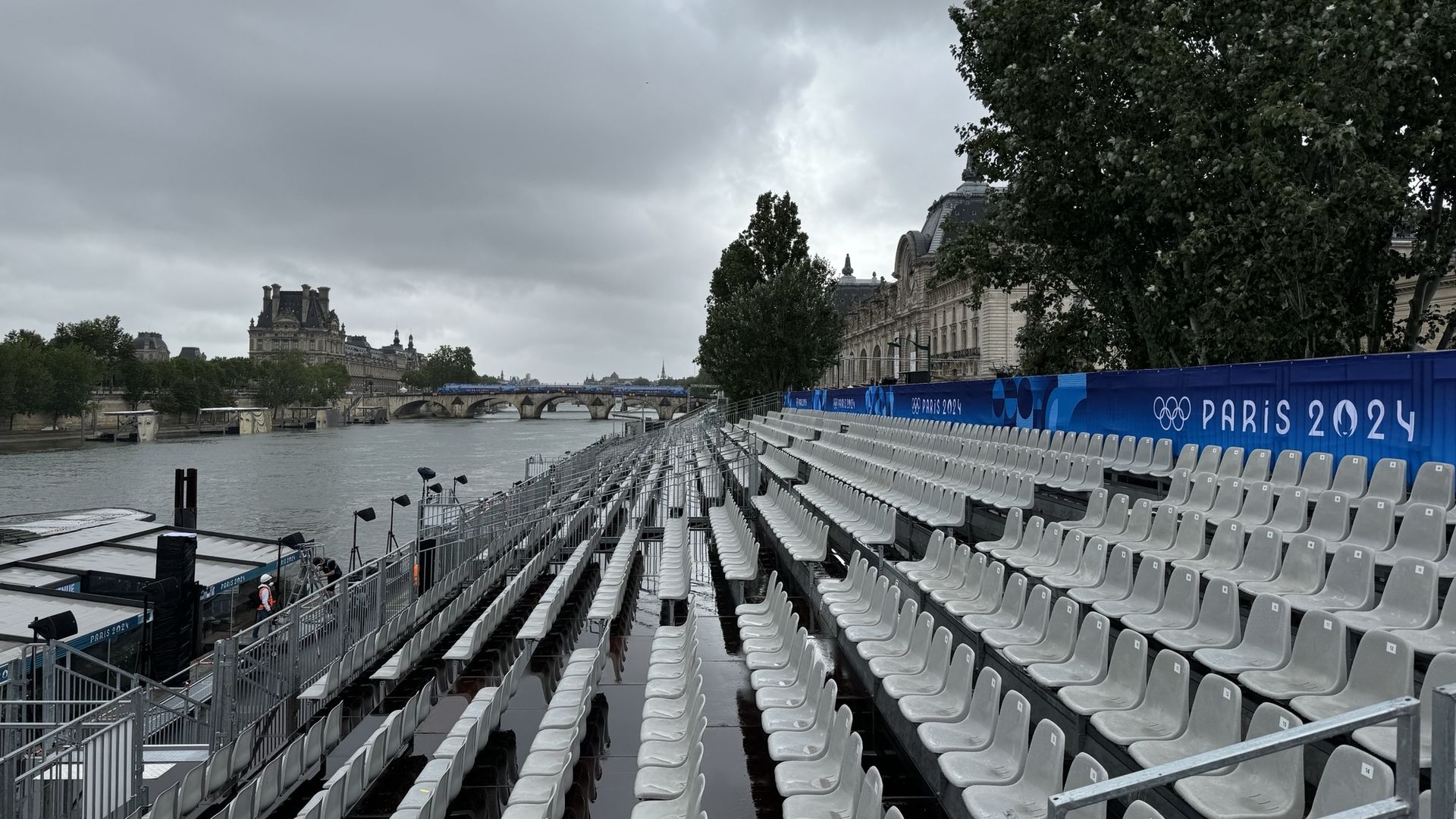
While all eyes will be on Paris when the Olympics kick off Friday, the City of Love this week resembles more of a ghost town.
Why it matters: A large swath of the city along the Seine River — home to the opening ceremony — is closed to all but those with permission or Olympic credentials.
With extreme heat a top concern for the Paris Olympics, the City of Light's historic architecture has become a point of friction. According to Roofscapes Studio, a startup founded by three MIT graduates, up to 80% of Paris' roofs are made of zinc, a material that absorbs and radiates heat, exacerbating the urban heat island effect.
Why it matters: This makes Paris extremely vulnerable to heat waves. Last summer, four heat waves hit France, causing more than 5,000 deaths.
A high density of buildings and low green space means heat is easily trapped and slow to dissipate, often making the city hotter than its European counterparts.
Driving the news: Paris is hosting the 2024 Summer Olympics, which will bring an influx of visitors to an already vulnerable region.
By the numbers: Temperature measurements show that the air one meter above a zinc roof can peak at more than 131° Fahrenheit, nearly 30° F greater than the Paris air temperature on the hottest days.
The effect also boosts temperatures on the top floors of zinc-roofed buildings.
What they're doing: Roofscapes Studio installs wooden platforms on top of the zinc roofs to reduce the worst of the heat.
Since wood can still radiate a certain amount of heat, they are developing a "green roof" to include planted vegetation, which can create energy and remove heat from the air.
A decommissioned city hall which was turned into L'Académie du Climat (the Climate Academy) had a green roof installed through a pilot program with Roofscapes Studio, and it hopes to expand this program throughout the city.
The green roof module has shown a 10° Celsius difference (18° F) between the air outside and the temperature inside the top floor of the building at 2pm on a hot day.
What they're saying: Olivier Faber, a founder of Roofscapes Studio, told Axios, "We wanted to work on the roofs because they're more than a third of the city's horizontal surface in dense urban centers like Paris." He explains that roofs are a societal opportunity for climate adaptation, as they typically sit empty and have a huge surface area.
Faber continues, "[I]f the zinc is protected from solar radiation, its surface temperature will never be above the temperature of the air, which in a heat wave could be 35°-40° C (95° to 104° F) maybe. But it will never be 75° C or 80° C (167° to 176° F)," so the first step is to shade the roof.
What's next: The city of Paris plans to implement green roofs to keep the city cooler during warmer months, but approvals and installations will be an uphill battle.
Because of the historic nature of Paris' buildings, builders require permission from a preservation architect for any modifications.








/2024/07/11/1720731712168.gif?w=3840)