Meta, the parent company to Facebook, Instagram and Whatsapp, reported its first ever year-over-year quarterly revenue decline since going public in 2012.
Why it matters: The results raise the question whether Meta's strongest growth period is behind it. Earlier this year, the Facebook app lost roughly 1 million daily active users — its first ever year-over-year user drop.
The Federal Trade Commission is suing Meta in an attempt to prevent the company from buying Within Unlimited, a virtual reality fitness company.
Driving the news: The FTC says Meta, Facebook's parent company, should not be allowed to acquire Within and its associated fitness app, Supernatural, because Meta is "already a key player at each level of the virtual reality sector," per a release.
The Senate voted 64-33 Wednesday to approve a $280 billion package meant to spur U.S. chip manufacturing, a major victory for the Biden administration and chip-makers.
Why it matters: The bill aims to reverse a long-term decline in domestic manufacturing of the computer chips that go into cars, computers, appliances and a range of other everyday items, after the pandemic exposed the fragility of the international supply chain.
TikTok on Wednesday said it plans to enable some researchers to easily access anonymized public data on the platform later this year.
Why it matters: Researchers have put pressure on tech platforms to give them access to public user data so that they can better track societal trends, such as political polarization and misinformation.
Vox Media is laying off 39 people, less than 2% of its total staff of more than 2000, in an effort to get ahead of economic uncertainty, according to a source familiar with the cuts and a memo obtained by Axios.
Why it matters: Vox Media is the latest in a long string of firms taking measures to prepare for a potential economic downturn.
Shares in Spotify spiked nearly 7% Wednesday morning after the streaming audio giant said it beat Wall Street's expectations on revenue, earnings and user growth.
Why it matters: Several media and tech firms attributed slowed growth last quarter to macroeconomic headwinds. CEO Daniel Ek told Axios he remains "paranoid" about a potential recession but said, "so far, we're not seeing much of it at all."
A Senate vote Tuesday teed up the latest version of Congress' effort to fund domestic chip manufacturing for final approval Wednesday morning and likely, though not certain, House passage by the weekend.
Yes, but: Congress has been deadlocked on this issue for over a year now, and has only reached this point after intense lobbying and by prioritizing the chips bill over many other proposals — including virtually all of those that involve the tech world.
There’s no instruction manual for working video games into family life. But if you’re a parent, you don't have a choice, Axios Gaming author Stephen Totilo writes.
Why it matters: Games can be fun hang-out spaces, digital canvases for creativity — and safe spaces for learning how to win, lose or chip away at a goal that might be hours, days or weeks away.
Instagram‘s top boss Adam Mosseri responded to a slew of criticisms Tuesday from some of the app's top celebrity users, including Kim Kardashian, Kylie Jenner, and Chrissy Teigen, about experiments the company is undertaking to make the social media platform more video-focused.
Why it matters: For many in Instagram's community, the pivot to video feels like an abandonment of its roots as an artistic photo-sharing app.
Google parent Alphabet narrowly missed revenue and earnings expectations in earnings reported Tuesday.
What's happening: Shares were up 2% in after-hours trading Tuesday. Investors had braced for the worst after weak earnings reports from Snapchat and Twitter suggested a slowing ad market.
Meta announced Tuesday that it would raise the price of both models of its core virtual reality product, the Quest 2 headset, by $100 effective August 1.
Why it matters: Tech hardware prices almost always go down over time, or customers get more for the same price. But Meta is betting it can raise prices even as it's trying to push the entire market towards its metaverse promised land.
The Senate voted 64-32 Tuesday to advance a roughly $280 billion package to boost funding for domestic chip production, a priority for the Biden administration and companies like Intel and IBM.
Why it matters: The bill is meant to entice companies to expand chip manufacturing in the U.S., reducing the risk of the supply chain disruptions that hampered production of everything from cars to appliances and helping the U.S. compete overseas, particularly with China.
Analysts have begun cutting projections for advertising growth this year, sending shockwaves through the media and tech industries.
Why it matters: Macroeconomic factors, such as supply chain issues and inflation, are causing a deceleration in ad growth at a level most companies hadn't anticipated when forecasting for the second quarter.
As the Senate finally moves this week toward a likely vote on funding domestic chip manufacturing in the U.S., the rest of the semiconductor world is charging ahead with big new deals and initiatives.
Driving the news: On Monday, Intel said that it has a deal to manufacture chips for Taiwanese smartphone-chip designer MediaTek. That marks Intel's first big customer for its effort to open up its factories to make chips based on others' designs.
A new generation is dramatically reshaping the internet — rejecting and rebuking the social networks they grew up with, which barely resemble themselves anymore.
Why it matters: The social hierarchies created by decades of public "like" counts, and the noise level generated by clickbait posts and engagement lures, have worn on Gen Z. And constant pivots by social media giants have eroded younger users' trust.
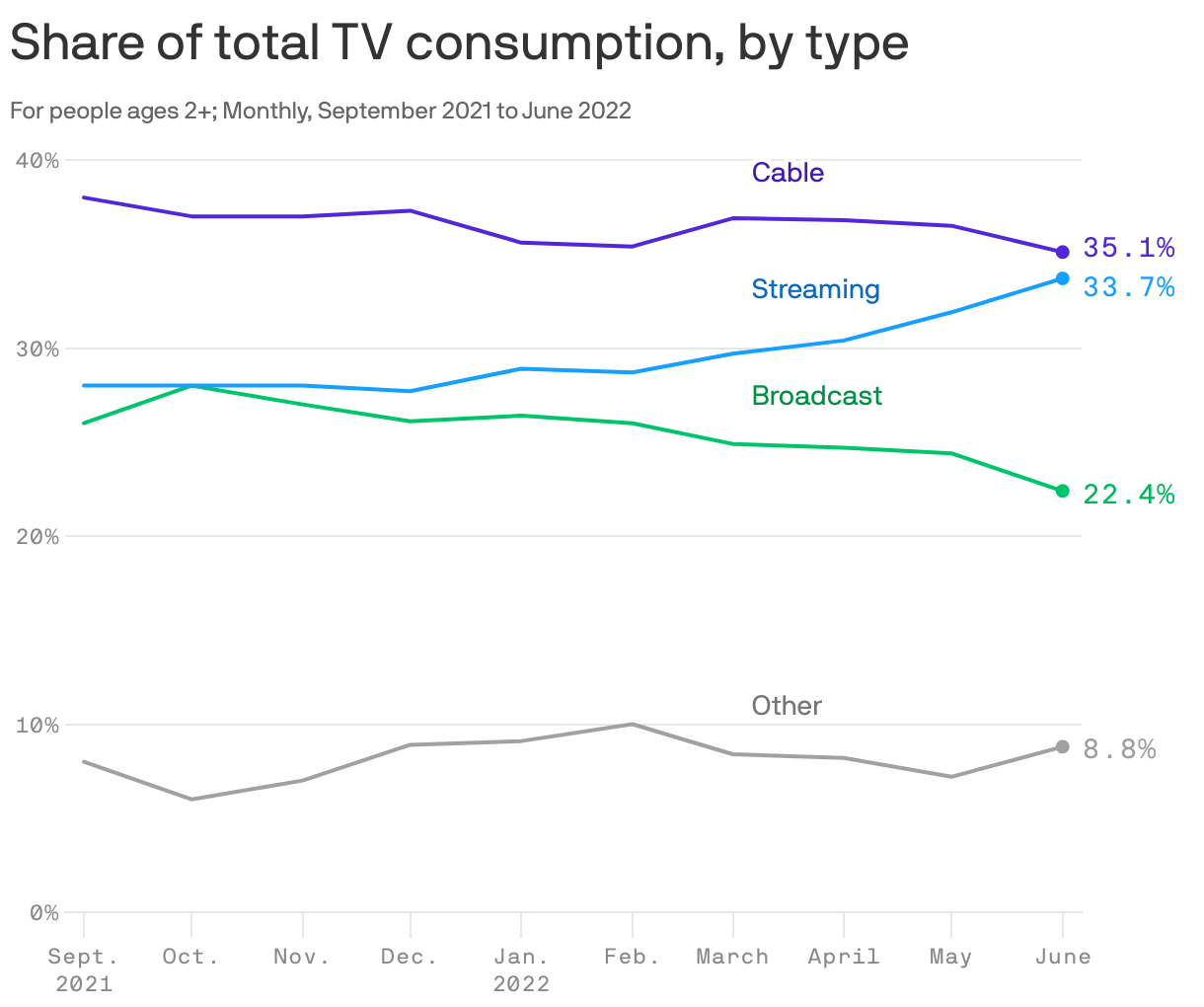
Streaming made up one-third of television consumption among people in the U.S. last month, per Nielsen, the highest percentage since the media measurement firm began its monthly report in June 2021.
Why it matters: Cable and broadcast saw their lowest-ever share of the television audience, although they still collectively make up the vast majority of TV viewing in the U.S., for now.