The Supreme Court has voted 5-4 to block Texas' social media censorship law, a major boon for tech companies who have been fighting against content moderation laws that would fundamentally change how they do business.
Why it matters: Conservative states have launched a legal war on social media companies in an effort to stem what they see as a wave of censorship, but this decision, like other recent rulings, suggests they face an uphill climb in court.
Apple surprise-announced today that one of Japan’s most revered game developers, Yu Suzuki, is making his next game for the tech giant’s mobile gaming subscription service, Apple Arcade.
Why it matters: Apple is an enigmatic but major player in gaming, with resources to do seemingly whatever it wants and tap some all-star talent in the process.
The parents of Kerri Moynihan have asked a California court to dismiss their lawsuit against Activision Blizzard over the death of their daughter, according to a recent court filing.
Driving the news: Paul and Janet Moynihan made their request, which hadn’t been widely reported, on May 6.
DAOs may be a revolutionary new way of organizing an enterprise, but they still have to get payroll out. Utopia Labs, which just raised $23 million in a Series A fundraising round, is looking to provide back-office support.
Why it matters: Utopia's proposition — payroll and payments for crypto-native organizations, to start — is to centralize operations for these decentralized organizations.
The Jonas Brothers are helping to launch a new subscription media company called Scriber that allows celebrities to charge their biggest fans for exclusive content via text messages.
Why it matters: The goal is to bring the subscription economy to Hollywood without using Big Tech platforms as intermediaries.
In the wake of mass shootings in Uvalde, Texas, and Buffalo, New York, right-wing conspiracy theories moved faster than ever from fringe to the mainstream, thanks to a misinformation infrastructure that's grown stronger over time.
Why it matters: The pipeline of misinformation moving from obscure internet platforms to the mouths of sitting members of Congress "seems to be going a lot faster now," said Bryce Webster-Jacobsen, director of intelligence operations at GroupSense, a threat intelligence firm.
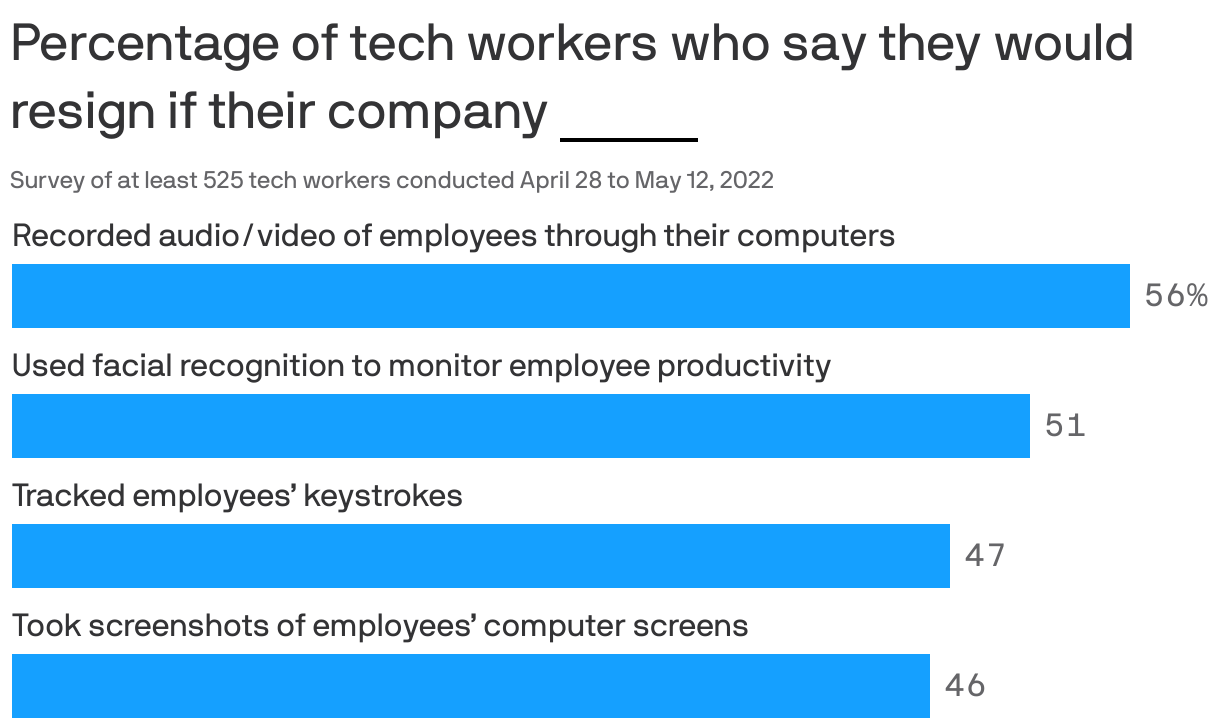
Recreated from Morning Consult; Chart: Axios Visuals
Roughly half of tech employees who today say they are not monitored at work indicated they would resign rather than be subject to facial recognition or having their employer record audio or video of them, according to results of a new Morning Consult poll, shared exclusively with Axios.
Why it matters: Employers are experimenting with new methods of keeping tabs on an increasingly remote workforce, including the use of video recording and facial recognition technology.