Facebook's stock was up nearly 4% in after-hours trading Wednesday after the company beat investor expectations for earnings, user growth and revenue.
Yes, but: The positive earnings were accompanied by several pieces of bad news.
Facebook announced that the Federal Trade Commission told it in June that the agency had opened an antitrust investigation into the company.
It also will set aside $2 billion, on top of $3 billion set aside last quarter, to pay a historic $5 billion fine that the FTC officially levied on the company today.
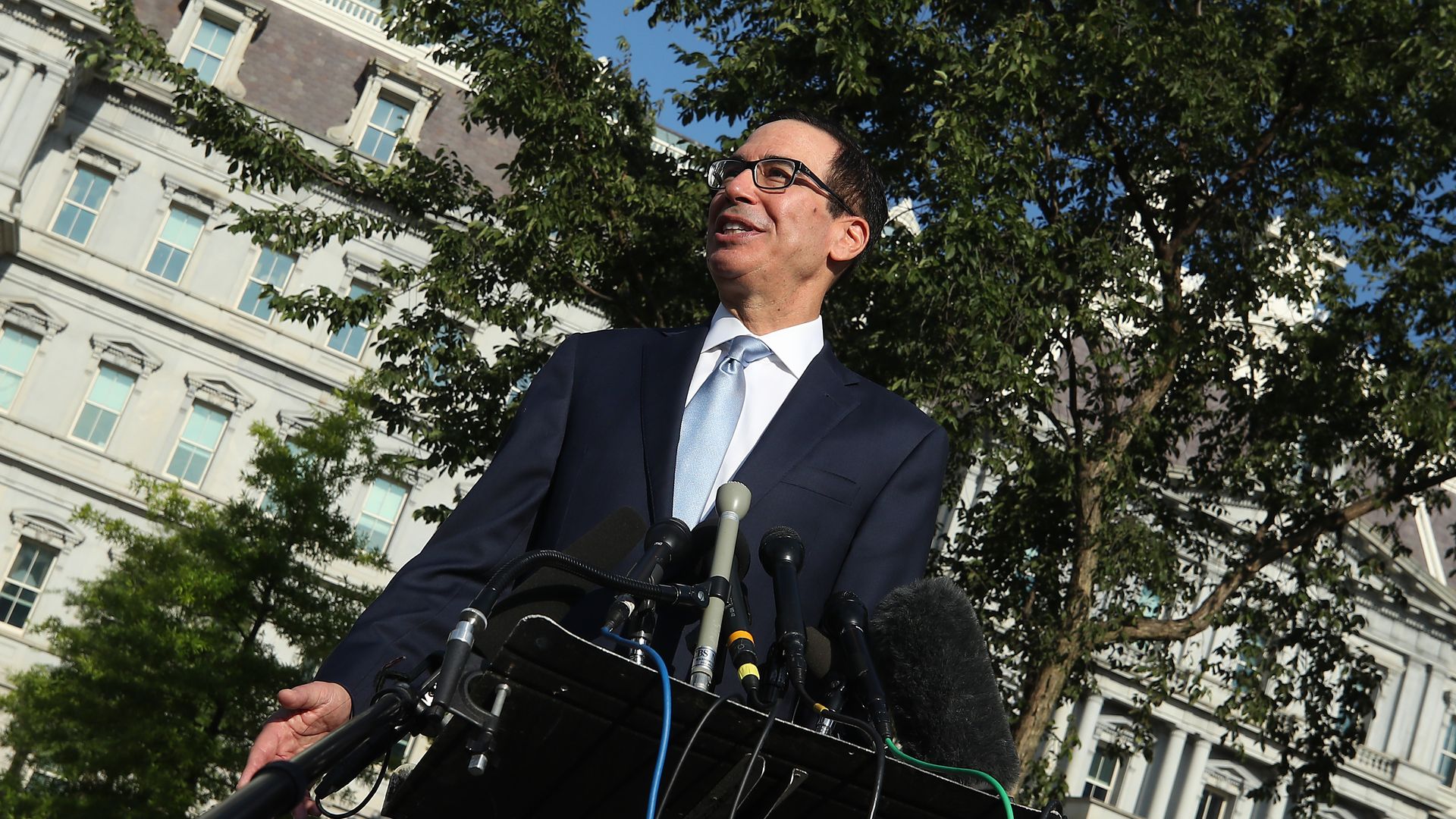
U.S. Treasury Secretary Steven Mnuchin said Wednesday that it's "absolutely right that the attorney general is looking into" Amazon because it "has destroyed the retail industry across the U.S."
The big picture: Amazon, along with Facebook and Google, appears to be the subject of a Justice Department probe into the market power of online platforms. Mnuchin, an administration official, is weighing in and suggesting that Amazon is stifling competition before the antitrust investigation has really even started.
The U.S. Department of Justice has launched an antitrust review that could sweep up Amazon, Google and Facebook. Dan and Axios tech policy reporter David McCabe dig in.
Expectations are that a deal between Sprint, T-Mobile and Dish Network will be announced within the next 48 hours, whereby Dish would pay around $3.5 billion for wireless spectrum from the two carriers to push through their merger.
Why it matters: In addition to America's mobile market no longer consolidating from four major national carriers to three, this could embolden top U.S. antitrust regulator Makan Delrahim, who looked to be on his heels after being handed his legal hat on the AT&T/Time Warner deal. This comes just as the Justice Department confirmed that it will launch an investigation into the power and behavior of online platforms.
Residents of major American cities are constantly watched by ubiquitous cameras, mushrooming license plate readers and a battery of new smart city sensors.
But, but, but: It's not just the government keeping tabs. An explosion of private surveillance — set up by businesses, landlords and neighbors — is being driven by increasingly cheap but powerful technology. And what these observers see could make its way back to law enforcement.
A Russian military contractor tied to 2016 U.S. election interference is behind a spate of mobile phone surveillance programs, researchers at Lookout mobile security have determined.
Driving the news: The mobile spyware, dubbed Monokle, was disguised as several different Android apps — ranging from pornography to Google. Monokle may have been in use since 2015.
The Federal Trade Commission has settled with Facebook over allegations that it "repeatedly used deceptive disclosures and settings to undermine users’ privacy preferences," in a deal that will apply some new oversight to its practices and force it to pay $5 billion.
Why it matters: Revelations last year that the political consultancy Cambridge Analytica had gathered a large trove of Facebook user data, and failed to get rid of it, set off a broader reckoning around data privacy in the era of Big Tech.
Cruise today acknowledged it will not meet a 2019 target to deploy driverless cars in an urban robotaxi service.
The big picture: The news is likely a bit embarrassing for General Motors, Cruise's majority owner, whose ambitious timetable helped fuel some of the hype around self-driving cars in recent years. But it also shows GM is sticking to CEO Mary Barra's vow not to deploy automated vehicles before it can prove they're safer than a human driver.
Snapchat's parent company has had a bumpy ride through a series of product and corporate setbacks in 2018. But now it's slowly making a comeback.
Why it matters: Snap's story is yet another example of the harsh realities of going public and facing comparisons to expansive rivals—in this case, Facebook. Now that Snap is regaining momentum, investors' enthusiasm for the company's long-term potential is also creeping back.
The Justice Department's announcement Tuesday that it will probe the market power of online platforms is the latest sign of deepening trouble in Washington for major tech companies.
Why it matters: Antitrust action is one of the most significant steps a government can take to rein in a company — and Justice's announcement is the kind that can kick off years-long probes.





/2019/07/23/1563917580063.gif?w=3840)