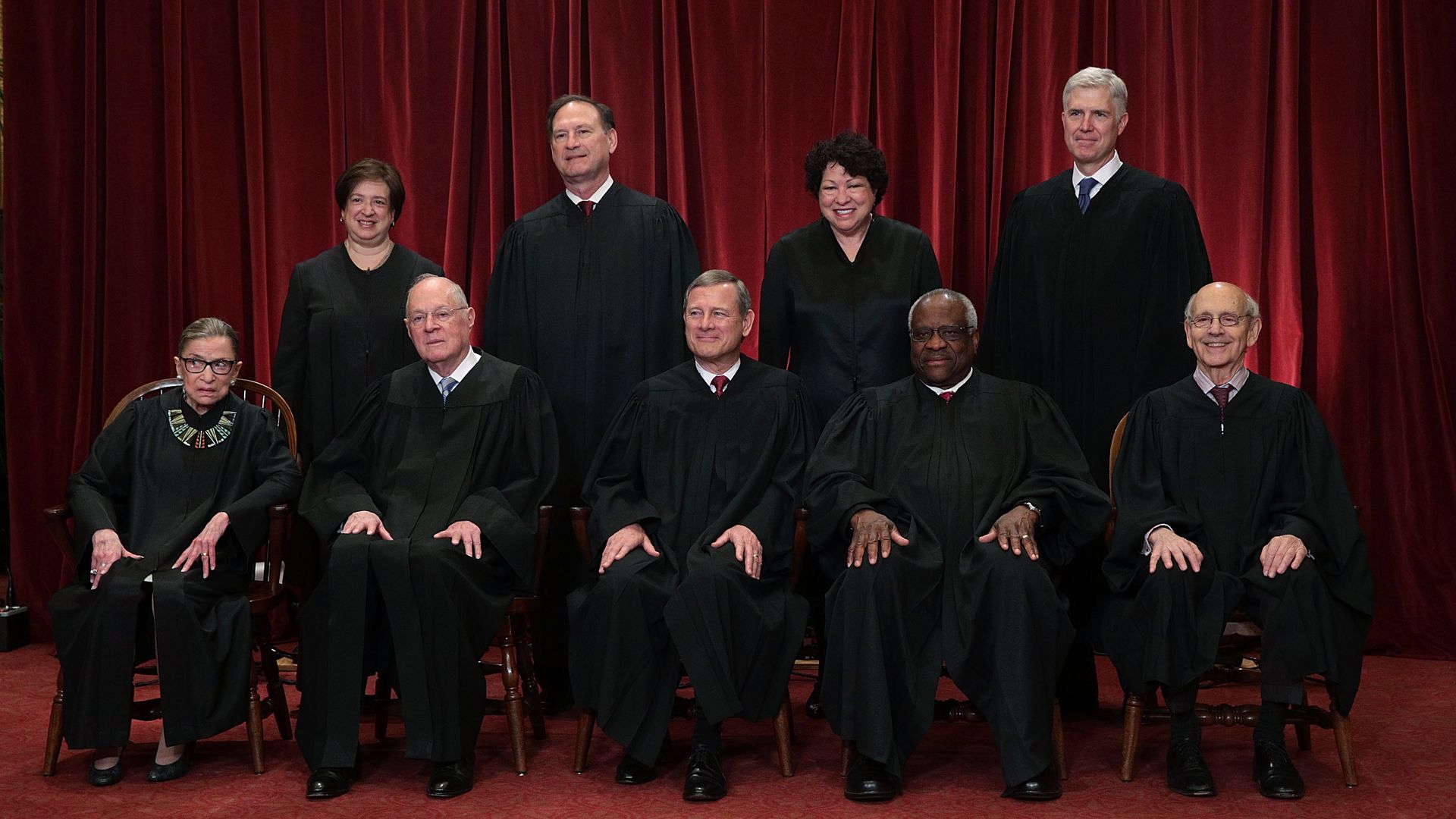
The Supreme Court has three blockbuster cases on the docket this week.
The big picture: One has the potential to deal a crippling blow to public-sector unions; another dives into email privacy vs. law enforcement; and the third centers on free speech at the polls.
Samsung is using a big event in Barcelona to introduce its latest pair of flagship phones, the Galaxy S9 and larger-screen S9+. The devices are similar in appearance to last year's S8 and S8+, but add a more powerful processor and an improved camera that packs a pair of fun features: AR Emoji and Super slo-mo. (This video shows the new camera and features in action.
Why it matters: Increasingly, Samsung and Apple are not only competing against each other, but also against the fact that people already have a pretty powerful smartphone in their pocket.
Three weeks after President Trump claimed to have been "totally vindicated" by Devin Nunes' memo, the White House is slamming the Democratic rebuttal memo as "politically driven" and incomplete.
Between the lines: Trump blocked a previous version of this memo, leading to the redacted version that was released today. Many of the White House's criticisms of this memo mirror what Democrats claimed about the last one — that it cherry picks certain bits of intelligence and doesn't actually prove anything.
In "The Case Against Google" — the cover story of tomorrow's N.Y. Times Magazine — Charles Duhigg (author of the bestselling "The Power of Habit") explores the antitrust case against Google, and whether the company's algorithmic alchemy stacks the deck against its competitors: