May 09, 2024
Good afternoon. We know how hard it can be to keep track of all of the major health care bills, even if you've been following closely, so we're introducing a tracker that we hope will make your job a little easier.
📅 Join Axios' Tina Reed and Caitlin Owens on May 16 at 8:30am ET in Washington, D.C., for an event on solutions to America's youth mental health crisis. It will feature Surgeon General Vivek Murthy and Rep. Bonnie Watson Coleman. Register here to attend.
1 big thing: The bills to watch

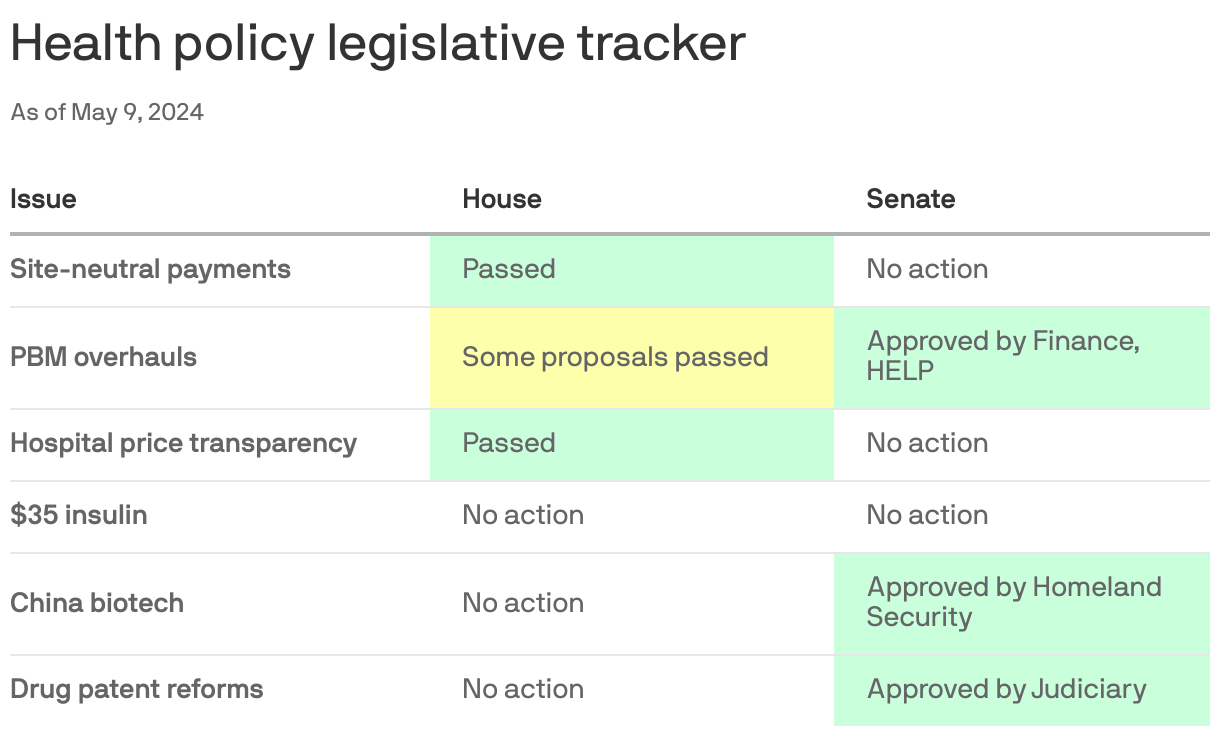
We're trying out something new: a handy cheat sheet for some of the big-ticket policy items that could find a home in must-pass legislation, Peter writes.
Why it matters: The biggest deals will likely come after the election, but the coming weeks will reveal a lot about what will command lawmakers' attention.
- It's important to watch the proposals that generate savings that could be used to help boost provider payments or extend expiring health programs.
- Meanwhile, here's a rundown of some the biggest targets on our radar. Watch for updates — and let us know how we can make this more helpful to you.
Site-neutral payment policies
- The issue: To have Medicare pay the same for physician-administered drugs regardless of whether they're administered in hospital outpatient departments or doctors' offices.
- Status: Passed House. No major action in Senate.
- Backers/opponents: Consumer/patient groups support. Hospitals oppose.
- Cost/savings: Saves $3.8 billion over a decade.
PBM overhauls
- The issue: A range of proposals to overhaul PBM business practices to lower drug costs.
- Status: Some proposals passed the House. Ways and Means approved changes to help pay for a telehealth extension. Senate Finance and HELP committees advanced proposals.
- Backers/opponents: Bipartisan support among lawmakers. PBMs oppose.
- Cost/savings: A range of estimates, some in the neighborhood of $1 billion over 10 years.
Hospital price transparency
- The issue: Codifies regulations for hospitals to publicize prices for procedures.
- Status: Passed House. No Senate action.
- Backers/opponents: Bipartisan support.
- Cost/savings: CBO found no budgetary impact.
$35 insulin beyond Medicare
- The issue: To cap monthly insulin costs at $35 per month for commercially insured Americans and the uninsured.
- Status: Two bills introduced in Senate.
- Backers/opponents: Some bipartisan support in Senate. House GOP more opposed.
- Cost/savings: Costs $629 million for the private market (latest known estimate).
China biotech crackdown
- The issue: To cut off U.S. government funding for Chinese contract research firms that critics say are tied to Beijing and pose a security risk.
- Status: Advanced from Senate Homeland Security and Governmental Affairs Committee. House Oversight marking up Wednesday.
- Backers/opponents: Wide bipartisan support.
- Cost/savings: Unclear.
Drug pricing patent reforms
The issue: Preventing tactics like "product hopping" and "patent thickets" that sponsors say drug companies use to delay competition from cheaper generic drugs.
- Status: Advanced from Senate Judiciary Committee.
- Backers/opponents: Bipartisan Senate support. PhRMA opposes.
- Cost/savings: Projected in 2022 to save about $1 billion.
2. House E&C sets May 16 for telehealth markup

Illustration: Natalie Peeples/Axios
The House Energy and Commerce Committee plans to mark up telehealth bills May 16, multiple lobbyists told Victoria.
Why it matters: It's the anticipated next step on extending pandemic-era virtual care flexibilities after House Ways and Means approved a two-year extension yesterday.
Zoom in: Lobbyists said E&C hasn't finalized which measures will be marked up.
- A committee spokesperson declined to confirm the hearing.
What we're watching: An extension of Medicare telehealth provisions that expire at the end of this year is expected to figure prominently in a lame-duck health care package, if it doesn't get taken up sooner.
3. 1 big number: $335 billion

Illustration: Annelise Capossela/Axios
A new CBO report projects that permanently extending enhanced Affordable Care Act subsidies that Democrats passed in 2021 would increase deficits by $335 billion over a decade, plus $48 billion in net interest outlays.
Why it matters: It's fodder for what's shaping up to be a fierce debate over renewing the subsidies, which are set to expire in 2025.
Catch up quick: The American Rescue Plan Act increased the size of premium tax credits for those previously eligible for them and extended them to people with incomes of more than 400% of the federal poverty guidelines.
- Those changes were extended through 2025 by the Inflation Reduction Act.
Former President Trump has said that he's looking at alternatives to the ACA and called the failure to repeal and replace Obamacare during his administration a low point for the Republican Party.
- But as we've reported, the enhanced subsidies have overwhelmingly benefited red states that haven't expanded Medicaid.
- Most Democrats are eager to extend the subsidies — and to campaign on the ACA's benefits.
What we're watching: Some predict that the coinciding expiration dates of the ACA subsidies and $3.6 trillion in tax cuts from the 2017 tax law will lead to a grand bargain that both parties can portray as a win.
4. Appropriators still weighing antiabortion riders
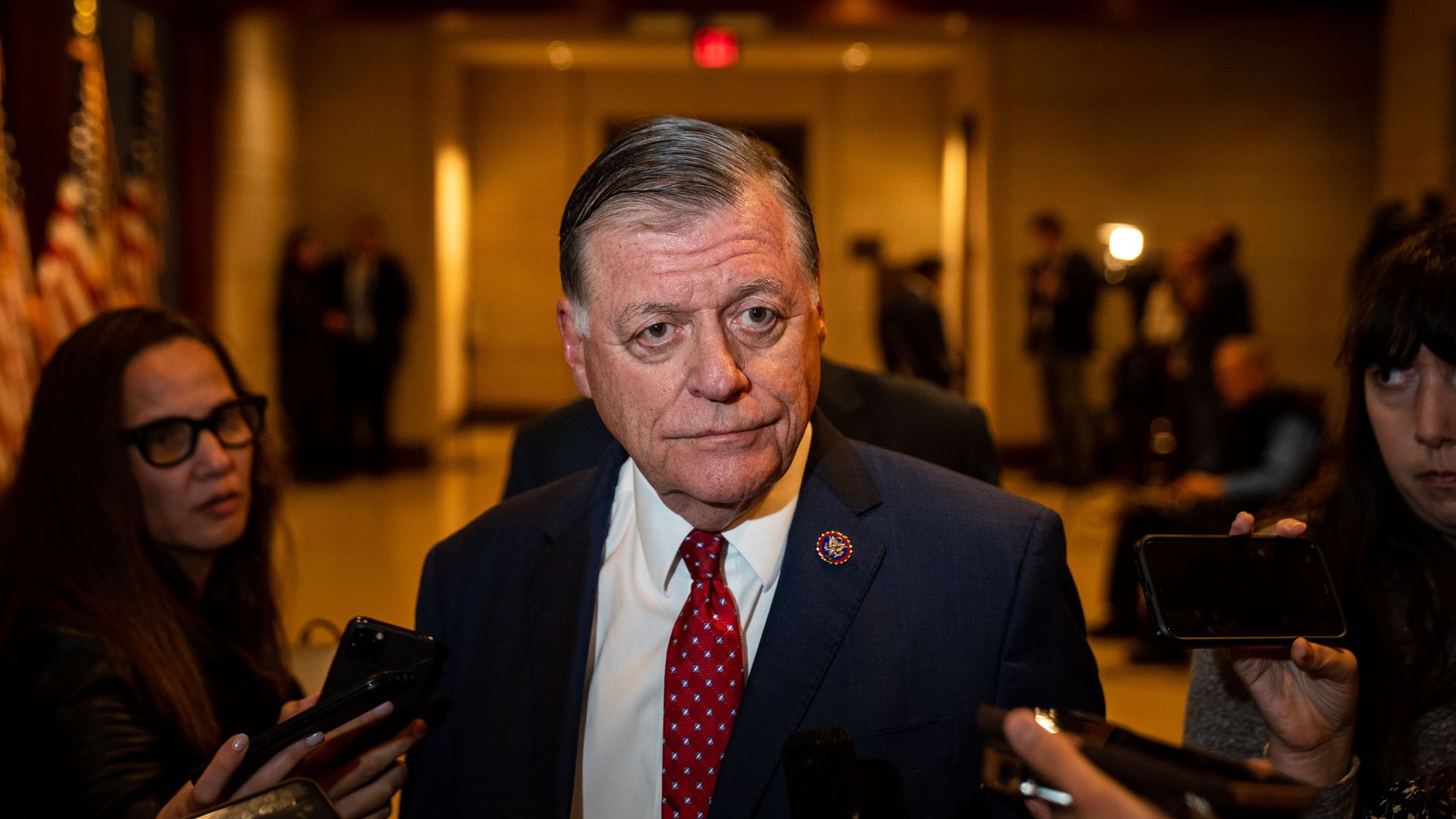
Cole. Photo: Kent Nishimura / Los Angeles Times via Getty Images
House appropriators haven't decided how prominently to feature antiabortion riders in FY25 spending bills that will be moving as the campaign season heats up, Victoria reports.
Why it matters: Provisions like language to overturn the FDA's policy on distributing mifepristone created havoc during the last cycle, splitting Republicans and leading to the defeat of the Ag-FDA spending bill on the floor.
What they're saying: Appropriations Chair Tom Cole told reporters yesterday there's no plan yet on how to treat antiabortion riders but acknowledged the process needs to be bipartisan to pass.
- "A lot of times you put things in with the knowledge that they're not going to stay.… I'm more interested in based funding for the budget," he said.
House Appropriations labor-HHS subcommittee Chair Robert Aderholt is assuming many riders will be proposed, including on abortion, but said his bigger focus was not getting jammed with "Senate poison pill earmarks."
Cole separately said he had a "pretty good idea" of what the FY25 topline funding number will be but isn't ready to say.
- He's hoping to have unspecified FY25 funding bills ready to mark up as soon as the end of this month.
✅ Thank you for reading Axios Pro Policy, and thanks to editors Adriel Bettelheim and David Nather and copy editor Brad Bonhall. Do you know someone who needs this newsletter? Have them sign up here.
View archive