Axios World

June 22, 2023
Welcome back to Axios World.
- Tonight's edition (1,835 words, 7 minutes) comes to you from the great state of Oregon. I'm here for a wedding (congrats S+C!). We start, though, with the big visit back in Washington, D.C.
1 big thing: Biden bets big on India
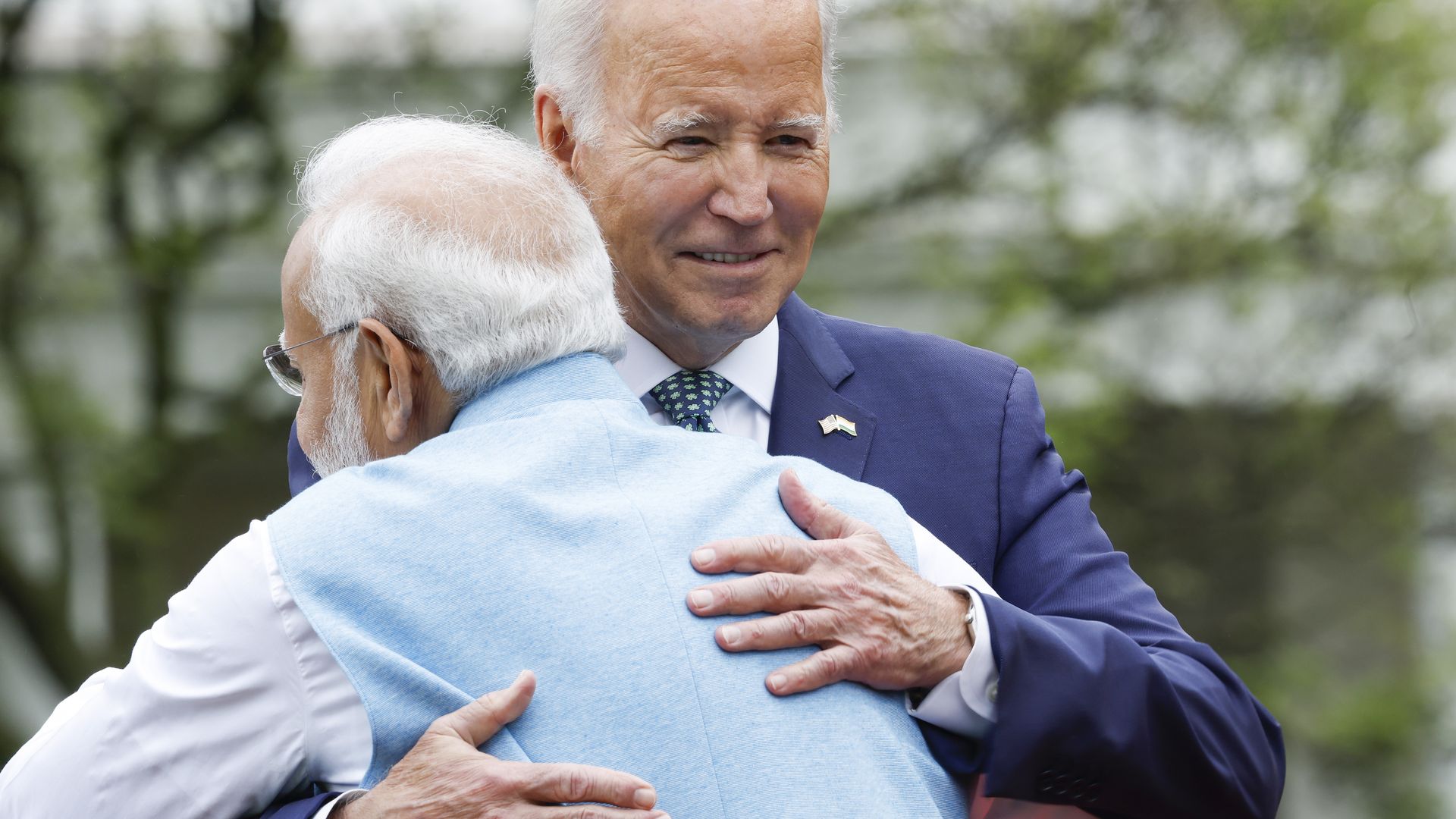
President Biden hugs Prime Minister Modi at a White House arrival ceremony. Photo: Anna Moneymaker/Getty Images
India is undercutting President Biden's strategy on Ukraine and backsliding on the human rights and democracy issues at "the core" of Biden's foreign policy — but U.S. officials are anxious to demonstrate this week that relations have never been better.
Why it matters: Prime Minister Narendra Modi's state visit underscores the stakes of the bet the U.S., and some major U.S. companies, are placing on the world's most populous country.
- India's economy is now the fifth-largest in the world, and by far the fastest-growing in the G20. U.S. firms like Apple and Micron see India both as a critical market and as an alternative production hub as they hedge away from China.
- U.S. policymakers, meanwhile, see India as arguably the biggest regional counterweight to Beijing's economic and military might.
- The gradual convergence between Washington and New Delhi over the past two decades is now speeding up considerably. "We're seeking escape velocity as we support India's emergence as a great power that will be central to ensuring U.S. interests and the interests of our partners in the coming decades," a senior U.S. official briefed reporters yesterday.
What's happening: India-China ties have deteriorated in parallel with U.S.-China ties, particularly after a deadly border skirmish in 2020.
- Modi has started embracing the Quad partnership with Australia, Japan and the U.S., after initially appearing sensitive to the perception it was an anti-China bloc. U.S.-India military exercises are growing more frequent.
- India's long-standing ties to Moscow and reliance on Russia for around three-quarters of its military kit remain a point of friction, but U.S. officials point to the fact that India is now looking to other suppliers, most notably the U.S.
- A deal to co-produce fighter jet engines is one of the primary deliverables from Modi's visit. There will also be announcements on topics including semiconductors, quantum computing, critical minerals, shipbuilding and drones.
Little surprise then, that the Biden administration is trying to make Modi’s visit a “transformational moment,” as national security adviser Jake Sullivan put it.
- Modi will attend a state dinner tonight after addressing a joint session of Congress.
- On issues like technology sharing that Biden and Modi discussed, the U.S. is actually "moving a little bit faster even than we do with traditional allies," noted Richard Rossow of the Center for Strategic and International Studies in a media briefing.
Yes, but: India is not a U.S. ally, and doesn't want to become one. In fact, Indian officials openly scorn the idea of a "U.S.-led global order." They envision a multipolar order, with India as one of the poles.
- Rather than endorsing Western sanctions after Russia's invasion of Ukraine, India has dramatically increased purchases of discounted Russian energy.
- Ahead of Modi's visit, analysts have debated whether India's approach to a U.S.-China crisis — over Taiwan, for example — would be significantly different.
What they're saying: “I believe India will side with the U.S. in any confrontation that we are engaged in with respect to China, but I think it’s unlikely that India will involve itself militarily short of any direct threats to India itself," Ashley Tellis of the Carnegie Endowment said on the Grand Tamasha podcast.
- "India's strategy to deal with a belligerent Beijing runs through Washington," but "it also runs through Moscow," said Nirupama Rao, a former Indian foreign minister who also served as ambassador in Washington and Beijing.
- "If you asked me to define India's position today [on China], I would say it's cautious without being pusillanimous," she told reporters. India is prepared to take on China on their shared border and in the Indian Ocean if it comes to that. Otherwise, "we have to tread cautiously."
Part II: India's democratic backsliding casts a shadow on the visit
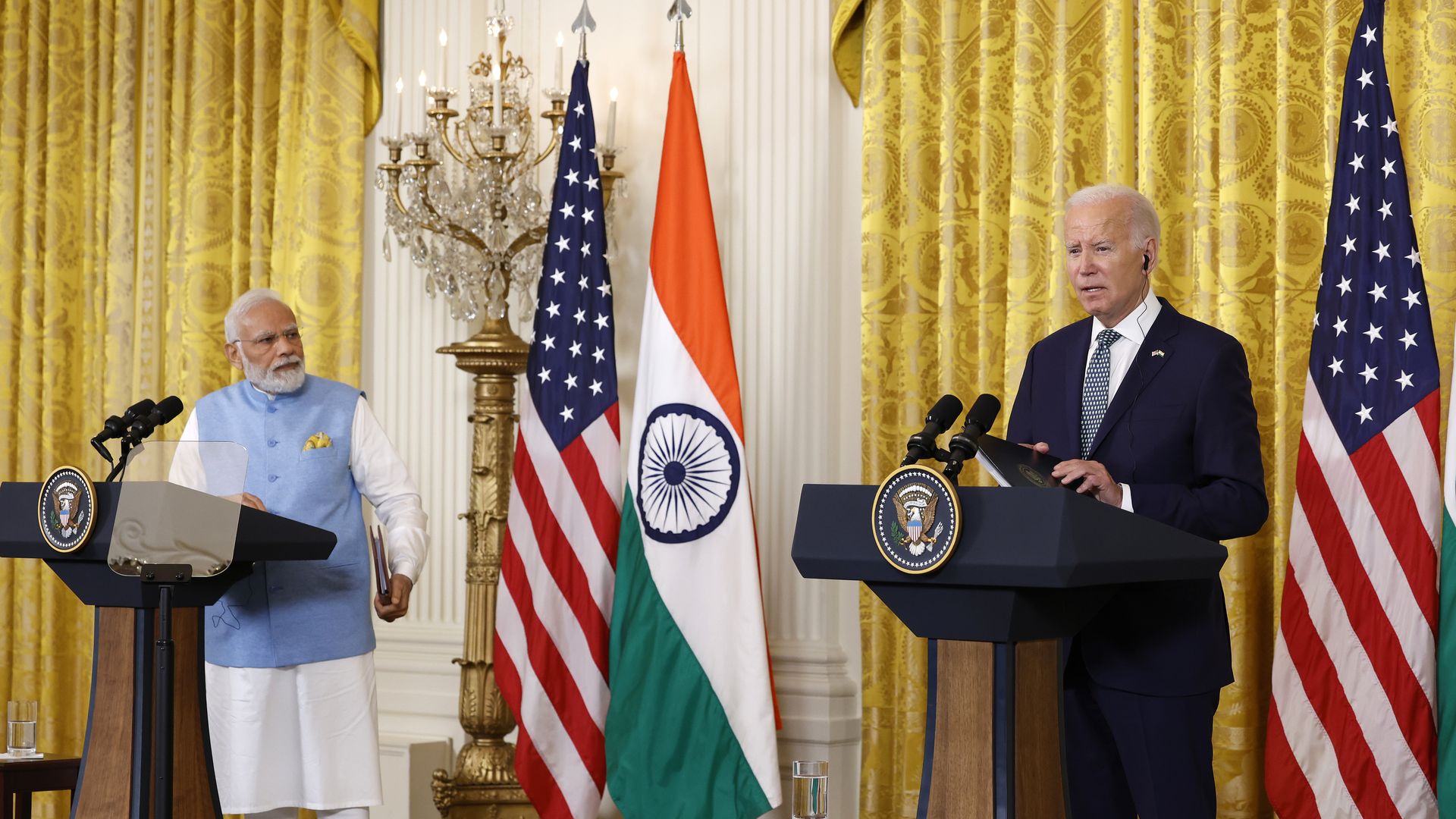
Photo: Anna Moneymaker/Getty Images
Modi issued an emphatic defense of India's democracy in a press conference today alongside Biden.
- Modi said he was "surprised" that people were concerned about India's democracy. "We have always proved that democracy can deliver — and when I say deliver, this is regardless of caste, creed, religion, gender. There is absolutely no space for discrimination," he said.
- The fact that Modi and Biden took two questions from reporters was itself remarkable. Modi hasn't held a single press conference in India since becoming prime minister nine years ago, according to Reuters.
- Biden said he and Modi had "a good discussion of democratic values," and argued that India's democratic tradition was a primary reason the U.S.-India relationship was stronger than the U.S.-China one.
Between the lines: If the relationship were based primarily on democratic values, it might be unlikely to reach an apex under Modi — who was once barred from the U.S. for failing as Gujarat governor to stop anti-Muslim riots that killed more than 1,000 in 2002.
- Freedom House downgraded India from "Free" to "Partly Free" on Modi's watch because of what it describes as "discriminatory policies and a rise in persecution affecting the Muslim population."
The bottom line: “We have enemies, we know how to deal with those. We have allies, we have clear expectations of those. And then we have India in the middle, so we are making things up as we go along," Tellis said.
3. Global news roundup

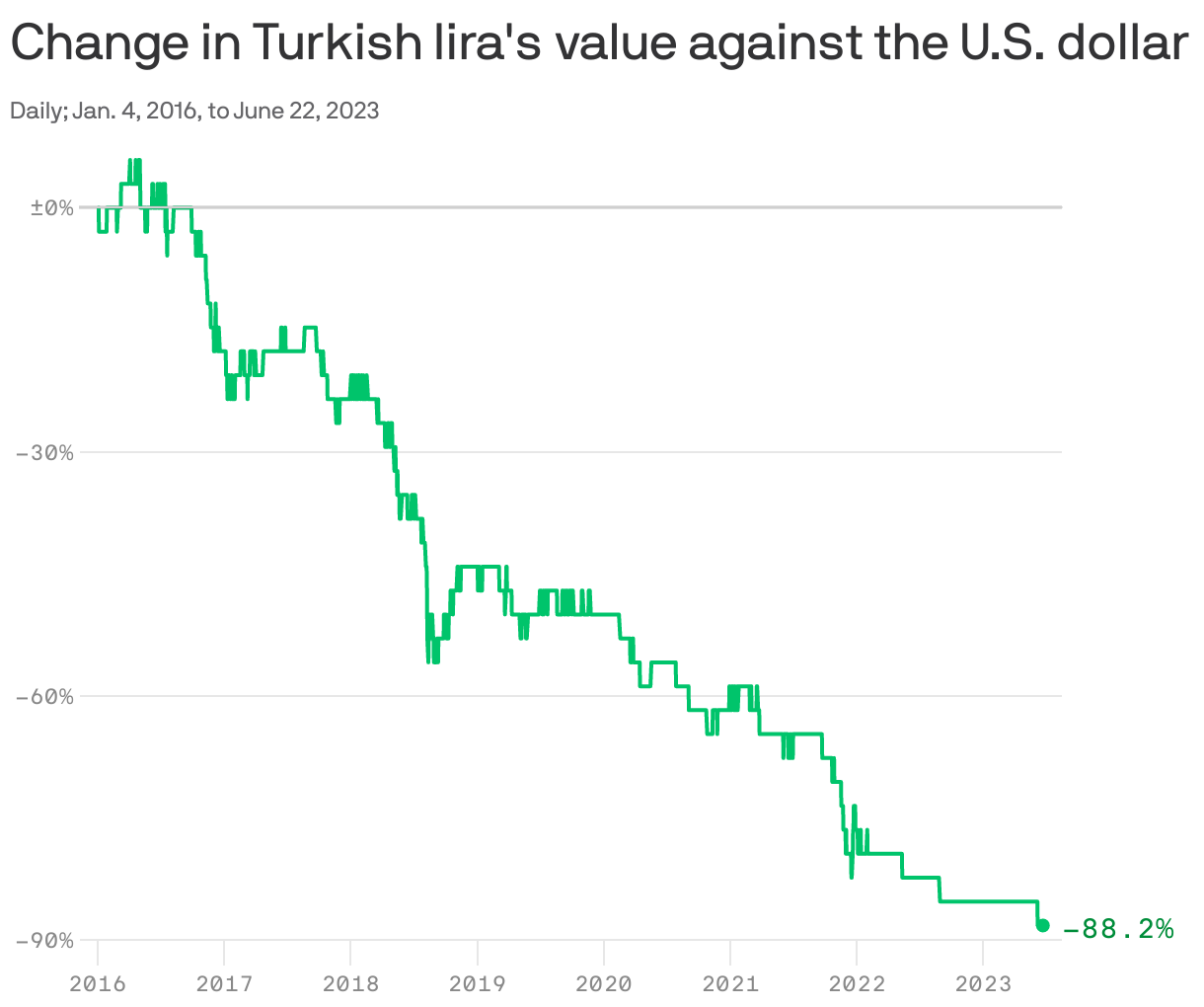
1. Turkey's new market-friendly finance minister raised interest rates by an eye-popping 6.5 points to fight inflation, signaling the end of "Erdoganomics."
- The Bank of England also announced a surprisingly large rate hike to fight the worst inflation pressures of any major developed economy, Axios' Courtenay Brown writes.
- The flipside: China's central bank cut rates, the latest attempt to kick-start an economic engine still sputtering in the aftermath of COVID, Axios' Matt Phillips writes. It's unlikely to do the trick. Go deeper.
2. Ukrainian missiles partially destroyed a key bridge used by Russia to supply its forces in southern Ukraine.
- President Volodymyr Zelensky acknowledged in a BBC interview that the counteroffensive is moving "slower than desired" but said people shouldn't expect it to unfold like "a Hollywood movie."
3. Violence in the occupied West Bank dramatically escalated this week after the Israeli military killed six Palestinians in a raid, Palestinian militants killed four Israeli settlers in an attack, Israeli settlers rampaged through a Palestinian town and torched dozens of homes and cars, and Israel conducted a rare drone strike on a car, Axios' Barak Ravid reports.
4. Secretary of State Tony Blinken's trip to China restored high-level dialogue between Washington and Beijing, but failed to persuade China's leaders to reopen communications that could help avert a potential military crisis, Axios' Bethany Allen-Ebrahimian writes.
5. Police raided the headquarters of the Paris 2024 Olympics organizing committee on Tuesday over concerns about the misappropriation of public funds, the latest in a long list of Olympics scandals.
Bonus: Where in the World?
Illustration: Natalie Peeples/Axios
Each of the following is the largest state or province by area of a country with a federal system. Can you name the countries? It might get harder as you go.
- Alaska
- Quebec
- Bavaria
- Abu Dhabi
- Amazonas
- Chihuahua
- Al-Anbar
- Niger (the answer is not Niger)
- Luxembourg (the answer is not Luxembourg)
- Rajasthan
- Balochistan
- Graubünden
- Sakha
- Sarawak
- Chuuk
Scroll to the bottom for answers.
4. Paris summit aims to mobilize trillions for the climate transition
Illustration: Aïda Amer/Axios
World leaders and top figures in finance are gathering in Paris today and tomorrow to discuss "a new global financing pact."
Why it matters: Dozens of developing countries are in debt distress, and most don't have access to the billions in financing needed to adapt to climate change and transition to clean energy.
- Loans to many developing countries are typically viewed by the World Bank and IMF as riskier investments, and are therefore subjected to higher interest rates and less favorable terms, Axios' Andrew Freedman writes.
- Barbados Prime Minister Mia Mottley, who is co-hosting the summit with French President Emmanuel Macron, is championing an ambitious and detailed agenda to free up more money at lower borrowing costs.
On the one hand: The proposals to revise the Bretton Woods consensus and reform the IMF and World Bank to respond to the climate crisis clearly have momentum.
- Dozens of African leaders, German Chancellor Olaf Scholz, Chinese Premier Li Qiang, Treasury Secretary Janet Yellen and new World Bank president Ajay Banga all turned up for the summit.
On the other: French officials concede that no concrete decisions will be made in Paris. They see the summit as a chance to demonstrate seriousness and keep these issues on the international agenda.
- The biggest deliverable from the summit may be an endorsement from a group of countries of a tax on shipping industry emissions.
5. Data du jour: How the world sees same-sex marriage


Estonia's parliament passed a law legalizing same-sex marriage this week, making the Baltic nation the 35th country and the first former Soviet republic to take that step.
Zoom out: A new survey of 24 countries from Pew finds that opinions on same-sex marriage vary widely, even within regions.
- Europe: Three-quarters or more of the respondents polled in all seven Western European countries support gay marriage, but just 49% in Greece, 41% in Poland and 31% in Hungary do.
- Africa: South Africa legalized gay marriage in 2006, though just 38% of South Africans support it, according to the poll. That's still far higher than in Kenya (9%) and Nigeria (2%), which are among the many African countries where gay sex is criminalized.
What to watch: A court in Japan issued a complicated ruling last month on the constitutionality of the country's ban on same-sex marriage. While the government opposes legalization, 74% of respondents support it — easily the most in any country polled where same-sex marriage isn't legal.
- Most South Koreans and nearly all Indonesians oppose gay marriage.
6. Two to watch: Elections this weekend
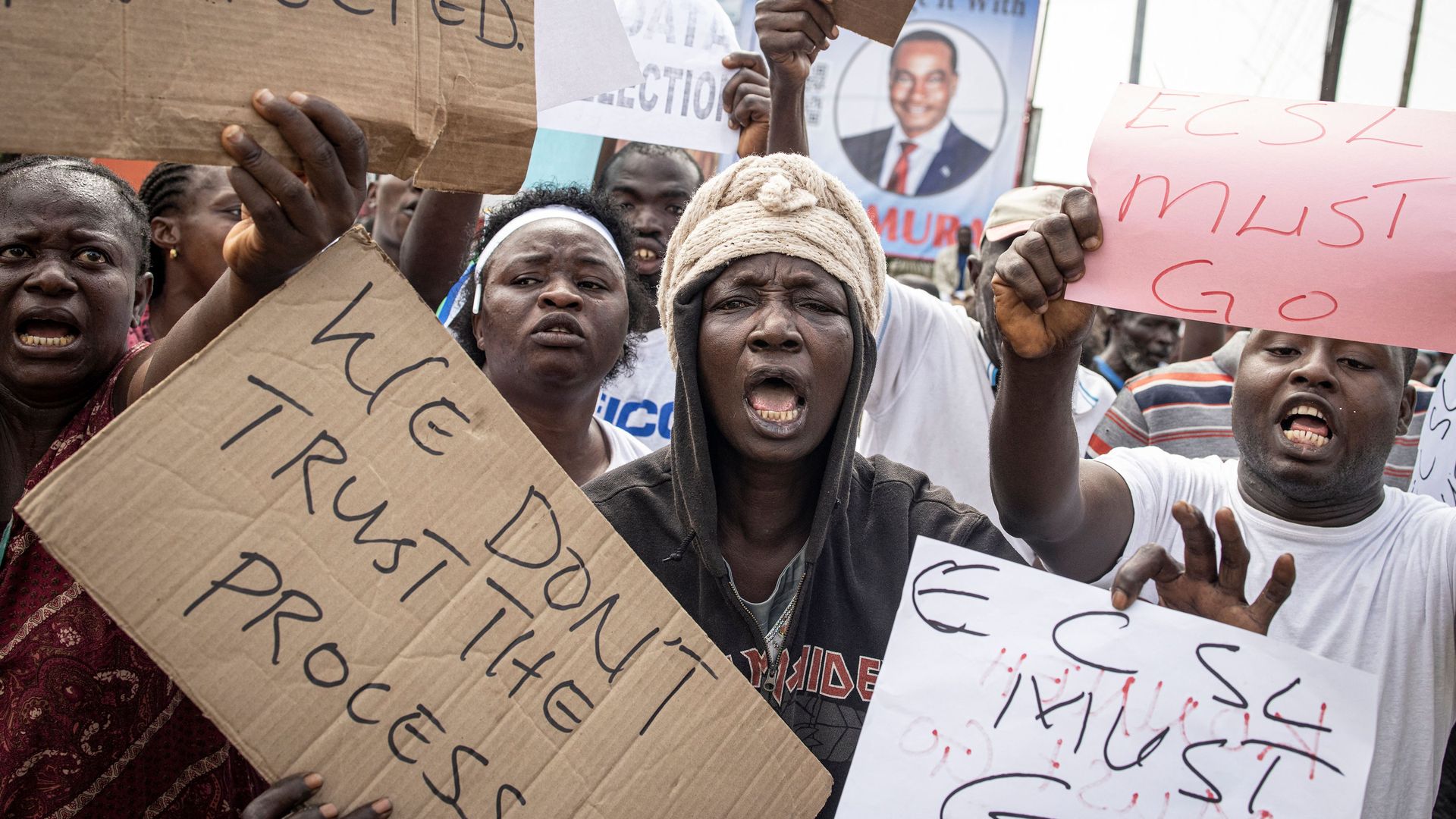
Opposition supporters demonstrate yesterday in Freetown, Sierra Leone. Photo: John Wessels/AFP via Getty
Sierra Leone will go to the polls on Saturday with President Julius Maada Bio seeking re-election, and voters grappling with high unemployment and soaring prices.
- The latest: One opposition supporter was reportedly killed by police during a pre-election demonstration outside opposition HQ in the capital, Freetown.
Guatemalans will also vote Sunday in an election that has been plagued by the illegal use of government funds and secretive rulings on which candidates can run, Axios Latino's Marina E. Franco writes.
- What they're saying: José Rubén Zamora, a veteran newspaper editor who was sentenced to six years in prison last week on money laundering charges likely motivated by his paper's reporting on corruption, told the Guardian the election will be "a simulation of democracy" to protect "the interest of the same elites."
7. Stories we're watching
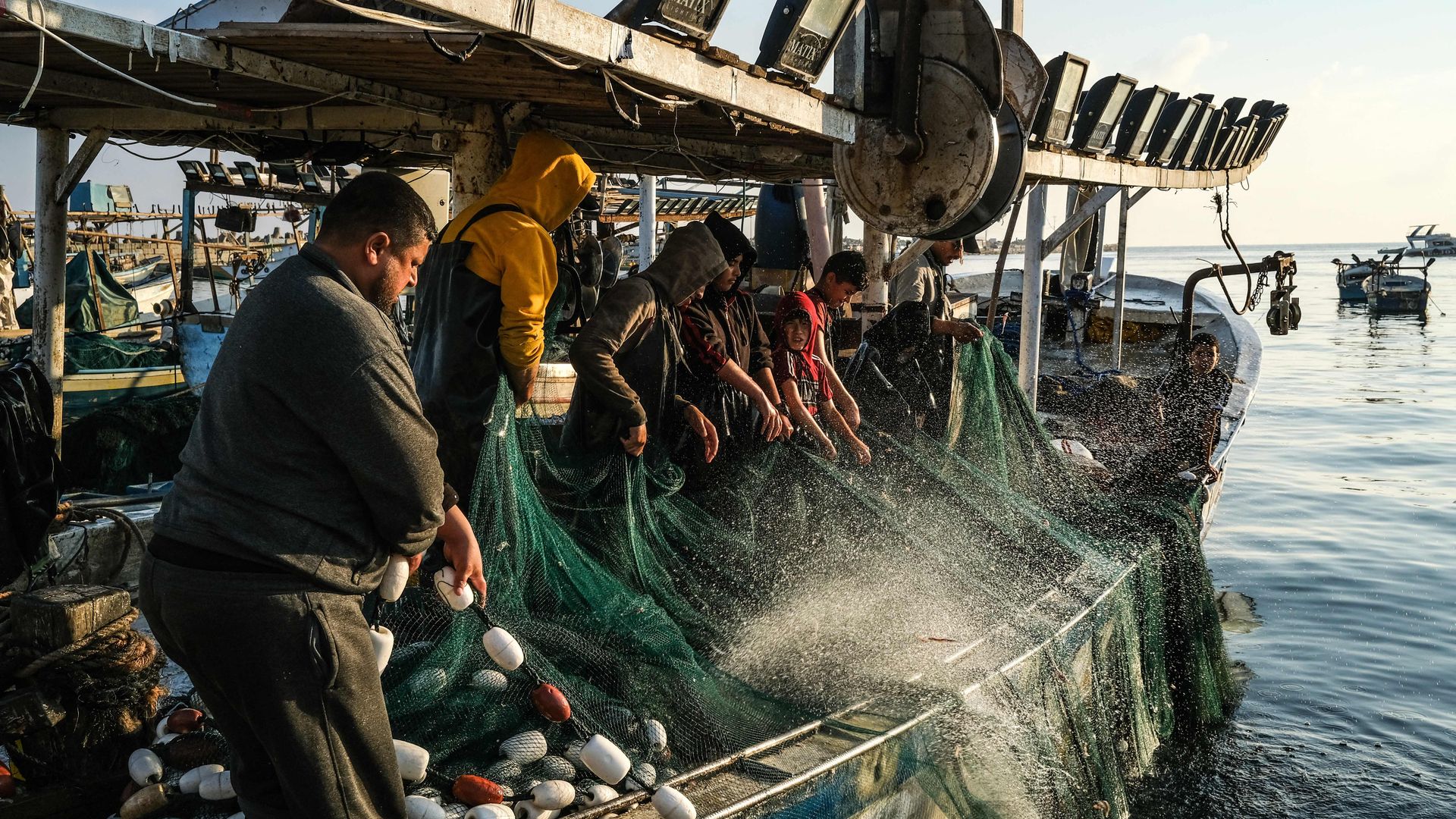
Hauling in the day's catch, in Gaza City. Photo: Ronaldo Schemidt/AFP via Getty
- The rise of extreme tourism
- Pentagon says accounting error frees up $6.2 billion for Ukraine
- Biden adviser in Saudi Arabia as part of Israel normalization push
- Global number of displaced children hits record high
- India to sign Artemis Accords governing Moon exploration
- Twitter may face fines in Australia
- Biden calls Xi a dictator
Quoted:
“That’s what’s a great embarrassment for dictators, when they didn’t know what happened."— President Biden to donors on why Chinese President Xi Jinping was so "embarrassed" about the spy balloon incident.
“With the latest irresponsible remarks about China’s political system and its top leader, people cannot help but question the sincerity of the U.S. side. ... The Chinese government and people do not accept any political provocation against China’s top leader and will resolutely respond.”— China’s embassy in Washington, announcing a formal protest over Biden's comments
Answers: 1. U.S.; 2. Canada; 3. Germany; 4. UAE; 5. Brazil; 6. Mexico; 7. Iraq; 8. Nigeria; 9. Belgium; 10. India; 11. Pakistan; 12. Switzerland; 13. Russia; 14. Malaysia; 15. Micronesia
Key: 1. Alaska; 2. Quebec; 3. Bavaria; 4. Abu Dhabi; 5. Amazonas; 6. Chihuahua; 7. Al-Anbar; 8. Niger; 9. Luxembourg; 10. Rajasthan; 11. Balochistan; 12. Graubünden; 13. Sakha; 14. Sarawak; 15. Chuuk
Sign up for Axios World

Take a tour of the most important stories shaping our world