Axios What's Next

October 11, 2023
Yesterday's World Mental Health Day was the biggest yet, Jennifer reports, at a critical time for youth mental health especially.
- Will you be in Vegas for Money 20/20? Join Axios' Dan Primack on Oct. 24 for conversations exploring the future of fintech.
Today's newsletter is 1,079 words ... 4 minutes.
1 big thing: World Mental Health Day goes big
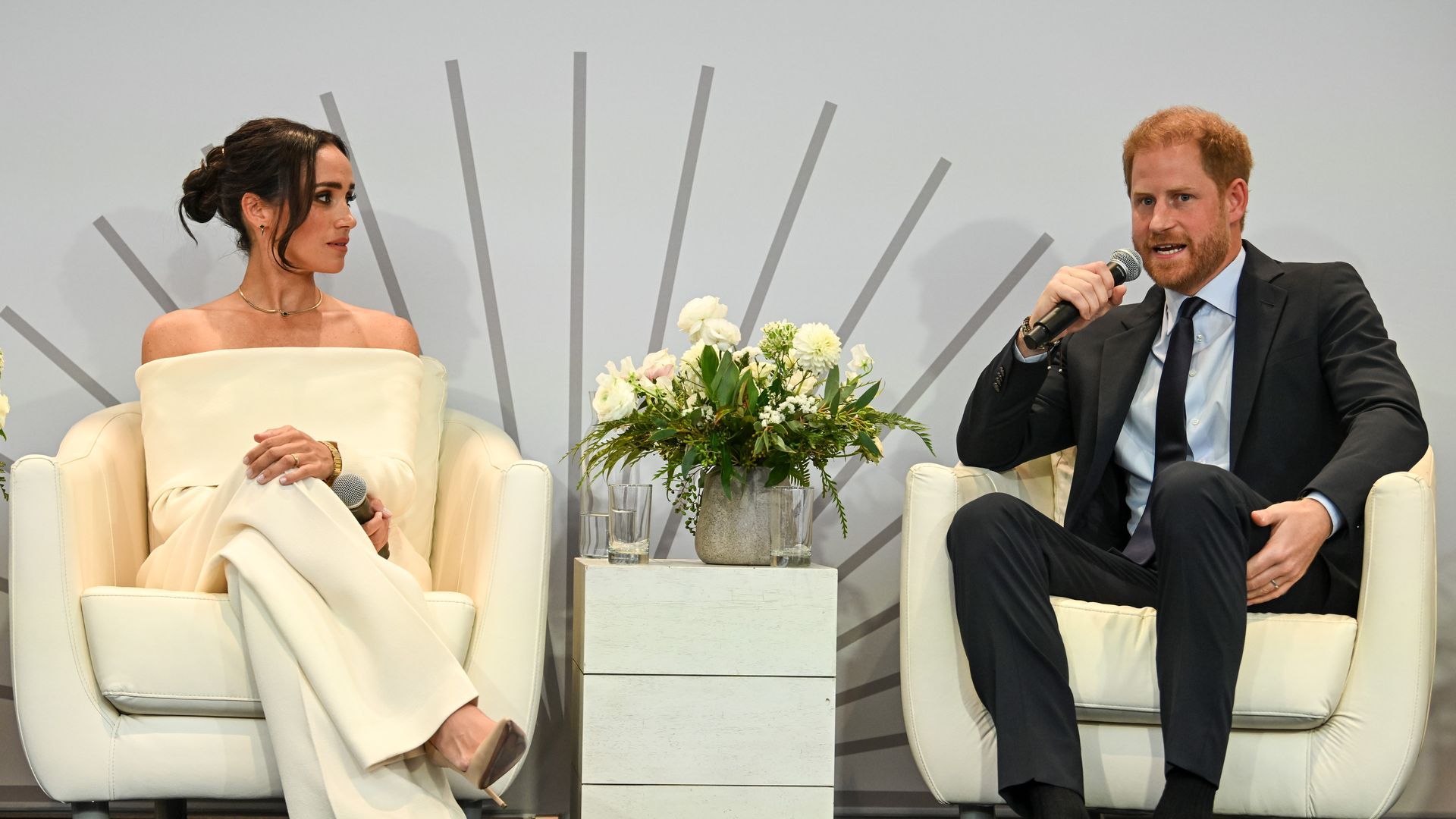
Meghan Markle and Prince Harry speak at The Archewell Foundation Parents' Summit during World Mental Health Day 2023. Photo: Bryan Bedder/Getty Images for Project Healthy Minds
Observance of World Mental Health Day has snowballed, with luminaries like Prince Harry and Meghan Markle throwing their weight behind what had been a low-key annual observance, Jennifer writes.
Why it matters: Mental health has turned into a defining social, medical and workplace issue, especially for young Americans.
Driving the news: A nonprofit called Project Healthy Minds yesterday held what it says was the largest festival in the world dedicated to World Mental Health Day, drawing 1,500 people to a flagship event in New York City.
- Prince Harry and Meghan, the Duke and Duchess of Sussex, shared the stage with U.S. Surgeon General Vivek Murthy and TV host Carson Daly to discuss the impact of social media on youth mental health.
- Simultaneous World Mental Health Day events were held in six U.S. cities and London, at the same time that various companies (like MTV Entertainment Studios and JOANN, the arts-and-crafts retailer) announced new relevant initiatives.
What they're saying: "For us, the priority here is to turn pain into purpose," said Prince Harry, whose organization which he founded with his wife, The Archewell Foundation, hosts a forum for parents of children who have died by suicide.
Where it stands: Project Healthy Minds has been developing a playbook for CEOs on approaching mental health issues in the workplace — as well as building a searchable online database of mental health resources.
- It's currently setting up a working group to create corporate standards for supporting workers' mental well-being — such as training managers and peers to recognize symptoms.
- It's striving to expand its database, which 300,000 people have used to locate mental health services, from about 65 options to 500 or more.
"I've been asked over time whether companies' interest in mental health would wane post-COVID, and the headline is, we've never had more companies asking us how to get involved," Project Healthy Minds founder Phillip Schermer tells Axios.
- "What that says is that the movement among companies to do more on mental health was not temporal."
The big picture: Mental illness and the lingering stigma around it have emerged as a top concern for parents, educators, health care professionals and even U.S. mayors.
- Debate over social media's impact on emotional well-being has pitted the most powerful tech companies in the world against lawmakers, regulators, doctors and parents.
- Pediatricians and others are trying to mediate with TikTok and other social platforms.
- Young people are driving a rise in mental health spending — and calls for a major societal shift in how mental illness is recognized and treated.
Zoom in: The depth of youth mental health struggles was on excruciating display during two successive panels of parents who had lost children to suicide.
- Toney and Brandy Roberts described finding their daughter, Englyn, lifeless in her room at 3:30 a.m. after watching a how-to Instagram video on hanging.
Zoom out: Murthy, the surgeon general, described a "crisis" of youth mental health — an issue that he has turned into a personal and professional mission, issuing an advisory in May about the effects of social media use.
- The addictive and potentially harmful nature of social media "pits the best designers and product engineers" against families, Murthy said.
- "We have placed the entire burden of managing that on parents and kids," he said. "That is not a fair fight."
What's next: "We hope this will be the start of a wider conversation about how we can support one another as we navigate the challenges of parenting in a digital age," James Holt, co-executive director of The Archewell Foundation, told the crowd.
2. Fighting AI disinfo
Illustration: Maura Losch/Axios
New products, guides and accountability initiatives are proliferating in response to the threat of AI-enabled election misinformation, Axios AI+'s Ryan Heath reports.
Why it matters: Major tech companies have been cutting back their internal investments in election integrity work, while the newest AI companies lack the resources and relationships to effectively manage the risks their tools pose to elections.
What's happening: Columbia University and the Paris Institute of Political Studies have launched an innovation lab to monitor AI influence on elections and "design and test interventions that strengthen democratic societies."
- Led by Rappler CEO and Nobel Peace Prize winner Maria Ressa and Camille François (a researcher known for her work uncovering Russia's 2016 election disinformation campaign), the lab is part of a digital literacy project backed by $3 million from the French government.
What they're saying: François told Axios she'll be investigating "actual risks and harms" posed by generative AI, aiming to "bridge the knowledge gap between experts on democratic theory and [AI] developers."
Meanwhile: The Integrity Institute, led by former Meta elections staff, has expanded its election integrity best practices guide.
- AI and You, founded by National AI Advisory Committee member Susan Gonzales, plans a campaign showing viewers what AI-generated deepfake election ads look like.
- Services like Nooz.ai have debuted features that perform language analysis of news stories and official documents to help users spot manipulation efforts.
3. 📈 Orders up


The restaurant industry is back — sort of, Axios Markets' Emily Peck reports.
Driving the news: Food service and bar employment has finally passed February 2020 levels, according to the latest jobs report.
- Yes, but: Were it not for the pandemic, another million-plus people would be working in these fields right now, says Julia Pollak, chief economist at ZipRecruiter.
Zoom in: Prior to 2020, the restaurant industry was growing at an "exceptional" pace, Pollak says. But COVID disruptions were monumental.
- When restaurants shut down in 2020, millions of employees were displaced. When restaurants reopened, many of them had a hard time finding enough workers.
Between the lines: Customer habits are shifting.
- Limited-service restaurants (think fast-casual) have grown, with employment rising by about 117,000 between February 2020 and August 2023, according to the latest available government data.
- But full-service restaurant employment fell by 212,000 over the same period.
4. Big bucks for Navy drones

A prototype Saronic Spyglass vessel in its first open water exercise with the U.S. Navy in the Pacific earlier this year. Photo: Courtesy of Saronic
Austin-based Saronic has announced a $55 million funding round to boost its robotic ship business, Axios Austin's Asher Price reports.
Why it matters: The U.S. Navy is expanding its drone fleet as part of an arms race with China, which has unveiled robotic ships of its own.
Driving the news: Saronic is currently developing Spyglass, a 6-foot vessel, and Cutlass, a 13-foot vessel, capable of carrying payloads in "communication-denied and GPS-denied environments," per the company.
What they're saying: "Think of them as drone boats for the Navy to enable target identification and intelligence gathering," Saronic CEO Dino Mavrookas tells Axios.
Editor's note: The story on Minnesota youth voter pre-registration we ran yesterday has been corrected to note that 1,141 teens have pre-registered to vote under the new law, not 1,817.
Was this email forwarded to you? Get your daily dose of What's Next by signing up here for our free newsletter.
Sign up for Axios What's Next

The next decade of big, sweeping changes will unfold in cities and communities where new technologies like 5G, AI and drones are transforming how we work, live and play together. What’s Next will guide you through the revolution.