
Axios Media Trends

September 12, 2023
Today's Media Trends, copy edited by Sheryl Miller, is 1,713 words, a 6½-minute read. Sign up.
Situational awareness: UFC-owner Endeavor has officially closed its previously announced deal to acquire the WWE and take it public with the UFC under one publicly traded company called TKO Group Holdings.
1 big thing: Freedoms backslide
Illustration: Brendan Lynch/Axios
Recent attacks on press freedoms in countries like Israel and India underscore how fragile protections for journalism have become in democracies around the world.
- Why it matters: Years-long efforts by autocrats to undermine the free press in places like Hungary, Turkey and Russia have given cover to democratic leaders looking to do the same.
Driving the news: In a departure from protocol, no independent journalists were allowed to cover Biden's meeting with Indian Prime Minister Narendra Modi on Friday night, NBC News reports.
India: The situation Friday reflects a broader attempt by the Modi government to stifle the press.
- A slew of recently introduced bills designed to suppress independent journalism ahead of the 2024 election in India are being condemned by the Committee to Protect Journalists, with one bill being labeled by the group as "a dangerous framework for the expansion of surveillance and censorship."
Israel: A group of some of the most prominent Israeli broadcasters last month began raising the alarm about new media regulations proposed by Prime Minister Benjamin Netanyahu's government that would see the creation of a government-controlled media regulator.
- In a statement, the Israeli Journalists Association said, "On the road to dismantling democracy — [Communications] Minister [Shlomo] Karhi is trying to eliminate the press."
Guatemala: José Rubén Zamora, an outspoken government critic, has been jailed for over a year on what press freedom groups have called bogus fraud charges.
- Media crackdowns in the country, including Zamora's arrest and the forced shutdown of his independent newspaper, came ahead of the country's most recent election.
- Zamora is the only imprisoned journalist in a Latin American democracy.
Be smart: In the U.S., federal support for press freedoms has improved under the Biden administration, but tensions between local newsrooms and local law enforcement officials have escalated in recent years, per data from the U.S. Press Freedom Tracker.
- Those tensions were made clear when a police department in Marion, Kansas, was accused of violating First Amendment protections after officers raided a local paper and the home of its owners.
The bottom line: "Democracies, democratic institutions and freedoms of the press take a very long time to build and strengthen, and these authoritarian and repressive regimes can shut them down in a matter of weeks," said Jose Carlos Zamora, the son of the imprisoned Guatemalan journalist, told me during a press conference in July.
2. Exclusive: The Economist will paywall its podcasts
Illustration: Brendan Lynch/Axios
The Economist plans to introduce a new subscription tier this Thursday called Economist Podcasts+ for $4.90 monthly, the Economist president Bob Cohn told Axios.
Details: The Podcasts+ tier will give subscribers exclusive access to all of the Economist's current and new podcasts, beginning in mid-October. Current subscribers to The Economist will get access at no additional cost.
- 🔎 Every show, with the exception of the Economist's flagship daily show "The Intelligence," will now only be accessible behind the paywall.
- 🎧 New shows coming to the podcast subscription tier include a limited series on management called "Boss Class" and a Saturday edition of "The Intelligence," a spokesperson told Axios.
Zoom out: The Economist Group now has 1.2 million subscribers across all of its products, making it one of the largest subscription news companies in the world.
- The creation of a paid tier for its audio products reflects a broader effort made by the company in the past few years to put more of its content behind a paywall.
- Today, the majority of its newsletters are subscriber-only. The firm relaunched its subscription daily news briefing app, Espresso, last year. In 2020, the company launched an enterprise subscription for corporations.
By the numbers: During its last fiscal year from April 2022 to March 2023, the Economist Group earned more than $470 million in revenue, with around 60% of that money coming from non-newsstand subscriptions.
- The rest came from a mix of newsstand sales, advertising, research and consulting services, education services, and events.
The big picture: More publishers are experimenting with putting their podcasts behind a paywall as their audiences grow, but few have opted to fully paywall their shows.
- The New York Times launched a subscriber-only audio app called NYT Audio earlier this year, but most of its biggest podcasts are still available for free. NPR has been putting more exclusive content on its podcast app NPR+.
3. 📺 Disney-Charter deal represents new era for TV bundles
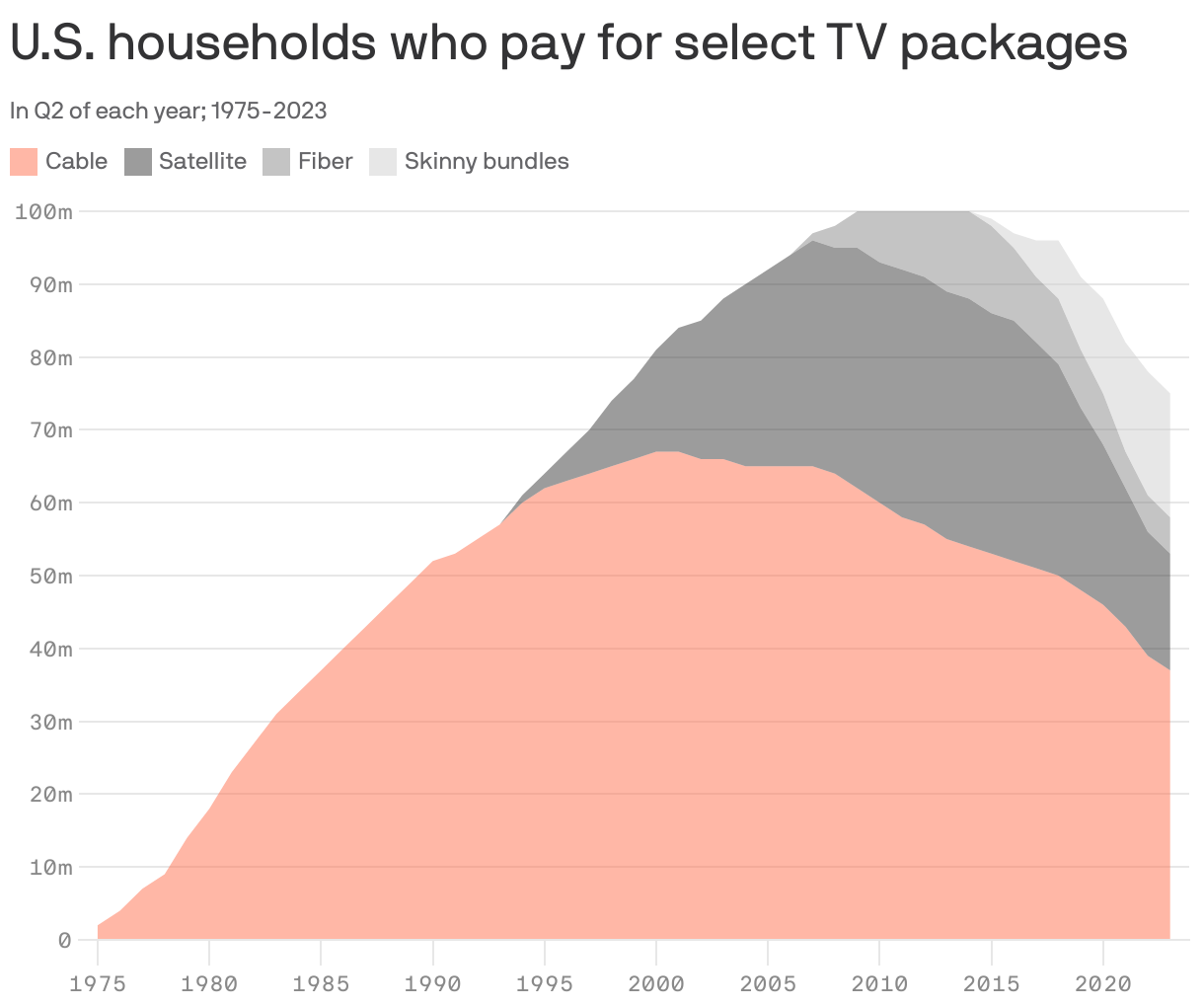
Disney and Charter's eleventh-hour deal to avert a blackout of ESPN's "Monday Night Football" kickoff for nearly 15 million Charter Spectrum customers suggests both cable operators and TV networks are committed to keeping the cable bundle alive, at least for now.
- In an interview with Hollywood Reporter, Disney executives basically conceded that they are willing to give up linear distribution for some of its more niche cable channels in favor of focusing on its core entertainment brands and streaming.
Why it matters: Rather than a cable bundle reckoning many predicted, the fight instead set a road map for future deals that could keep the legacy business afloat, Axios' Tim Baysinger writes.
- "We'd call it a first down for both companies, but well short of a touchdown. At least it does set a higher bar for the next carriage renewal to come," said Macquarie senior media tech analyst Tim Nollen.
Disney has agreed to give Charter customers access to the basic, ad-supported tier of Disney's main streaming service, Disney+. Charter subscribers who pay for a higher tier will get access to ESPN+. (Disney initially didn't want to give any free access to its streaming products.)
- Disney will also make its forthcoming direct-to-consumer service for ESPN available to Spectrum TV Select subscribers upon launch.
Charter has agreed to distribute 19 of Disney's TV networks, but it will no longer include several smaller channels, including Baby TV, Disney Junior, Disney XD, Freeform, FXM, FXX, Nat Geo Wild and Nat Geo Mundo.
- It will also make the full Disney streaming bundle available to Charter customers at a retail rate, rather than for free.
What to watch: Future carriage deals between programmers and distributors could look similar to the one Disney and Charter made: A mix of linear TV and streaming services, with a serious culling of the sheer amount of TV channels.
- Sign up for Axios Pro Media Deals.
4. ⚾ Exclusive: The Sporting News raises $15M, more than a century after launch

Illustration: Brendan Lynch/Axios
The Sporting News, a digital sports news site, has raised $15 million in a growth round led by Playtech, a London-based, publicly traded gambling software development company.
Why it matters: It's not common for a brand that launched in the 1800s to raise growth capital, but TSN CEO Rich Routman said he sees it as a "series A against the firm's new strategy."
Zoom out: Digital media companies have mostly struggled to raise money this year, given a slowdown in the ad market.
- Routman said the firm's focus on affiliate revenue, or money it makes by brokering sales and subscription sign-ups to third-party websites, is what made it attractive to investors.
Details: The raise values TSN in the "eight figures," Routman said. He declined to provide annual revenue figures, but he said the firm is profitable.
- The money will be used to continue expanding the website globally and to continue building its affiliate business, which today represents 40% of the firm's revenue. (Advertising represents the other 60%.)
- Alongside the raise, the company has also made a strategic investment in SuperDraft, an online fantasy sports platform, that it will manage day to day.
The big picture: The raise also represents a new era for TSN, which was founded as a newspaper in 1886.
- The outlet has changed hands a number of times since the family of its founder sold it in the 1970s. It became a digital-only outlet in 2012. It began building its affiliate business in 2021, after selling to a group of private investors led by Hong Kong-based investment firm Pax Holdings.
5. Google heads to court for historic antitrust trial
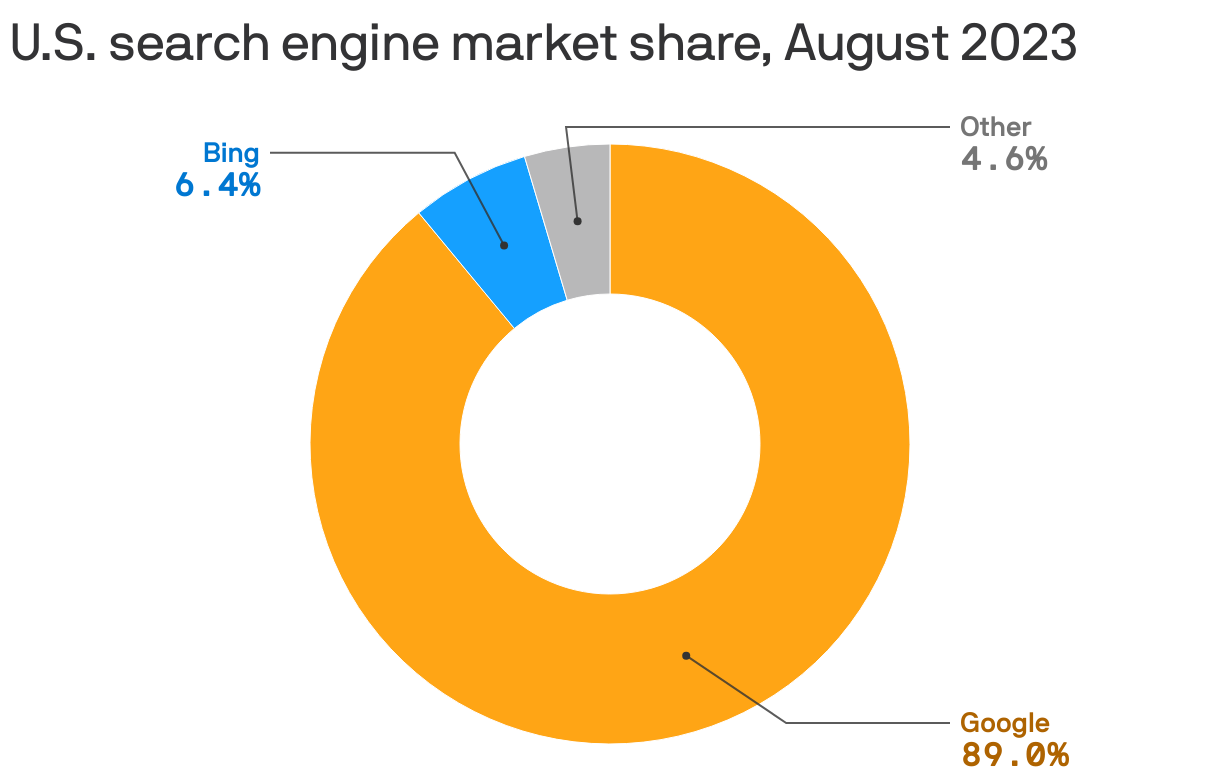
Google will square off against the Justice Department in court today to defend itself against federal antitrust charges over its search dominance.
Why it matters: Antitrust experts don't expect Google to be broken up. (At least not in this trial. Google is facing a break-up threat in a separate DOJ antitrust lawsuit against its ad tech dominance.)
- The greater danger to Google may lie in the distractions and cautions imposed by its simple existence, Axios' Ashley Gold and Scott Rosenberg write.
Zoom out: Every 20–25 years, the Justice Department's antitrust enforcers have taken on a dominant tech company.
- First it was IBM's turn (1969–1982), then Microsoft's (1998–2002). Google now has the baton.
- IBM and Microsoft both lost momentum in their markets during the course of their antitrust ordeals, even though they both ultimately won their court battles.
- Companies hesitate and second-guess themselves when they know they're being watched by regulators.
Be smart: Each of these trials has taken place as one era in computing was transitioning to another: From the mainframe to the PC, for IBM; from the isolated PC to the Web, for Microsoft.
- The advent of AI now looms over Google's case.
What we're watching: Google on Friday filed a motion to dismiss a federal antitrust lawsuit from Gannett, America's largest newspaper chain.
- The complaint alleged Google's dominance in digital advertising undercut revenue for news publishers.
- In the Justice Department's lawsuit against its ad tech dominance, both Google and the DOJ are still preparing their cases for trial.
6. 🗞️ Largest philanthropic push ever for local news
A coalition of nearly two dozen nonpartisan philanthropies last week announced a plan to commit more than $500 million over the next five years through a new initiative called "Press Forward."
Why it matters: It represents a new era for local news investment, where donors are more unified toward a common set of goals.
- Through collaboration, "we have an unprecedented opportunity to combine our efforts and work toward shared goals at a scale unlike anything I can recall in philanthropy," said Carnegie Corporation of New York president Louise Richardson.
- On the regulatory front, similar efforts are being made to streamline progress by unifying more groups to find solutions together.
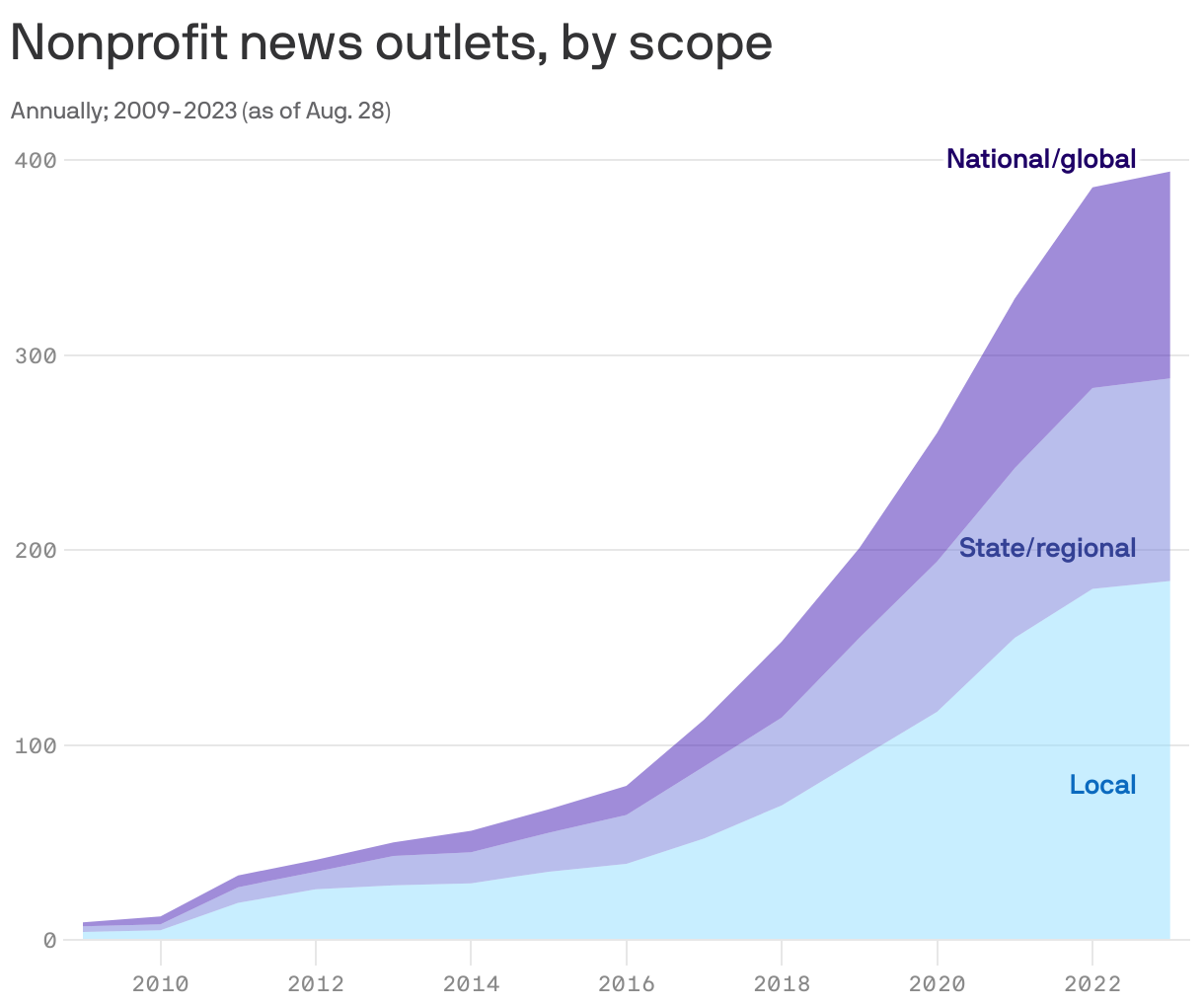
The big picture: Philanthropists are increasingly stepping up to help local news organizations launch and survive in the U.S.
- Nonprofit newsrooms backed by large philanthropic donors have launched more frequently in an effort to fill the void, according to data from the Institute for Nonprofit News. (See chart above.)
- Foundations now make up 45% of nonprofit local news revenue streams.
Sign up for Axios Media Trends

Sara Fischer’s inside look at the forces reshaping media.