
Axios Media Trends

September 30, 2025

Good afternoon. Today's Media Trends, edited by Christine Wang and copy edited by Sheryl Miller, is 2,307 words, an 8½-minute read. Sign up.
Next week: Axios Live and Noticias Telemundo are headed to Los Angeles for our fourth annual Visionarios event on Wednesday, Oct. 8, featuring 2026 California gubernatorial candidate and former HHS Secretary Xavier Becerra, LA Galaxy's Christian Ramirez & more. RSVP here.
⚖️ Situational awareness: A federal judge temporarily suspended the Trump administration's plans to cut more than 500 jobs at the U.S. Agency for Global Media, which oversees Voice of America.
- VOA director Michael Abramowitz called the ruling an "important step" in a note to staff and said he's hopeful Congress will continue to fund the broadcaster.
1 big thing: 🎯 Scoop... Disney targets Character.AI
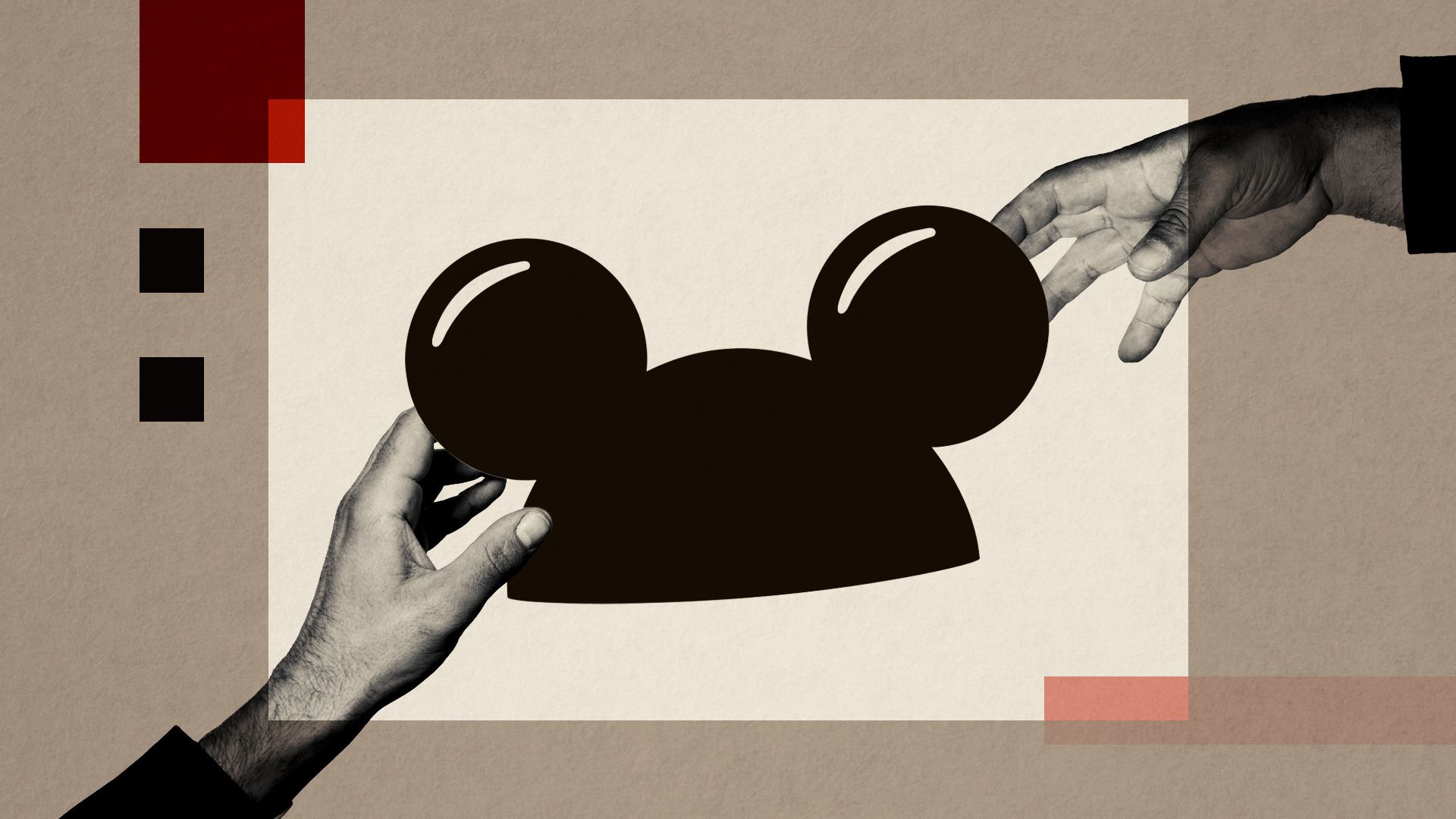
The Walt Disney Company last week sent a cease and desist letter to Character.AI demanding the personalized AI chatbot developer immediately stop using its copyrighted characters without authorization, according to a copy of the letter obtained by Axios.
Why it matters: In the letter, Disney emphasizes its main concern isn't just financial, but that Character.AI's platform weaponizes Disney characters in a way that could damage its brand long term.
📝 Zoom in: "Character.ai's infringing chatbots are known, in some cases, to be sexually exploitive and otherwise harmful and dangerous to children, offending Disney's consumers and extraordinarily damaging Disney's reputation and goodwill," the letter reads.
- "In sum, Character.ai chose to systematically reproduce, monetize, and exploit Disney's characters, that are protected by copyrights and trademarks, without any authorization, in a way that is anathema to the very essence of the Disney brand and legacy."
State of play: In response to the letter, a Character.AI spokesperson said that Disney's characters have been removed from its service.
- While all of the characters on the platform are generated by users, the spokesperson said, "It's always up to rightsholders to decide how people may interact with their IP, and we respond swiftly to requests to remove content that rightsholders report to us.
👀 Zoom out: Disney has taken a more aggressive stance in going after AI companies for copyright infringement in recent months.
- In June, the entertainment giant — alongside NBCUniversal — became the first major studio to sue a generative AI company when it filed a complaint against Midjourney. Warner Bros. Discovery sued Midjourney in early September.
- Earlier this month, it teamed with NBCU and WBD to sue the Chinese AI firm MiniMax, alleging large-scale piracy of their respective studios' copyrighted works.
The big picture: Disney's letter to Character.AI and its previous lawsuits indicate that the entertainment giant believes the responsibility falls on AI platforms to proactively take down user-generated content of copyrighted works.
- AI companies have typically tried to shy away from that responsibility and rather risk lawsuits than slow down the creative development of their platforms.
2. 🤖 OpenAI enters AI video war
OpenAI is launching a social video app powered by its generative AI video tool, Sora, which can generate AI videos featuring copyrighted material unless rights holders explicitly opt out, per Axios' Ina Fried.
Why it matters: The opt-out feature suggests OpenAI is willing to take an aggressive stance toward testing the limits of copyright law in an effort to win the short-form video attention battle.
- The social app is powered by Sora 2, a new version of OpenAI's video model, which also launched today.
📱 The big picture: OpenAI's new app would compete directly with TikTok, Instagram Reels and YouTube Shorts, which have built massive audiences around endless feeds of short-form videos.
- Meta CEO Mark Zuckerberg said last year that more than half of the time spent on Instagram is with Reels, and he's stressed that statistic to creators.
Zoom out: The new video app proves how much mobile video is increasingly shifting from fostering personal connections on social media to providing AI-driven entertainment.
- That shift can be highly lucrative from an advertising perspective. (OpenAI just hired former Meta executive Fidji Simo to lead the company's commercial push.)
🛍️ Between the lines: Because AI can churn out endless personalized videos, it also creates more opportunities for Big Tech to explore commerce.
- TikTok has rapidly expanded into e-commerce with TikTok Shop.
- OpenAI just announced a new partnership with Shopify and Etsy to offer instant checkout.
What to watch: For traditional media publishers, the looming challenge is figuring out how to compete with platforms that can generate infinite personalized content.
- OpenAI's opt-out policy also puts pressure on content owners to actively police how their intellectual property is used.
3. 🚨 Spanish TV blackout looms
If Telemundo parent NBCUniversal and YouTube TV fail to strike an agreement tonight, the country's largest Spanish-language broadcasters — Univision and Telemundo — could be made inaccessible to YouTube TV customers at the same time.
📺 Why it matters: YouTube TV is one of the largest pay-TV providers in the U.S., with more than 8 million customers.
- Sources tell Axios a deal between NBCU and YouTube appears unlikely before the deadline.
🏛️ Zoom in: Congress rarely intervenes in intra-market disputes between pay-TV providers and content programmers, but this situation has lawmakers on high alert.
- Members of the Congressional Hispanic Caucus on Friday sent a letter to the heads of Google, TelevisaUnivision and Telemundo urging all parties to reach distribution agreements to avoid risking a Spanish-language blackout on YouTube TV, according to a copy of the letter obtained by Axios.
- The caucus asked the three leaders to let it know how they plan to address the ongoing dispute as members of Congress "continue to evaluate legislative considerations regarding access to Spanish-language media."
- Other lawmakers, including Republican Sens. Ted Cruz of Texas and Bernie Moreno of Ohio, have also blasted YouTube.
🍁 Zoom out: While pay-TV disputes like this are common ahead of the fall sports season, YouTube TV has been at the center of most of the major disagreements this year.
- In August, ahead of football season, YouTube TV threatened to drop Fox Corp. channels. The two sides ultimately came to an agreement days later.
4. 💰 Trump banks nearly $100M in media settlements


YouTube has agreed to pay President Trump $22 million to settle his 2021 lawsuit, which he filed after the company suspended his account following the Jan. 6 Capitol riot.
- YouTube will also pay $2.5 million to the other plaintiffs on the case.
⚖️ Why it matters: President Trump has racked up nearly $100 million in legal wins against tech and content companies in the past year, including Meta, X, ABC and CBS.
Reality check: While legal experts believe the content firms could've won these cases in court, settling lawsuits can be less distracting and sometimes less costly than seeing a case all the way through to a trial.
- Redstone Family Foundation chair Shari Redstone, formerly the chair of Paramount Global, told Axios earlier this month that CBS settling with Trump was "absolutely" the right thing to do.
- "It took up way too much time in the news, which really had an impact on our employees, on our ability to do other transactions," she said.
5. 🎮 EA goes private amid gaming industry reckoning
Electronic Arts is the latest video game giant to be acquired, as the sector still wrestles with post-pandemic headwinds, such as slower sales, franchise fatigue and inflationary impacts on consumer spending.
🔧 Why it matters: Analysts are bullish on the gaming sector long term, but they see most of the new growth coming from companies that focus on tools and tech serving the sector, not large studios that bet on content.
The big picture: "One of the themes of the last couple of years has been the high cost of development and long development timelines," Derek Douglas, head of games at CAA, tells Axios.
- "This increases the risk of each title and can lead to fewer tentpole releases and creates revenue gaps for the publisher," which Douglas notes has a bigger impact on large incumbents like EA.
👾 Meanwhile, user-generated gaming platforms such as Roblox, Fortnite and Minecraft are seeing double-digit user growth, outpacing traditional console and PC games.
Driving the news: EA on Monday agreed to be taken private in what would be the largest leveraged buyout ever, by Saudi Arabia's Public Investment Fund, Silver Lake Partners and Jared Kushner's Affinity Partners.
🤝 Zoom out: Gaming studios have been eyeing buyouts as a way to hedge against short-term headwinds.
- Microsoft closed its $69 billion acquisition of Activision Blizzard in 2023 after a long-winded regulatory approval process, and Take-Two Interactive bought Zynga in 2022.
By the numbers: While sales have slowed in the past year, analysts are still hopeful the industry has steam.
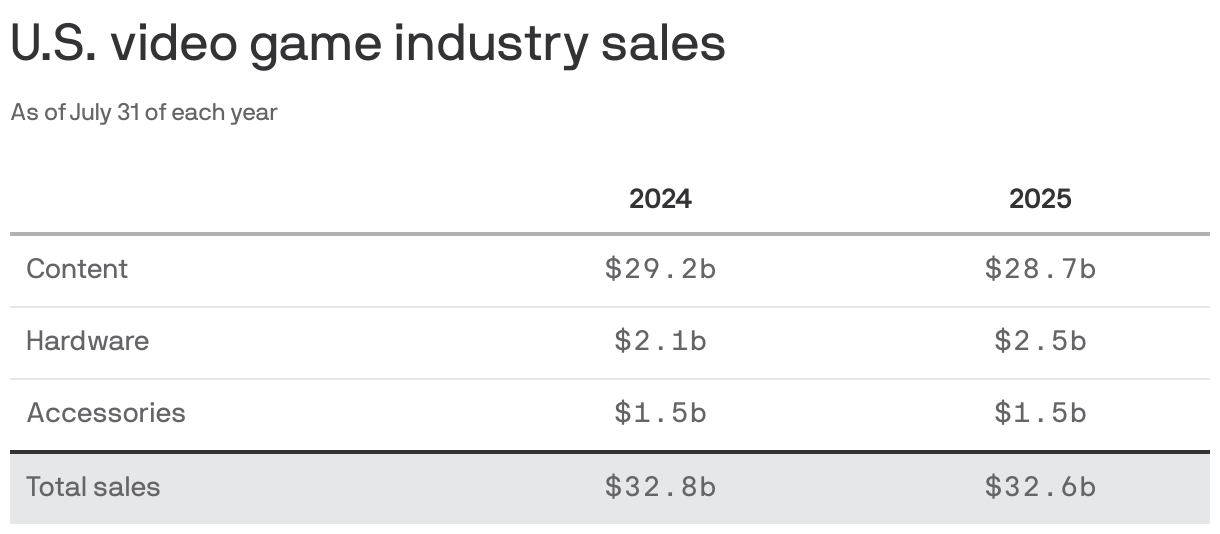
- Total U.S. game sales have hit $32.6 billion so far in 2025, down slightly from $32.8 billion for the same period in 2024, per Circana.
- PwC projects U.S. video games and esports revenue will grow from $62.8 billion in 2024 to $87.4 billion in 2029, for a 6.8% compound annual growth rate that outpaces most other entertainment categories.
- Social and casual gaming, which already makes up more than 60% of revenue, is expected to hit $57.2 billion in 2029.
Between the lines: As more games shift to the cloud, few video game makers have been able to capitalize on digital advertising, slowing the industry's revenue growth potential.
- Traditional growth engines like new consoles and graphics updates are no longer delivering the same wow factor, as audiences are content with playing older games, Game File reporter Stephen Totilo tells Axios.
6. 🔉 Spotify CEO steps down
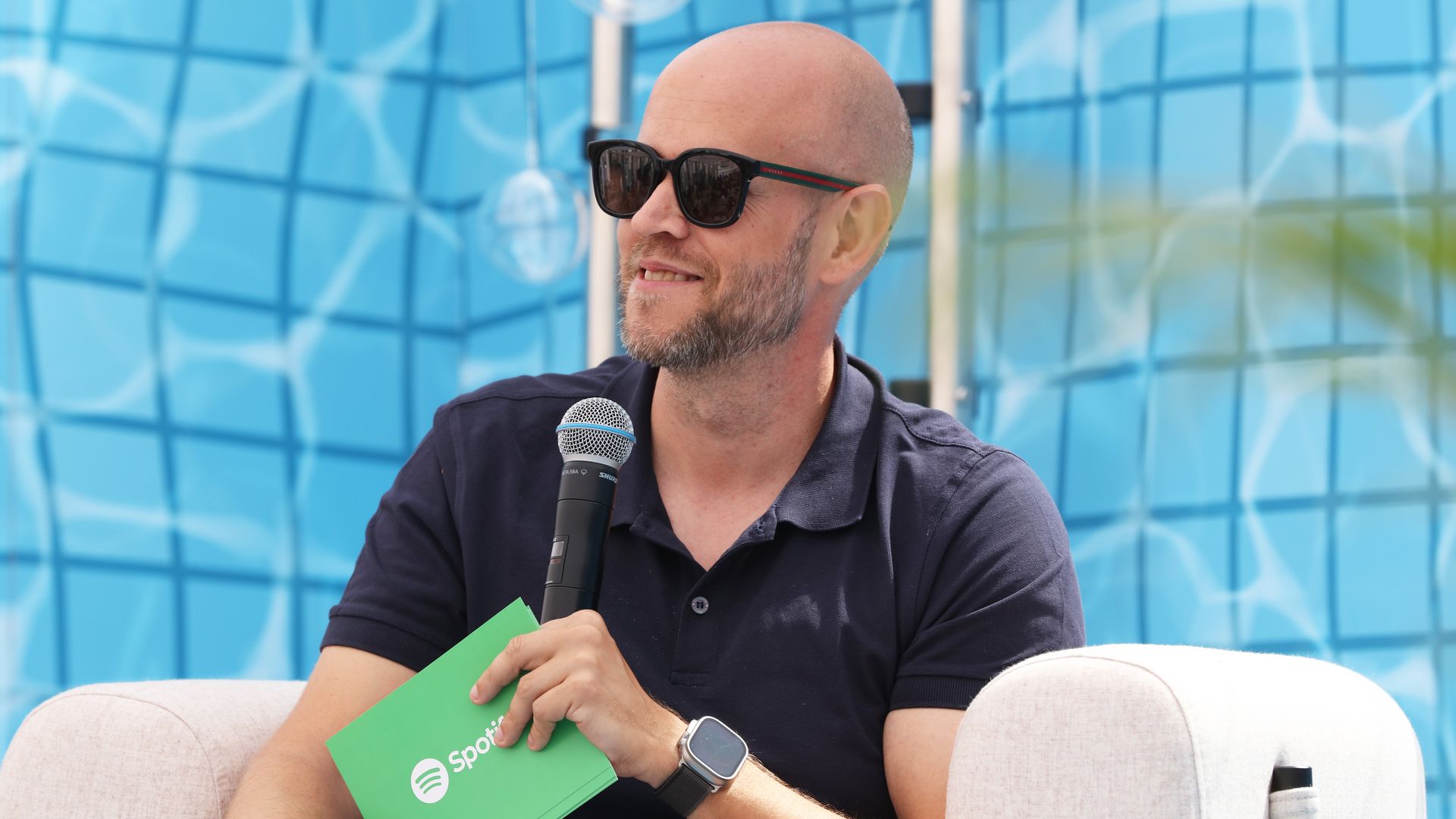
Spotify CEO and founder Daniel Ek, who has led the audio giant for almost 20 years, is stepping aside and will transition to a new role as executive chair beginning next year, the company said in a statement.
Zoom in: Two co-presidents, Gustav Söderström and Alex Norström, will become co-CEOs, reporting to Ek. They will serve on the board of directors, subject to shareholder approval.
Between the lines: Söderström, who also serves as chief technology officer, and Norström, who also serves as chief business officer, have been primed for this transition since they were named co-presidents in 2023.
The big picture: The announcement today follows a string of media and tech companies that have started to split key executive roles among two leaders to create a smoother executive transition.
- On Monday, Comcast named longtime executive Mike Cavanagh as co-CEO alongside Comcast heir Brian Roberts.
- Netflix named Ted Sarandos co-CEO alongside co-founder Reed Hastings in 2020. Hastings transitioned to a role as executive chairman in 2023.
- Oracle and other tech firms have also named co-CEOs in the past year.
7. Exclusive: Tony Haile's next media startup raises $10M

Tony Haile, the founding CEO of both media analytics company Chartbeat and Scroll, a news startup that sold to Twitter, has raised $10.7 million in seed funding to launch Filament, an invite-only professional conversations platform.
🗣️ Why it matters: Haile believes professional networking is shifting from open feeds on platforms like LinkedIn to closed spaces where executives can have more private conversations.
- While tools like Slack allow people to network with peers in channels outside of their company, Haile says Filament is built explicitly to make that type of cross-company collaboration easier.
Follow the money: The seed funding for Filament comes from EQT Ventures, Flybridge Capital and Oceans Ventures, with support from Mozilla Ventures, Betaworks, and industry leaders Jay Sullivan and Frank D'Souza.
🎧 Yes, but: For years, startups have tried to conquer the private chat space for professionals with audio, to little success.
- Clubhouse laid off half of its staff in 2023. X still has "Spaces," its Clubhouse competitor, but it's not considered a core feature of the platform.
What's next: Because Haile has a successful track record of building products specifically for professionals in the news and information space, he expects early adopters of this type of platform to be in publishing, media and tech, but it's built to serve any type of professional.
- Haile says his primary focus is to scale the platform via feedback from a select number of "design partners," or beta testers, before focusing on a monetization plan.
8. 🎬 Trump renews vague theater threat
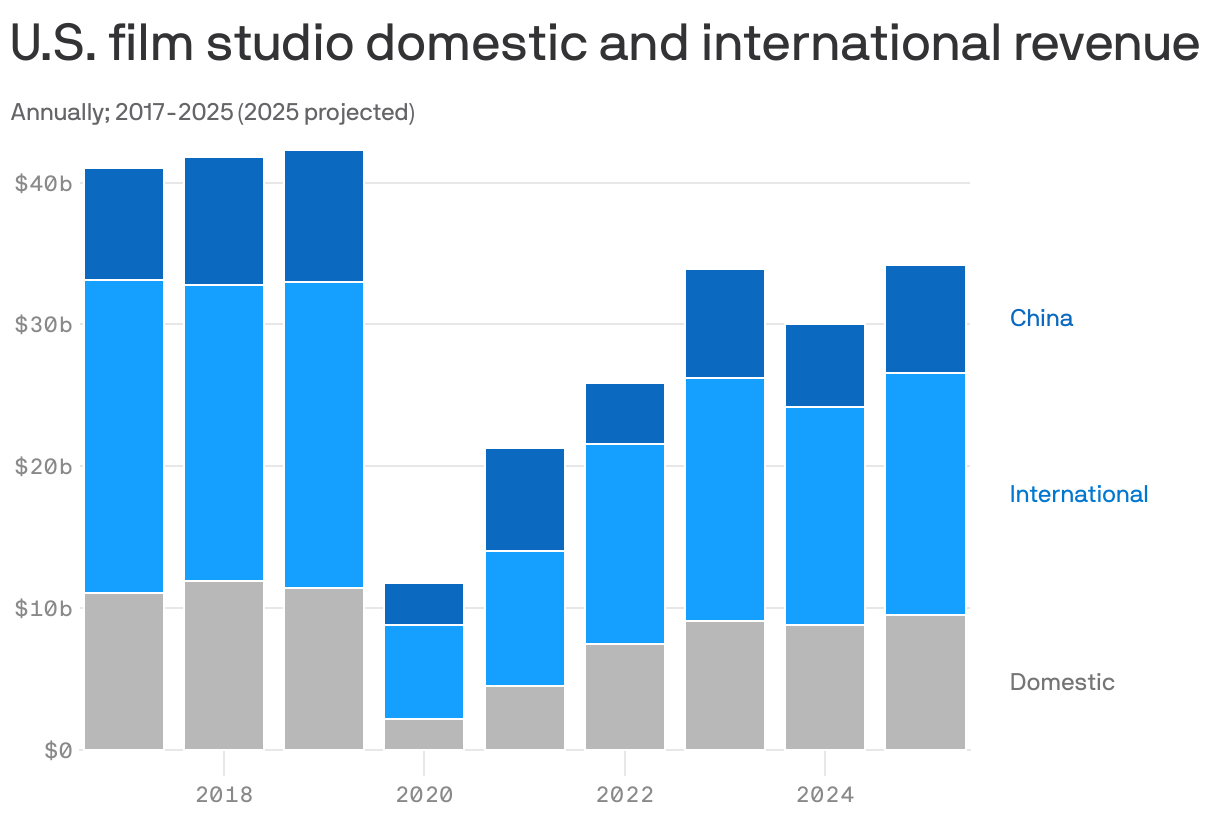
President Trump reiterated his plans to impose tariffs on film imports to the U.S. yesterday, but analysts caution that without any new details on how the policy would work, it's still an empty threat.
🌏 Why it matters: For now, scant details mean studios can't do much to prepare for the new policy. But long term, tariffs could risk retaliatory actions in international markets, where American film studios make the bulk of their box office revenue.
🤔 Reality check: The White House has yet to offer any details on how it would characterize foreign production.
- Many Hollywood hits are at least partially shot, edited or directed overseas.
The bottom line: "Bringing this up a second time does add to the potential threat, but we caution investors against taking these statements at face value," said Raymond James analyst Andrew Marok.
- The tariff threats are likely "a bargaining chip as a part of larger conversations and negotiations around tariffs, as well as potentially future changes to digital service taxes imposed on U.S. tech firms," he added.
What to watch: Tariffs are typically placed on physical goods, not services. A movie tariff could prompt the administration to consider taxes on other digital services, like advertising.
9. 🇵🇷 MAGA unleashes on Bad Bunny

Far-right commentators are lashing out online over Bad Bunny headlining the 2026 Super Bowl.
Why it matters: The Puerto Rican artist is increasingly becoming a political talking point after he decided to skip the continental U.S. over concerns that ICE would raid his concerts.
Driving the news: MAGA influencers and conservative social media accounts widely denounced the NFL's decision.
- Super Bowl halftime performers are selected by the NFL, Apple Music and Roc Nation, an entertainment group founded by Jay-Z.
Flashback: This is not the first time the NFL has waded into politics and sparked controversy over its halftime shows. Kendrick Lamar and Beyoncé drew criticism for their performances.
The big picture: Bad Bunny was the third-most streamed artist globally last year on Spotify and the only Latino to crack a top-five spot on Spotify's list.
- His 2022 album "Un Verano Sin Ti" is the most-streamed album on Spotify of all time.
Sign up for Axios Media Trends