Axios Generate

November 13, 2023
πΊ Let's do this! Today's newsletter has a Smart Brevity count of 1,199 words, 4.5 minutes.
π¬ Did a friend send you this newsletter? Welcome, please sign up.
πΈ This week in 1986, blues great Robert Cray released "Strong Persuader," which has today's brilliant intro tune...
1 big thing: Exxon unveils "Mobil Lithium" in foray into EV supplies
Illustration: Shoshana Gordon/Axios
Breaking: After months of vague signals, Exxon just vowed to become a "leading producer" of lithium for electric vehicles, Ben writes.
Why it matters: It's a major expansion of the oil giant's diversification strategy, at a time when EVs are becoming a major focus for automakers, even in the face of operational and political headwinds.
Driving the news: Exxon will develop rights obtained this year in Arkansas' Smackover formation, in news first reported by Reuters.
- The plan calls for separating lithium from salty groundwater and processing it onsite to battery-grade material.
- Exxon didn't provide the estimated investment size.
What's next: Exxon plans to start production in 2027 and by 2030 provide enough for over 1 million EVs annually.
- For a sense of scale, this year U.S. EV sales topped 1 million annually for the first time. They'll be far higher by 2030, but that would nonetheless make Exxon a big supplier.
- The announcement calls ongoing work in Arkansas the "first phase" of North American production.
What they're saying: "This landmark project applies decades of ExxonMobil expertise to unlock vast supplies of North American lithium with far fewer environmental impacts than traditional mining operations," Dan Ammann, head of the company's low carbon solutions unit, said in a statement.
Quick take: It's consistent with Exxon's diversification plans focused on carbon capture, hydrogen and biofuels.
- They center on areas adjacent to their core businesses β in this case drilling, and managing water that comes with it.
- The product will be branded "Mobil Lithium," which Exxon calls a shoutout to Mobil's history with the auto sector.
The big picture: Lithium needs are projected to soar in years and decades ahead.
- The International Energy Agency sees demand to supply EVs and stationary storage rising fivefold by 2030 under nations' existing policies β and potentially more if countries fight harder against climate change.
- Australia, Chile and China are now the largest producers, while China is by far the biggest processor.
What we're watching: Rival Chevron has also sounded bullish about lithium, so let's see if they dive in.
The bottom line: Exxon's still go-go-go on oil but planting more flags elsewhere too.
- It's a bet on robust markets for fossil fuels and emerging sources alike as global energy demand grows.
2. Making sense of nuclear's bad day

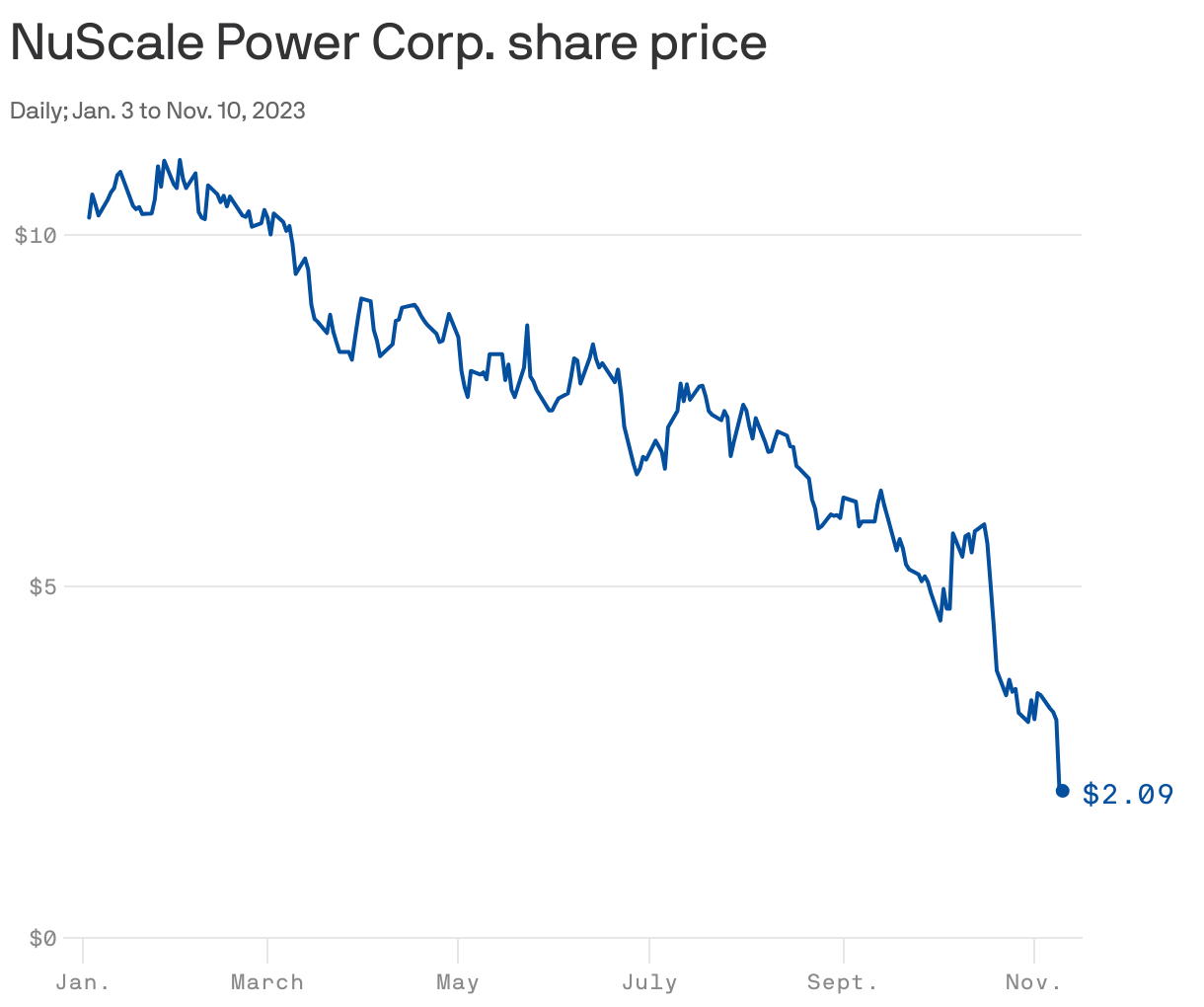
It's easy to over-interpret the death of small modular reactor firm NuScale's Idaho project, but it nonetheless has lessons β and omens β for the future, Ben writes.
ππ½ββοΈCatch up fast: Utah Associated Municipal Power Systems and NuScale last week said there weren't enough buyers for the project's increasingly costly energy.
What they're saying: Energy analyst Todd Moss notes first-of-a-kind projects are always costly.
- That's true even though SMRs promise standardized manufacturing to prevent huge cost overruns that bedevil traditional reactors.
- "But getting to scale means getting over the early humps. This first hump proved too much," Moss, executive director of the Energy for Growth Hub, wrote on Substack.
The intrigue: Bloomberg's Liam Denning writes that amid surging renewables and storage, the SMRs use case may narrow to industrial energy, with grid-focused output a lesser focus.
Threat level: NuScale has the only SMR design with Nuclear Regulatory Commission approval.
- Nuclear critic Edwin Lyman, of the Union of Concerned Scientists, said the Idaho project's demise shows "broader challenges" for U.S. development.
- It "does not bode well for the dozens of other, more exotic reactor types in various stages of development that are being touted as the next best thing."
Yes, but: Moss said a "vibrant nuclear ecosystem exists," citing the many startups and projects somewhere in the pipeline β and he's confident some will survive.
- "Flexible nuclear power will still be attractive in some emerging markets," like Ghana, one of NuScale's target regions.
- Third Way, working with Moss' group, tracks projects worldwide.
3. A key advance in monitoring CO2 from space

A SpaceX Falcon9 Rocket carrying Earth-observing satellites, including a GHGSat mission, launches from Vandenberg Space Force Staton on Nov. 11. (Photo: SpaceX)
A new, high-resolution satellite can track global carbon dioxide emissions down to the power plant level, Andrew writes.
Why it matters: Known as GHGSat's "Vanguard," the spacecraft is part of a new generation of monitoring tools to pinpoint CO2 and methane emissions, both potent planet-warming gases.
- The new constellation β plus other methane and CO2-monitoring satellites and aircraft-generated emissions surveys β has the potential to transform the Paris Agreement and future global climate pacts into enforceable components of international law.
- Solutions like GHGSat and MethaneSAT, slated to launch next year, could improve the accuracy of national emissions reporting and identify emissions hotspots.
Zoom in: The satellite launched Saturday from Vandenberg Space Force Base in California via a SpaceX Falcon 9 rocket.
It carries equipment that can locate CO2 emissions from individual power plants, industrial facilities and other emissions sources, the company says.
What they're saying: GHGSat CEO Stephane Germain said the company's goal is to "change the conversation around CO2."
- "With regulators, investors and the public increasingly holding companies to account, both for their direct and indirect emissions, there is little doubt that better CO2 data is needed," Germain said in a statement.
4. Bill Gates' theory of the case
Illustration: Sarah Grillo/Axios
Bill Gates is known for promoting and financing innovation, but a new report offers his team's thinking on spurring faster deployment of emerging climate-friendly energy, Ben writes.
Driving the news: Gates-led group Breakthrough Energy just published its inaugural "State of the Transition" report.
The intrigue: One section offers lessons from a "Catalyst" program that aims to speed use of tech like clean hydrogen, long-duration storage and industrial decarbonization. Among them...
- Better engineering, procurement and construction contracting practices, including incentives for meeting timeline and budget targets.
- Working to secure long-term offtake contracts to give investors' confidence.
- Developers "should be careful about locking in pricing until the design of their project is mature and the full costs are known."
- Ensuring reliable access to clean feedstocks and electricity.
Go deeper: It also delves into transmission needs to enable wider integration of wind and solar tech; why carbon removal matters but "can't be an excuse" to keep emitting; and far more.
5. ποΈ Big this week: Diplomacy, Congress, oil
πΌ We'll be looking for any joint climate and energy initiatives when President Biden and Chinese President Xi Jinping meet Wednesday on the sidelines of the APEC summit, Ben writes.
β° The clock is ticking toward a government shutdown unless Congress and the White House reach a spending deal by the end of Friday.
- Why it matters: A shutdown would likely slow β but not fully halt β implementation of the 2022 climate law and 2021 infrastructure law.
π’οΈ The IEA will release its monthly oil market analysis tomorrow, and we're curious if they'll revise the demand outlook amid signs of weakness.
6. ICYMI: the stakes of Manchin's Senate exit

Photo illustration: Sarah Grillo/Axios. Photo: Tom Williams/CQ-Roll Call, Inc via Getty Images
Senate Energy Committee Chairman Joe Manchin's decision not to seek reelection could change the course of policy on the Hill, Axios Pro's Nick Sobczyk reports.
Why it matters: The West Virginia Democrat has wielded the gavel with immense legislative impact, but his successor could take Democrats in a decidedly different direction.
Between the lines: Martin Heinrich will be the immediate favorite to take the committee's top Democratic spot, if he wins reelection next year.
- He's a prominent voice on transmission policy, and, unlike Manchin, is broadly aligned with environmental groups on oil and gas issues.
Unlock the whole story β and vital weekly scoops and analysis β by talking to our sales team about Axios Pro: Energy Policy.
π Thanks to Chris Speckhard and Javier David for edits to today's edition, along with the talented Axios Visuals team.
Sign up for Axios Generate

Untangle the energy industryβs biggest news stories