
Axios Generate

July 31, 2023
π₯ Good morning! Today's newsletter has a Smart Brevity count of 1,260 words, 5 minutes.
πΈ Blues legend Buddy Guy celebrated a birthday over the weekend, and he's got today's intro tune...
1 big thing: Big Oil's rising interest in lithium
Illustration: Shoshana Gordon/Axios
ExxonMobil CEO Darren Woods gave the strongest confirmation yet of the company's interest in lithium as electric vehicles boost demand, Ben writes.
Why it matters: Multiple U.S. oil companies see extraction and processing meshing with their skillsets β and now the most powerful player is among them.
Driving the news: "We're actively exploring that opportunity set and like what we're seeing so far," Woods told analysts on Exxon's earnings call Friday.
- Lithium is "really an extension of a lot of the current capabilities that we have."
State of play: "It requires a good understanding of the subsurface, requires a good understanding of reservoir management, requires drilling and injections," Woods said.
- Processing brine water to pull out lithium is "very consistent" with what occurs at Exxon refineries and chemical plants, he said.
- Woods argued Exxon can bring cost advantages and environmental ones to bear, contrasting what they're exploring to "open mining" in other nations.
What we don't know: A lot! Woods cautioned "we're still early in evaluating the opportunity."
- Exxon is acquiring acreage in Arkansas, per May coverage in the Wall Street Journal and a Reuters account in June, but reported investment levels are small relative to its budget.
- And Exxon's not commenting on a WSJ report that it plans to build one of the world's largest processing plants there.
The big picture: Chevron CEO Mike Wirth recently told Axios that his company may venture into lithium.
- Energy Intelligence reports that Pioneer Natural Resources "is in a similar initial conceptual evaluation stage."
- Occidental Petroleum is the "farthest along" as a subsidiary explores lithium brine mining tech that integrates into geothermal operations, they report.
Reality check: Oil companies are hardly ceding transportation to electricity over their core petro-products.
- Exxon, Chevron and the wider industry have recently attacked draft EPA climate rules for vehicles, arguing they're overly reliant on EVs.
- They say standards should better encourage a range of technologies β EVs, hybrids, more efficient petroleum engines, renewable fuels and more.
Zoom out: Global lithium demand is rising fast. EV batteries and stationary storage are key reasons.
- Lithium demand tripled between 2017 and 2022, per International Energy Agency data, with lots more to come.
The bottom line: Lithium remains tiny compared to the fossil fuel sector, but demand may get too big for Big Oil to ignore.
2. The unsettling mystery unfolding in Antarctica
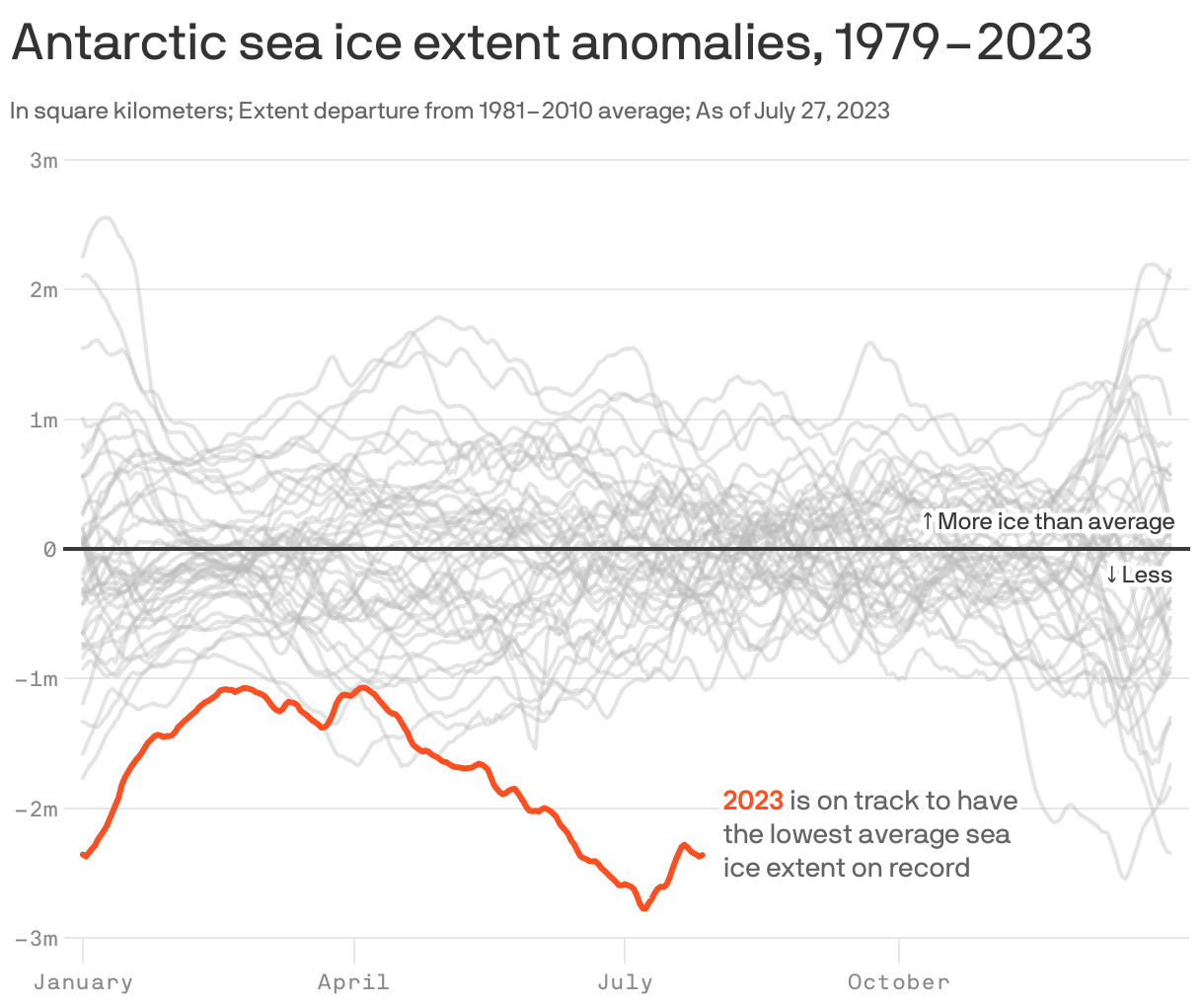
Scientists are urgently trying to determine why so much Antarctic sea ice is missing during winter, Andrew writes.
The big picture: Sea ice should be growing during the region's winter season, but that growth is lagging significantly. If it signals a new, lasting shift, the unprecedented anomaly could have drastic global consequences.
- The missing ice area is about equal to the combined areas of Texas, California, New Mexico, Arizona, Nevada, Utah and Colorado.
Threat level: If Antarctica's sea ice cover starts off the coming melt season this way, it could accelerate global sea level rise by allowing greater amounts of unusually warm waters to reach increasingly fragile land-based ice.
- Unlike sea ice, which is already floating, land-based ice melt contributes to rising sea levels.
- The losses could also affect critical ocean currents that help move heat worldwide and absorb carbon dioxide.
What they're saying: "Something major in a huge part of the planet is suddenly behaving differently from what we saw for the past 45 years,β Ted Scambos, an ice researcher, told CNN.
3. How extreme heat hits America's hungry

Photo illustration: Shoshana Gordon/Axios. Photos: Luke Sharrett/Bloomberg, Patrick T. Fallon/AFP, Irfan Khan/Los Angeles Times via Getty Images
Some Americans are being hit harder than others by the extreme heat wave baking swaths of the country because they can't get enough to eat or drink, Axios' Ayurella Horn-Muller reports.
The big picture: Food-insecure households face unique exposure to dehydration and costly relief that further strains dwindling food budgets.
Zoom in: This population grapples with specific complications during high heat and humidity, said W. Larry Kenney, a Penn State professor of physiology and kinesiology.
- "One of the problems for people with food and water insecurities is the lack of high-quality foodstuffs that contain lots of water, like soups and fruits, and more importantly, potable water," Kenney said.
- He said lack of potable water access can bring "frank dehydration" β which makes it even harder for the body to dissipate heat and causes body temperatures to increase more rapidly.
State of play: Spikes in emergency room visits from heat-related illnesses have been reported amid the heat wave affecting over two-thirds of the country's population β something that would have been virtually impossible without climate change.
- At St. Mary's Food Bank in Phoenix, where temperatures hovered at or above 110Β° F for most of July, the pandemic's lasting toll and rising food costs are compounding the sweltering heat to strain resources.
- "We're no stranger to heat here in Arizona," St. Mary's director of public relations Jerry Brown told Axios. "But...I've never seen anything like this."
4. The newest potholes on the road to COP28

Illustration: Sarah Grillo/Axios
Back-to-back G20 meetings this month lacked consensus on aggressive climate and energy targets, signaling hurdles facing U.N. talks late this year, Ben writes.
Catch up fast: Friday's meeting of G20 climate ministers yielded an "outcome document" and "chair's summary," rather than a joint communique.
- The same thing happened when G20 energy ministers met a week earlier.
Why it matters: What sounds like semantic dissembling reflects real disputes within the G20, which accounts for the lion's share of global emissions.
State of play: Friday's document acknowledged "divergent views."
- The "chair's summary" β reflecting areas without consensus β notes "some" members backed peaking of global emissions by 2025.
- That section also housed shoutouts to tripling renewables capacity by 2030 β a plank of COP28 president-designate Sultan al-Jaber β and phasing down "unabated" fossil fuels.
The intrigue: The Financial Times reports China refused to discuss emissions targets and that Saudi Arabia backed its posture.
Reality check: A reminder that G20 meetings βΒ and U.N. summits for that matter βΒ have little direct effect on national policies.
- But they indirectly boost calls for stronger efforts.
What we're watching: Whether this year's heads of state meetings at the G20, U.N. and elsewhere can overcome divides bedeviling ministerial sessions.
Andrew contributed to this item.
5. ππ½ββοΈCatch up fast on policy: Cars and nuclear sites
π The Transportation Department floated draft rules that would mandate efficiency increases in cars and light trucks, Ben writes.
- Driving the news: The light-duty vehicle proposal for model years 2027-2032 would require automakers to achieve a fleet-wide average of 58 miles per gallon by 2032. It also covers heavy-duty pickups and vans for 2030-2035. The Detroit Free Press has more.
- Why it matters: Transportation is the largest source of U.S. carbon emissions.
- What we're watching: Whether the Corporate Average Fuel Economy (CAFE) rules curb oil use and emissions more than brewing EPA vehicle CO2 standards would alone.
- State of play: Consumer Reports analyst Chris Harto doesn't think the rules floated Friday would provide additional benefits. But they could be strengthened.
- What they're saying: He said CAFE standards can enable "compliance pathways" that focus more on efficiency than just the EPA carbon rules, which push an aggressive shift to EVs.
- Zoom in: "In addition, the CAFE standards take into account EV efficiency so if the CAFE rules were stronger it would discourage automakers from building too many big, heavy, inefficient EVs," he said via email.
βοΈ "The largest U.S. solar power site and other clean energy projects could be built on lands owned by the Department of Energy, including where components for Cold War-era atomic bombs were developed, the agency said on Friday," Reuters reports.
- State of play: They're reporting on the Cleanup to Clean Energy program announced Friday. It looks to develop energy projects across five areas including the Hanford site in Washington State and Idaho National Laboratory.
π¬ Did a friend send you this newsletter? Welcome, please sign up.
π Thanks to Chris Speckhard and Javier E. David for edits to today's edition, along with the talented Axios Visuals team. Have a great weekend!
Sign up for Axios Generate

Untangle the energy industryβs biggest news stories