Axios Future of Defense
November 19, 2025

Hello, everyone! Reminder: Every time you say "neo-prime" you owe me $5.
- Thanks to everyone who tuned in for my panel at the General Catalyst Institute's inaugural Summit on U.S. Resilience.
🏭 Situational awareness: Vulcan Elements picked Benson, North Carolina, as the location for its $1 billion rare-earth magnet facility. The company and state agreed to a $17.5 million incentives package, my colleague Zachery Eanes reported.
Here we go: The Atlantic Council's newest commission, an Army acquisitions update and Windward's latest intelligence offering.
Today's newsletter is 2,093 words, an 8-minute read.
1 big thing: Trump, MBS and the F-35
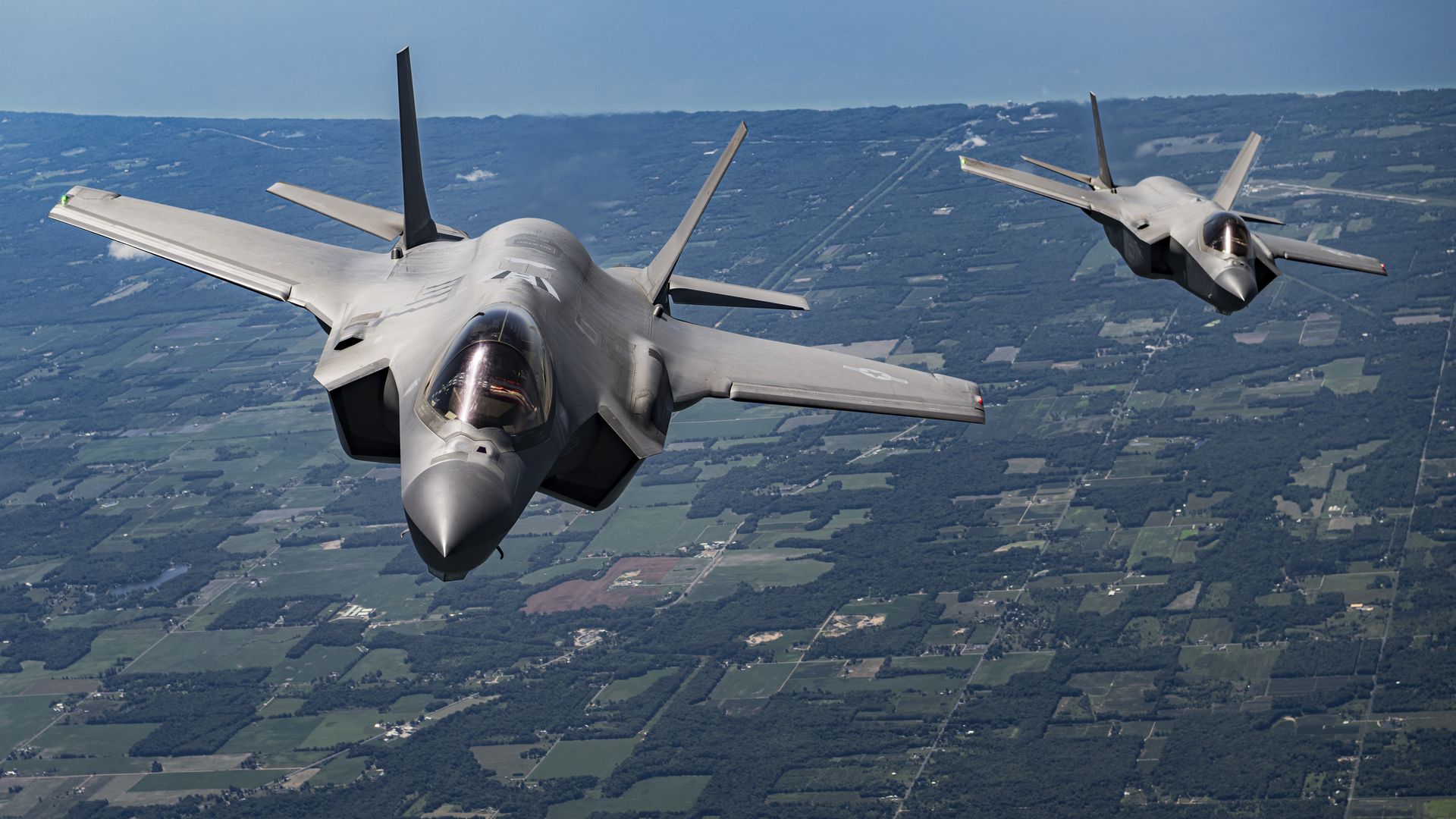
The potential sale of F-35s to Saudi Arabia has almost everybody worked up. Rightfully so.
Why it matters: Such a consequential deal — long whispered about, worth billions of dollars and to be fulfilled over many, many years — touches every corner of today's geopolitical and defense-tech zeitgeist.
- President Trump's growing affection for the Gulf states, plus his unpredictability? Check.
- Relations with Israel and rules governing its firepower, or qualitative military edge? Affirmative.
- China's influence abroad and its IP thievery? Yup.
- F-35 exclusivity and scrutiny of card-carrying members? Mhmm.
- Soft power, foreign military sales and congressional oversight? Absolutely.
Driving the news: Trump met yesterday with Saudi Crown Prince Mohammed bin Salman, who brought with him a security wishlist. The president told reporters in the Oval Office the country deserved "top of the line" F-35s, on par with what Israel receives, because both have been "great allies."
- "They're buying them from Lockheed," he said. "We make the best planes, the best missiles."
- Lockheed praised Trump's announcement in a statement to me, saying it was "honored" to work with Saudi Arabia. "We look forward to working with the Trump administration, Congress and the Saudi government as this process moves forward."
Friction point: China and Saudi Arabia are inching closer. The two recently concluded the Blue Sword naval exercise, building upon an earlier iteration in 2023.
- The Saudis said the drills were meant to "strengthen military cooperation between the two sides and to exchange expertise to raise combat readiness."
- That's raised hackles here. China's spies and hackers often target U.S. defense contractors and abscond with sensitive data; critics of Beijing have derided its arsenal as a copycat.
What they're saying: "My bottom line is, before providing Riyadh the F-35, I think we need to address concerns related to China ... and demand that Saudi Arabia normalize relations with Israel," Bradley Bowman, an expert at the Foundation for Defense of Democracies, told me.
- "You want our nation's best aircraft? Then you can't be doing military exercises with China. Sorry. And you probably shouldn't be working with them on ballistic missiles."
State of play: Lockheed Martin has delivered more than 1,250 F-35s worldwide. They are wielded only by select countries, including NATO allies, Japan and South Korea. Israel is the only Middle Eastern country currently equipped with the stealth jets, and used them against Iran in June.
- Turkey was booted from the club for its employment of Russian S-400 air defenses. Another arrangement with the United Arab Emirates was frozen by the Biden administration.
- An F-35 deal for Saudi Arabia would require congressional review.
The other side: Saudi air forces include F-15, Tornado and Typhoon warplanes. F-35s — one of the most costly, complex and in-demand weapons on Earth — would be a significant step up.
The bottom line: "I think it's fair to see the F-35 as an important card on the table, in this sort of very complex, multiparty negotiation, trying to figure out what the future security architecture of the Middle East is going to be," John Hannah, former Vice President Dick Cheney's national security adviser, told me.
Go deeper: U.S. security guarantee for Qatar sparks jealousy and confusion
2. Exclusive: A moneymaking Method

Method Security, a dual-use company combining cyber expertise with artificial intelligence speed, raised $26 million across its seed round and Series A.
Why it matters: Much national-security energy today is paid to drone-and-missile stockpiles, shipbuilding and the like. But digital breaches — something like China's Volt Typhoon, which jeopardized critical infrastructure — could upend it all.
- "Cyber conflict is perpetual, it's always on across all sides and it does not discriminate between public and private targets," CEO Sam Jones told me.
- "Our view is that the future of cyber conflict will be decided by who can harness autonomy safely at scale."
Context: Method offers offensive and defensive tools to users. That includes autonomously mapping attack paths and executing red-team tests.
Follow the money: Andreessen Horowitz led the seed; General Catalyst led the Series A. The company's other backers include Blackstone Innovations Investments, Crossbeam Venture Partners, Forward Deployed Venture Capital and Pax Ventures.
- "Cyber conflict is moving to machine speed, with state actors now weaponizing AI at scale. We can't regulate our way to victory — U.S. cyber operators need new autonomous systems to win the fight," David Ulevitch, a general partner at Andreessen Horowitz, told me.
- "Method has the team, the approach and the platform to deliver that advantage."
- Ulevitch founded OpenDNS, a cloud-delivered security service sold to Cisco in 2015 for $635 million.
Zoom in: Method's earliest customers included Blackstone as well as a Defense Department organization. The company — staffed by AWS, CrowdStrike and Palantir Technologies alumni, among others — now has "a number" of Pentagon deals under its belt, according to Jones.
The bottom line: "America has a cyber resilience problem," Jones said, "and that is the problem we're focused on here at Method."
Go deeper: Chinese hackers used Anthropic's AI agent to automate spying
3. Exclusive: Hicks and Thornberry lead ReForge

The Atlantic Council yesterday launched the ReForge Commission, tasked with examining the industrial demands of modern warfare and building a blueprint for future manufacturing health and national security innovation.
Why it matters: Defense Secretary Pete Hegseth said in a defense-acquisitions speech Nov. 7 that portions of the Pentagon must be on a wartime footing.
State of play: ReForge is led by former Deputy Defense Secretary Kathleen Hicks and former Rep. William "Mac" Thornberry, a Texas Republican once at the head of the House Armed Services Committee.
- The bipartisan commission's 20-plus other members include: James Cartwright, former vice chairman of the Joint Chiefs; Nadia Schadlow, former deputy national security adviser; Lael Brainard, former director of the National Economic Council; Jon Tester, former Montana senator; Paul Kwan at General Catalyst; Steve Escaravage at Booz Allen Hamilton; and Megan Dake at Lockheed Martin.
The intrigue: One area of keen interest is how the U.S. and its friends can mobilize for a potential two-theater war (versus China and Russia, perhaps).
What they're saying: "I've been working on acquisition reform since before I became chairman, so more than 10 years or so. But I don't think I've ever seen a time where you had Congress and the department so aligned to take really significant action," Thornberry told me.
- "It's not just about what might happen someday; it's what's happening right now," he said. "The key challenge for this commission is to have specific, concrete recommendations — not just pie in the sky stuff."
Between the lines: The ReForge Commission builds on previous work done by the Atlantic Council's defense-innovation adoption and software-defined warfare panels.
Go deeper: Hypersonic weapons are lethal advantage for China, Russia
4. Dan Driscoll's designs
The U.S. Army plans to dramatically increase its purchases of commercially available technology, much to the detriment of bespoke, one-off products and projects, according to Dan Driscoll, the service's top civilian.
Why it matters: That pledge, paired with promises made by Defense Secretary Pete Hegseth earlier this month, could begin reshaping a Pentagon supplier pool that has for decades been dominated by a handful of companies.
Driving the news: In an hourlong sit-down with reporters, Driscoll and other Army leaders detailed their plans to overhaul weapons trying, buying and fielding.
Zoom in: The new approach involves restructuring program executive offices and introducing portfolio acquisition executives to oversee six broad topics. Those include fires, command and control and counter C2, and agile sustainment and ammo.
These PAEs will report to Transformation and Training Command — or T2COM, a combination of Futures and Training and Doctrine commands — as well as the assistant secretary of the Army for acquisition, logistics and technology.
What they're saying: "This is the type of thing that, from our understanding, is like a 65-year change in how we actually buy things," Driscoll told reporters, adding that complacency has generated "bad habits."
- "This is a directional number: It used to be 90% of things we bought were purpose-built for the military or the Army and 10% were off the shelf."
- "What we are trying to do is flip it to 90% being commercially available and 10% being specific in the worst of cases."
What we're watching: When, where and how the Army continues to court and consult both Silicon Valley and Wall Street.
- "What we're trying to do is not performatively engage with them as a one-off, but learn from them," Driscoll said.
- "They want to get their products in the hand of the soldier, because we use them in different and complicated use cases," he added. "That makes their basic offering better."
Go deeper: How the U.S. Army chief is retooling for future war
5. Super Tucano's new task
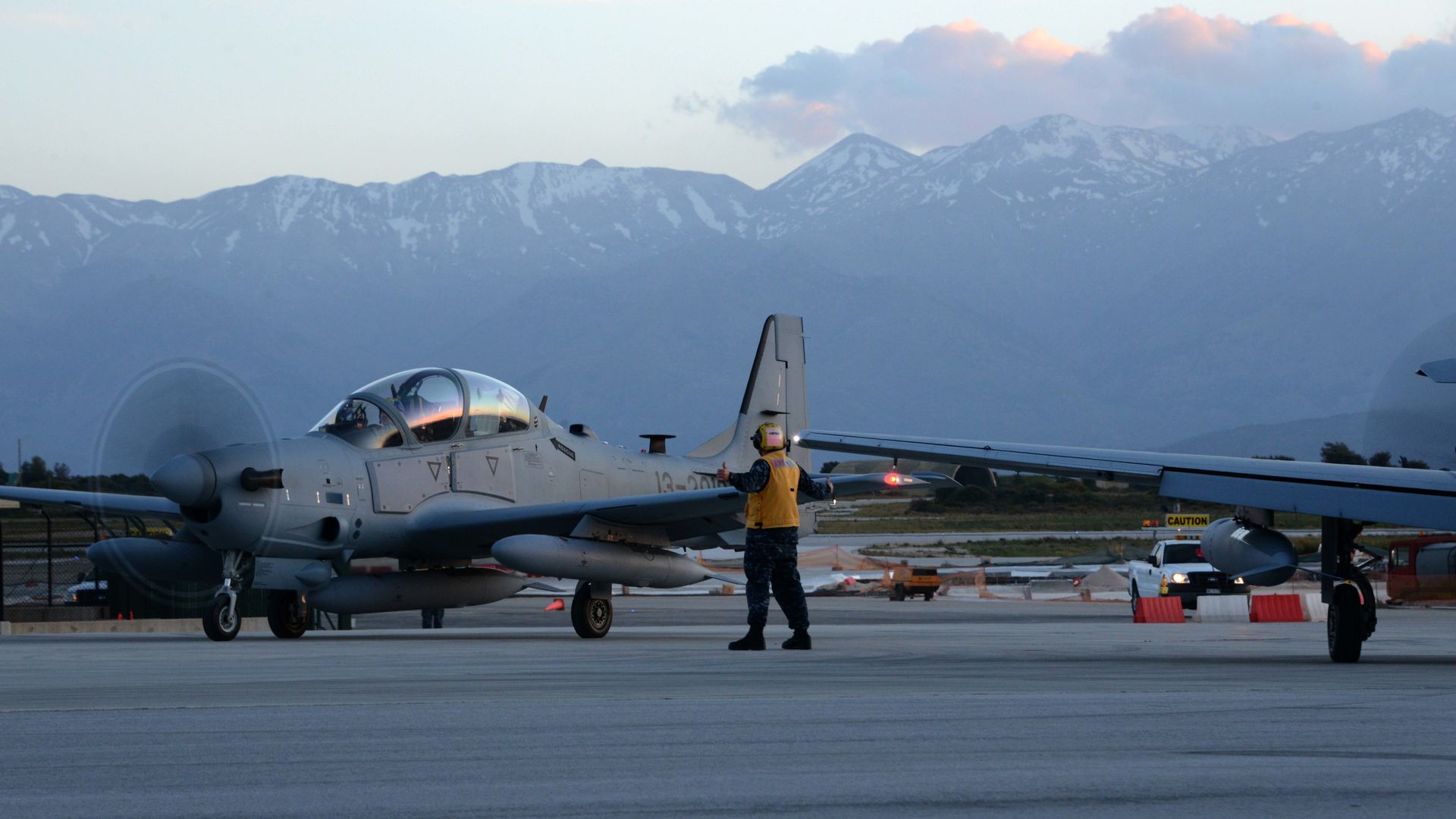
Embraer is now marketing the A-29 Super Tucano as a drone killer, equipped with sensors, laser-guided rockets and .50 caliber machine guns.
The big picture: The drone-counter-drone dynamic is producing novel technologies and tactics; in Eastern Europe — a hot spot — everything from prop planes to AI-empowered turrets to helicopter door-gunners are fair game.
Driving the news: Embraer on Nov. 11 rolled out imagery depicting two Super Tucanos engaging four small unmanned aerial systems above a coastline.
- "We continue to expand the A-29's capabilities to address the most recent challenges faced by many nations worldwide," Bosco da Costa Junior, Embraer Defense and Security's chief executive, said in a statement.
- The light-attack aircraft is already used for close air support, armed reconnaissance and training. It's been selected by more than a dozen countries, including Paraguay, Portugal and Uruguay.
Flashback: Sierra Nevada Corporation, a defense contractor, in September announced a plan to buy one Super Tucano in advance of a pending foreign military sale.
What's next: More of these rebrands and pivots from more of these defense contractors.
More from Axios:
South Korea and UAE buy Bullfrog counter-drone turrets
6. Quick hits
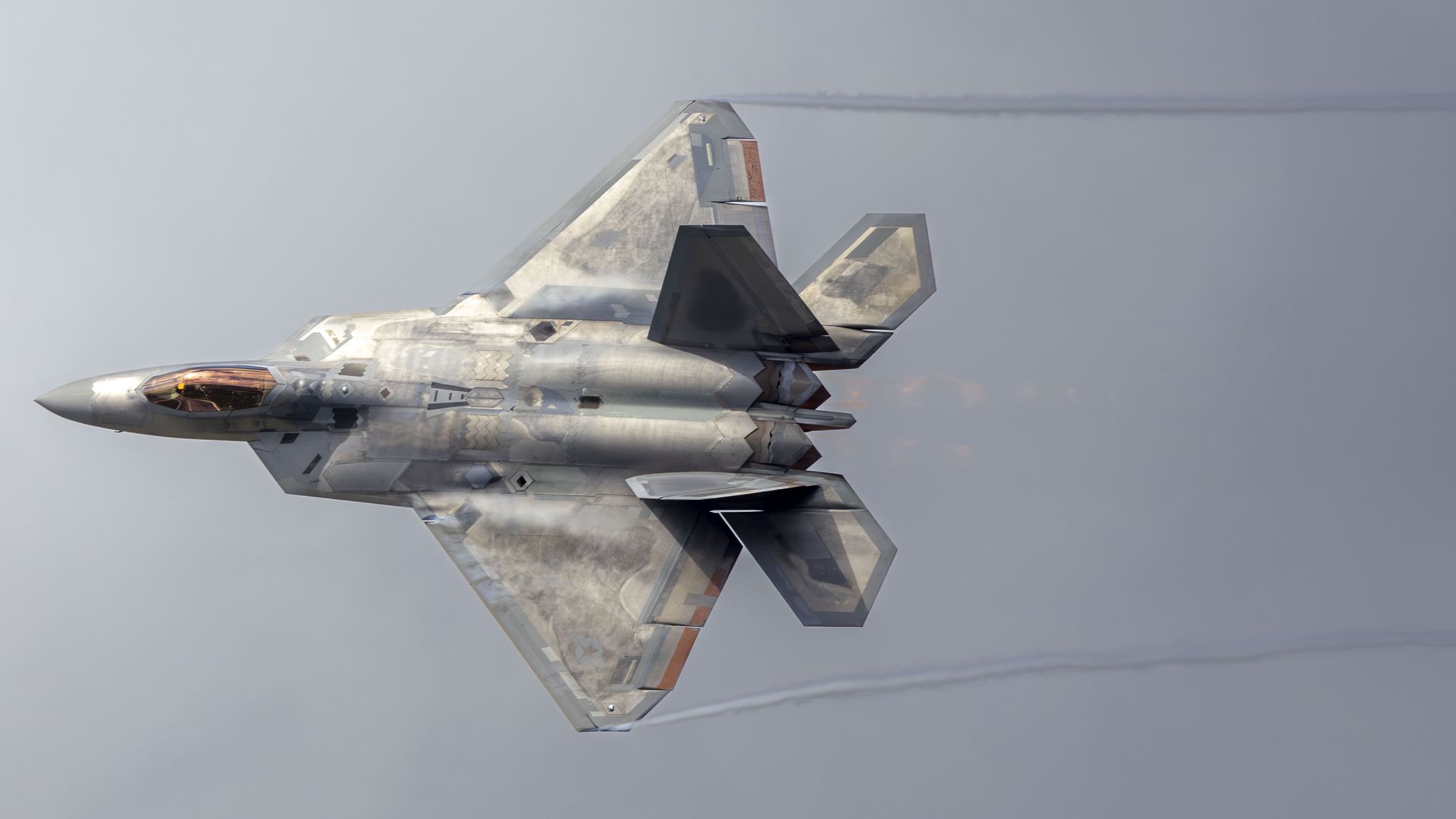
↔️ An F-22 Raptor and an MQ-20 Avenger demonstrated manned-unmanned teaming during an October flight test in Nevada, according to the companies involved.
- Why it matters: The demo assembled some of America's largest and most-experienced defense contractors: Lockheed Martin (stealth fighter), General Atomics (drone) and L3Harris Technologies (radios and networking).
- 💭 My thought bubble: Robo-wingmen? It's happppennniinnnng.
⛵ Windward rolled out Remote Sensing Intelligence, which brings together satellite imagery, detections, analytics and operational details to boost maritime domain awareness.
- Why it matters: Sketchy things — smuggling, illegal fishing and the like — happen on the open seas. Windward in the third quarter found 11,600 vessels hit by GPS jamming as well as the emergence of 13 new fraudulent flag registries.
- 💭 My thought bubble: Overhead imagery is booming. It's used by open-source intelligence folks on X as well as the most specialized branches of U.S. national security.
💵 Chaos Industries and Forterra both announced new funding. The former had a $510 million Series D; the latter, a $238 million Series C.
- Why it matters: Defense-tech investments show little sign of slowing. (For what it's worth: Chaos raised a $275 million Series C four months ago.)
- 💭 My thought bubble: The two worked together on a robotic air-defense system. More on that, here.
🎁 The State Department approved the potential sale of hundreds of Standard Missile-6 Block I and Standard Missile-2 Block IIIC to Germany.
- Why it matters: The arrangement, which also includes associated equipment and services, is initially valued at $3.5 billion. RTX was named the lead contractor.
- 💭 My thought bubble: Germany's rearmament is worth watching closely.
7. Check this out
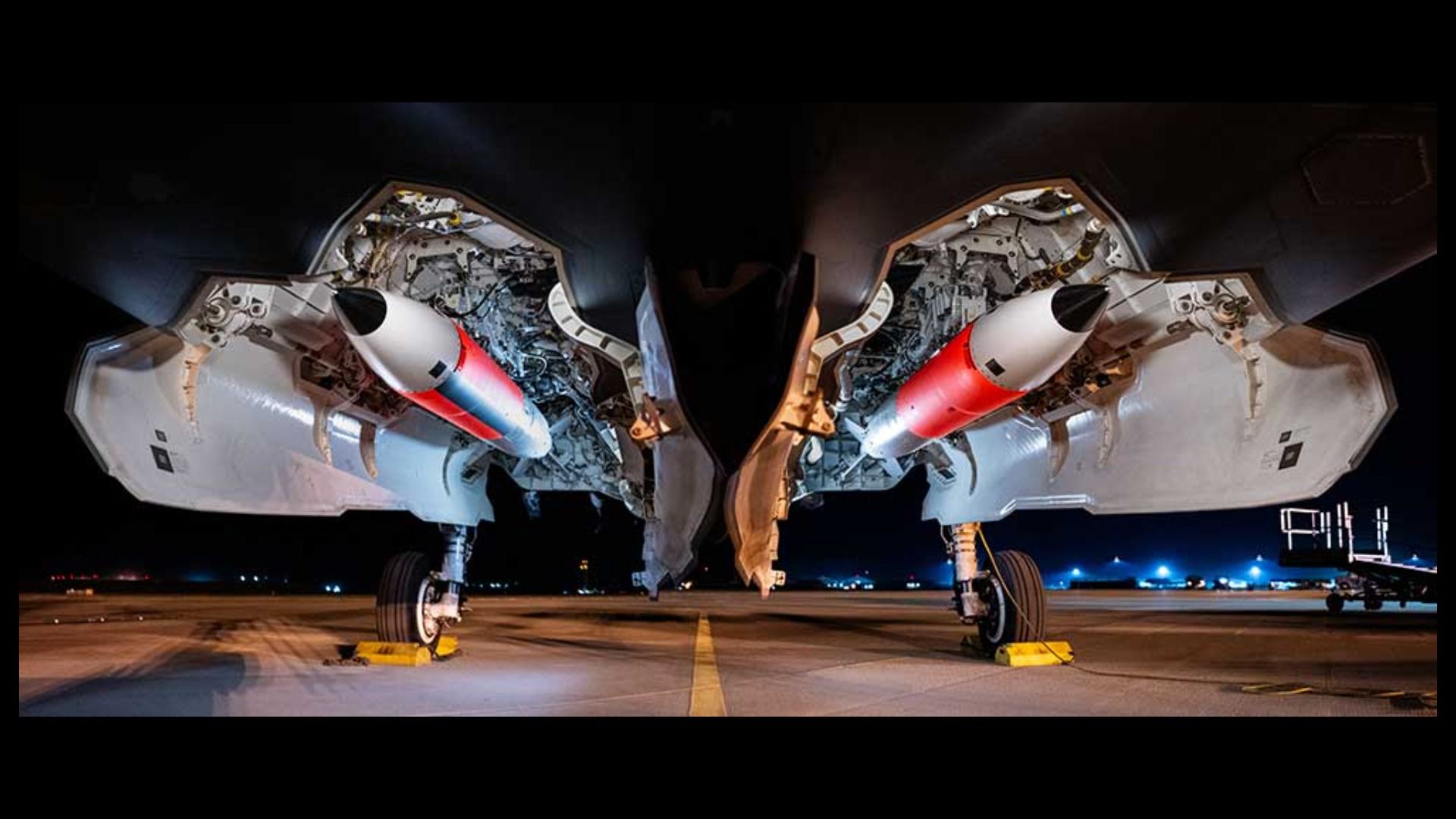
The U.S. Air Force and Energy Department this summer conducted tests of unarmed B61-12 nuclear gravity bombs, dropping them from a Lockheed Martin-made F-35.
The big picture: Sandia National Laboratories shared two minutes of behind-the-scenes footage Nov. 13. You can — and should — watch it, here.
By the numbers: The National Nuclear Security Administration completed a B61-12 life-extension program late last year.
- It's expected to extend the weapon's longevity by at least 20 years.
Context: These tests happened well before President Trump teased the resumption of nuclear-weapons testing.
Go deeper: U.S. to spend $1 trillion on nuclear weapons over next decade
Shoutout to Dave Lawler for editing and Matt Piper for copy editing.
👋🏼 Thanks, as always, for reading and sharing. Tell your friends to subscribe here.
Sign up for Axios Future of Defense