Exclusive: Expect more "reshuffling" in Army's transformation

Add Axios as your preferred source to
see more of our stories on Google.
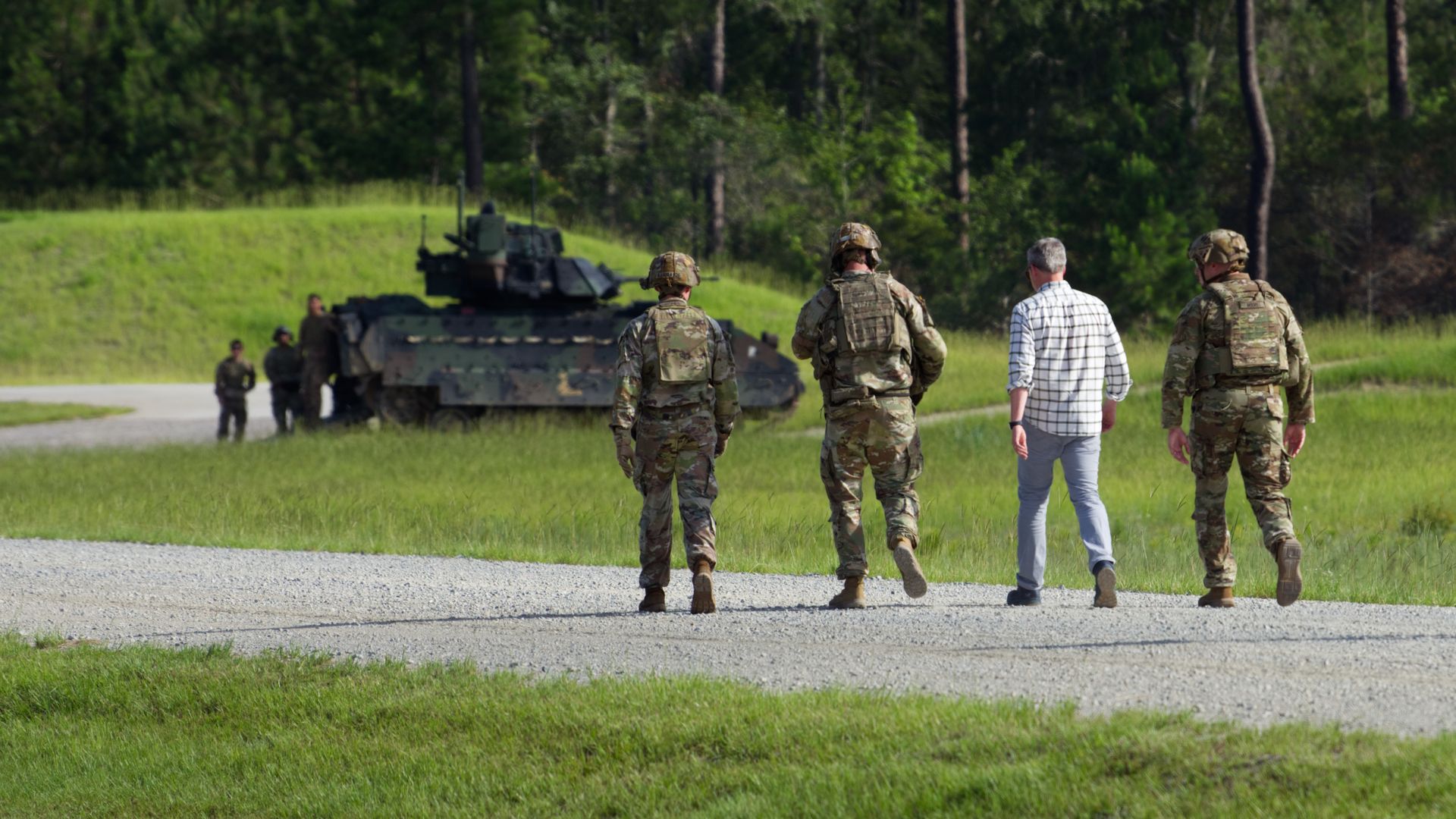
U.S. Army Secretary Dan Driscoll, wearing what he called "rugged casual," touring Fort Stewart, Ga. Photo: Colin Demarest / Axios
Thousands of feet in the air, returning to D.C. from Georgia, U.S. Army Secretary Dan Driscoll told Axios of his housecleaning ambitions — the "cobwebs and bullsh*t" that need sweeping.
- "Complacency right now is going to be rewarded with failure and death in the short- to medium-term," he said.
The big picture: The Army Transformation Initiative's opening salvo landed May 1 with the backing of Driscoll and others, including Chief of Staff Gen. Randy George and Defense Secretary Pete Hegseth.
- It jarred Congress and industry alike with its cuts (M10 Booker), consolidation (Futures and Training and Doctrine commands) and urgency.
- A second push, colloquially known as "2.0," is now in the works.
- It focuses on "procurement, reorganizing and reshuffling, and firing," Driscoll said, as well as funding "good ideas" plucked from the minds of soldiers and small- and medium-sized businesses.
- Nothing is sacred, it appears. "We should be held accountable if we're not willing to look at everything."
Driving the news: Driscoll spent Monday at Fort Stewart, in the swampy southwest of Savannah, inspecting armored vehicles and drones and workout regimens and barracks. He sought feedback from troops on what desperately needs fixing — and warned them of how radically different war looks today.
- Axios was the only media in tow.
Zoom in: Fort Stewart is home to the 3rd Infantry Division. Two armored brigade combat teams there are involved with Transforming in Contact, meant to quickly arm soldiers and test commercially available kit.
- That initiative predates and informs ATI.
- Soldiers are experimenting with robotics to clear battlefield obstacles, aerial drones to make first contact with an enemy, and tools to better understand and leverage the electromagnetic spectrum, which is key to communications and weapons guidance.
Friction point: Congress has not been happy with the level of detail the Army has thus far provided concerning its overhaul, said to save $48 billion over five years.
- "We don't serve either the taxpayer or the common defense with blank checks for vaguely defined priorities," Sen. Mitch McConnell (R-Ky.) said at a June 18 appropriations hearing.
- "We want to see the analysis behind the specific bets the Army wants to place on ATI," he added. "We want to understand the second-order effects on industry, other services and allies."
The other side: Driscoll promised to show the service's work in 10 days.
- The information had not been relayed as of Monday evening.
The bottom line: "We believe the decision to not act is actually riskier than the decision to act and get it wrong," Driscoll said.
- The Russia-Ukraine war, a potential Chinese invasion of Taiwan and a constant simmer in the Middle East consume Beltway thinking.
- "The existential factors and threats that are occurring today make it a very credible statement to say 'We're either going to do this in a wartime footing or we're going to do it in a pre-wartime footing,'" Driscoll added.
Go deeper: Army must modernize much faster, can't keep buying "VCRs" of warfare
